While lying in bed I found myself wondering about the word “atmosphere.” Of course these sorts of things are likely to have a Greek origin…But was the first part of the word”atmo” or “atmos?” Of course the second part of the word, “sphere,” has been added to the English language. What did that first part of the word mean?
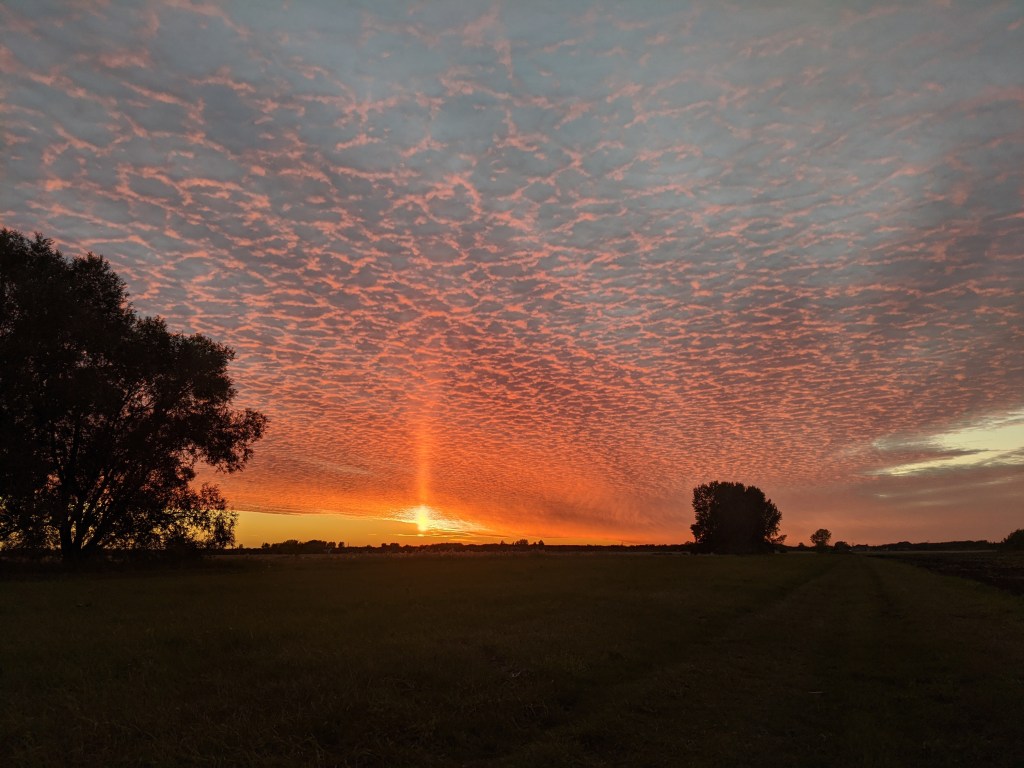
This bothered me so much I got out of bed to go down a Wikipedia rabbit hole. Turns out “atmos” means “vapour” or “steam.” Okay, fair enough. Maybe my mind wasn’t blown by the etymology of the word itself. What made me stay up reading was the succinctness of the summary of what Earth’s atmosphere is: its properties, and how it works…not only the chemical makeup of the atmosphere, but the biological forces that contribute to it (emphasis mine):
The atmosphere of Earth is composed of nitrogen (78%), oxygen (21%), argon (0.9%), carbon dioxide(0.04%) and trace gases.[2] Most organisms use oxygen for respiration; lightning and bacteria perform nitrogen fixation to produce ammonia that is used to make nucleotides and amino acids; plants, algae, and cyanobacteria use carbon dioxide for photosynthesis….The current composition of the atmosphere of the Earth is the product of billions of years of biochemical modification of the paleoatmosphere by living organisms.
I found it profoundly refreshing to read such a condensed little paragraph that contained the physical, historical and biological reality of the makeup of our atmosphere. Maybe because the backdrop to that paragraph is a cacophony of nonsense in the media about whether or not climate change is real and inaction from governments around the world.
If we are to overcome climate change or change our food systems or agricultural systems or land management practices, it may help us to start with what things we are actually dealing with. To overcome these problems and change our ways, we need a significantly better level of basic “ecological” or “planetary” literacy.
At least it would help us ask better questions!
Like…why do we think Nitrogen fertilizer is so important for plants to grow if it makes up 78% of the atmosphere?
If a change in CO2 concentration from 350ppm to 423ppm in just ~30 years out of the Earth’s 4+ billion year history is enough to supercharge the oceans with enough energy to last for centuries, why are we burning more fossil carbon than ever to produce even more Nitrogen fertilizer for crops? Is this our best idea?
If nature has evolved organisms that do things like change the bond structure of atmospheric Nitrogen in a symbiotic relationship with plants, what other organisms are helping plants, and what organisms do plants help, and how does it all work?
We humans have a reductive problem….we demand everything be simple.
The part that has always bothered me most about modern agricultural practices focusing on applying chemicals to get a desired yield is that it completely ignores the complex biology of plants and their symbiosis with literally everything around them that contributes to the health of the plant.
It also ignores the (unbelievably fascinating) history of the billions of years of evolution that has resulted in the world as it exists now. The first photosynthetic organisms were dumping their garbage (Oxygen) into the atmosphere (they’re still dumping their garbage in the atmosphere!) The problem is that Oxygen is highly reactive and toxic. It took far far longer than humans have existed for organisms to evolve a way to deal with the immutable properties of Oxygen.
To ignore this global symbiosis and the miracle of engineering that is life and DNA creates a massive problem. Humans have become the single greatest biochemical modifiers of the atmosphere since the advent of using fossil carbon as an industrial energy source for everything from producing electricity to synthesizing Nitrogen fertilizers to powering personal vehicles.
And since humans are reductive, we like to make it about one thing, which is CO2. But a parallel truth is that we are also destroying unfathomable amounts of biological systems and reducing them to single-organism tracts of lands. Another truth is we are slow to change. Yet another truth, is we have never changed faster….if we are able to negatively alter the atmosphere in less than 100 years, we can fix our mistakes.
The other side of the coin of our current age of massive disinformation, is that we all have a Star-Trek-like device in our pockets with access to more information our species has ever had access to. You can even voice-activate your little pocket supercomputer we call a “phone,” just like in Star Trek. You can read about the composition and evolutionary history of our planet’s atmosphere (at 1am if you so want). You can learn about Rhizophagy or Mother Trees. You can find amazing photographs of mychorrizae intertwining with plant roots. The invention of the NPK model of plant health from the 19th century which still drives the majority of our reductive understanding of plant health today.
Our global ecosystem is a story of nutrient cycling…whether its a water cycle, a Carbon cycle or a Nitrogen cycle. Every organism has its place and niche, its function and services. “Carbon capture technology” that hasn’t yet been invented by tech bros working for oil barons will not fix our tapestry of issues, especially since nature figured it out 2+ billion years ago. Photosynthesis was first described in the 18th century. We’re a little late to this party.
We live in a closed system. A terrarium floating through the vacuum of space wobbling on an axis and falling around the sun at 29.78 kilometres per second. Full of life in all its beauty and complexity.
It’s all we’ve got.
“It was among the strongest feelings of grief I have ever encountered. The contrast between the vicious coldness of space and the warm nurturing of Earth below filled me with overwhelming sadness.
“Every day, we are confronted with the knowledge of further destruction of Earth at our hands: the extinction of animal species, of flora and fauna … things that took 5bn years to evolve, and suddenly we will never see them again because of the interference of mankind. It filled me with dread.
“My trip to space was supposed to be a celebration; instead, it felt like a funeral. Everybody else was shaking bottles of champagne, and it was quite a sense of accomplishment. And I didn’t feel that way at all. I was not celebrating. I was, I don’t know, shaking my fists at the gods.”
William Shatner, 2022


 Complimentary Blueberry Juice
Leave a comment