When I wrote last week’s post Art Can Show Us the Diversity We’ve Lost, I didn’t know that a couple days later I would be stumbling into the Garden Futures: Designing With Nature exhibit in Helsinki’s Designmuseo.
The stated goals of the exhibition seemed to jar with my perspective as a farmer. It is not often there is a museum filled with what are effective, natural-based agricultural solutions practiced throughout the world for many decades, hundreds, or thousands of years, as well as effective government policy ideas for incorporating gardens and what amount to local food production systems seamlessly into urban areas.
It is really wonderful to see so many people take in these histories, agricultural methods, community ideas, policies and the consequences of human actions, in an exhibit that runs for nearly 5 months.
When you put it all into a condensed exhibit in a museum, it feels inspiring, and hopeful. Yet when I look out at much of the world that surrounds me, to be in the museum feels a bit like seeing a tiger in a zoo: these ideas are wonderful and amazing, they are proven to work, they are important to protect and expand, but as soon as you walk out the door, the capital decisions that drive commodity-based extraction systems built on a foundation of destroying one’s own resources and environment take over, and we are back at business as usual, destruction as usual, pollution as usual, and land speculation as usual. We simultaneously understand what we are doing, and why the tiger is in the zoo, yet we continue as though there is nothing we can do about it.
Humans have two equal powers: the ability to destroy the world as we know it with cold calculations, and the ability to create infinite abundance and harmony.
Which path we choose today is crucial for the success of our species and the well-being of our planet for generations to come.
Graham
thanks for reading Complimentary Blueberry Juice
subscribe for a new post every Wednesday, in your inbox
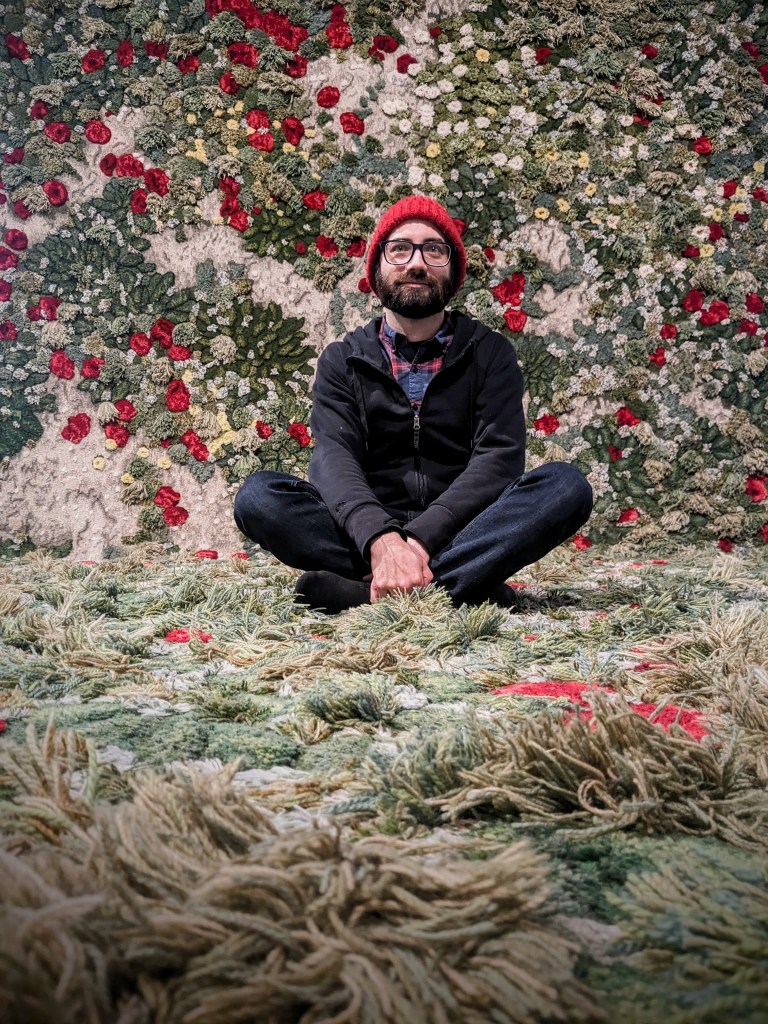
Alexandra Kehayoglou‘s amazing textile installation at Garden Futures “Meadows” measuring 4.3 metres by 6.4 metres.
Description from the installation: “…Meadows centres on the Greek island of Milos. While the operation of more than 200 mines has dramatically altered its landscape, once a year the barren rocks burst into bloom when the wildflowers blossom. Given the effects of climate change, however, it is hard to predict how long this phenomenon will endure.”
The regenerative farmer perspective: that even in a degraded ecosystem, nature is attempting to provide the tools to build soil and work towards an improved landscape capable of harbouring more. Life begets more life. Humans are in the unique position to accelerate this process….if we so choose.
Kehatoglou’s website and more of her fantastic artwork is here.


 Complimentary Blueberry Juice
Leave a comment