One of the more fascinating parts of science and science history (at least to me) is that the true nature of something can be ascertained by asking the right questions.
There are many many many examples of science (or society) rejecting a correct assertion dozens or hundreds of years before it is accepted. And since history doesn’t stop, we are currently living through a few such things that, one day, will be solved. Future humans will look back on the early 21st century and wonder at what it was like to live through the old days of cancer or climate change. Rejecting the correct assertion may play out as a political or cultural resistance, but it could also be an issue of needing a special person to connect some dots and sharply articulate something that is world-changing to our understanding. More often than not, it is both.
The way we view the world shapes what sorts of questions we ask about it, and over time, there is sort of an accepted boundary of what is or is not a valid question. These boundaries are precisely why certain subjects can get “stuck.” Science can become dogmatic. One of the best examples of this is the geocentric model of the universe: that the earth is in the middle, and everything rotates around it. It required both declining ecclesiastical power as well as great articulators (Copernicus, Galileo) to overturn the consensus, even though the assertion had been made approximately 1800 years prior to the 16th century by Aristarchus.
And so currently, we live in a time where we think of plants as a lesser form of life. This worldview shapes the questions we ask and the conclusions we come to. It also leads to a dismissive view of their over-arching importance…The way we treat our planet holds a nearly infinite number of examples of this.
It is not a wild stretch for me to consider plants to be intelligent life. While making a living working with plants and having been fascinated by them all my life, the mechanisms and design of plants are absolutely brilliant, and the more I learn the more I am sure this is true. Only since I left university, there have been an astounding array of findings by scientists all over the world observing and describing the remarkable things that plants do that have been invisible to us. Modern technology, cameras and microscopes have been at the forefront of this discoveries, and with each new astounding thing, it becomes more clear that we need new frames to peer through.
You can only know what questions to ask if you have the proper frame with which to ask them. Our world is in dire need of a new framework with which to view humans in relationship to the other 8.7 million species we share the planet with, a wide majority of which are plants.
Like other issues facing science throughout the ages, the idea that plants are a form of intelligent life is not new. It was first proposed by Democritus and over 2000 years later, Charles Darwin was making assertions about plants that seem remarkable in retrospect.
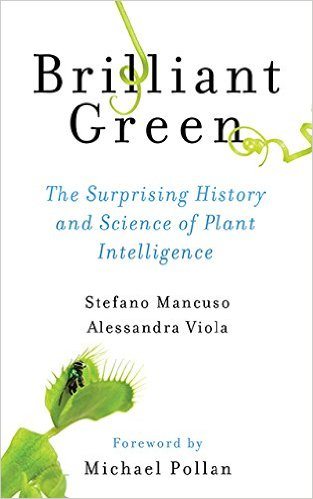
This post is really about a book, Brilliant Green by Stefano Mancuso, which is a really great read on the subject of plant intelligence. If you’re looking for an easy read and something that might stretch your consciousness on plants, I highly recommend this one.
Mancuso challenges the resistance to the idea of plant intelligence in both the scientific community and culture. He lays out the argument pointing out contradictions in thought, using well-known examples from the world of plants that surround us.
The implications of a paradigm shift in how we view and think of plants are too great for me to speculate on at this point in the post, but for the subject of agriculture I will: viewing plants as intelligent and collaborative and learning to speak their language would lead to the sorts of questions that would break the addiction and dependence on synthetic inputs.
Plants are waiting for us to understand their true nature.
Stay curious!
Graham
thanks for reading complimentary blueberry juice


 Complimentary Blueberry Juice
Leave a comment