For the past few weeks, we’ve been treated to quite the display as we are working in the field. The sight of two Tree Swallow parents flying about all day and the sounds of hungry hungry Tree Swallow babies was really captivating and a joy to see.
When I left for a couple days for some camping, I thought I could return and get some nice footage of the baby Tree Swallows feeding at the nest box entrance or even trying to fly. But…I was too late. All it took was two days, and everyone was gone from the nest. I guess if you’re a baby Tree Swallow, once you leave that nest hole there is no going back!
It was a bit of a shame as I’d hoped to get some final footage before they were gone, but Nature goes by her own timeline. We as humans cannot be present for all the moments in other creature’s agendas. Camping for all of two nights was all it took for some baby birds to get big enough to learn to fly, catch their own food and be wholly independent. Even though I missed the big moment, I still feel lucky I got to see them daily for about two months. Now it feels a bit empty and weird that my resident Tree Swallows have gone away.
As a good Canadian, first I knocked to be polite, and once I was sure nobody was home I checked the side door.

It’s amazing that so much went on inside these several square inches of floor space, for months. Even to think that an unknown number of baby Tree Swallows thought that this tiny box was the entire world for the first weeks of their lives.
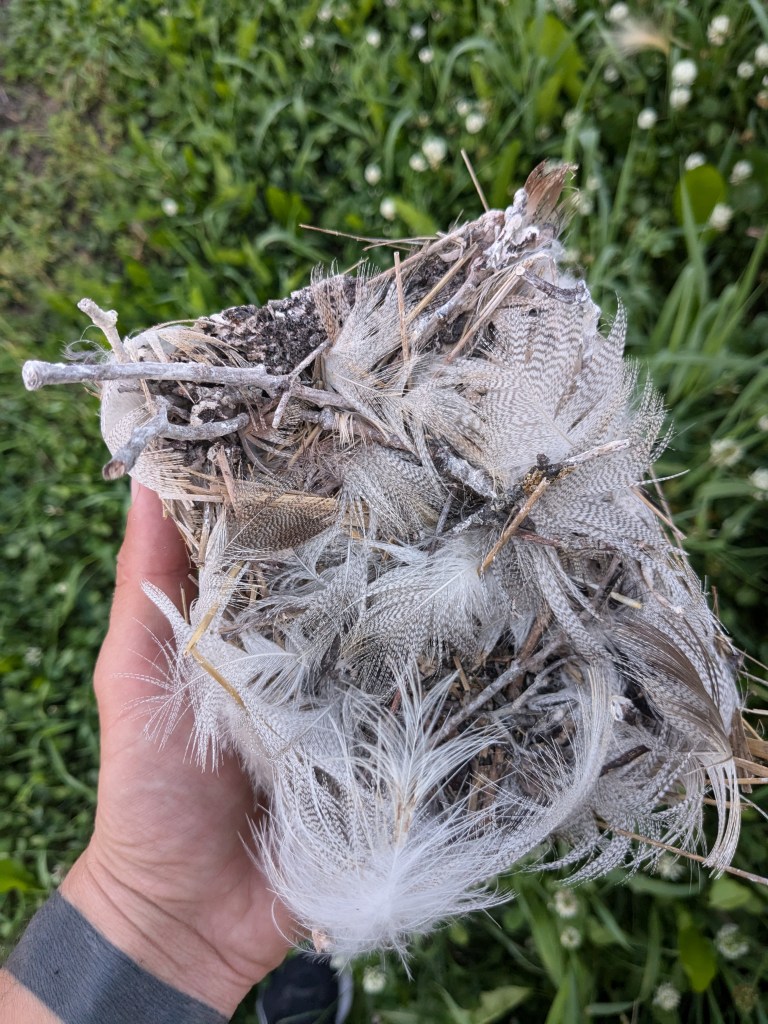
A square-shaped bird nest is not what most of us have in mind! But this is what it looks like when I pulled it out to leave it empty for a future resident.
As a side note, I checked the other two boxes I had put up and both also had constructed bird nests in them, but no residents. Interesting! I had noticed some sparrows checking one of them, and a pair of Eastern Bluebirds checking in on the other, but neither seemed to pay more than the occasional visit. The entrance hole size for the Eastern Bluebird was too small, so I had ruled them out as a possibility (but also may make the hole bigger for them for next year). It was surprising to find that someone had been busy making nests! I did not know that birds may sometime construct nests and then not use them. Perhaps they are backup nests? Perhaps birds make multiple nests? If anyone knows, let me know in the comments.
And so I know a lot of you are interested in hearing about the bees…
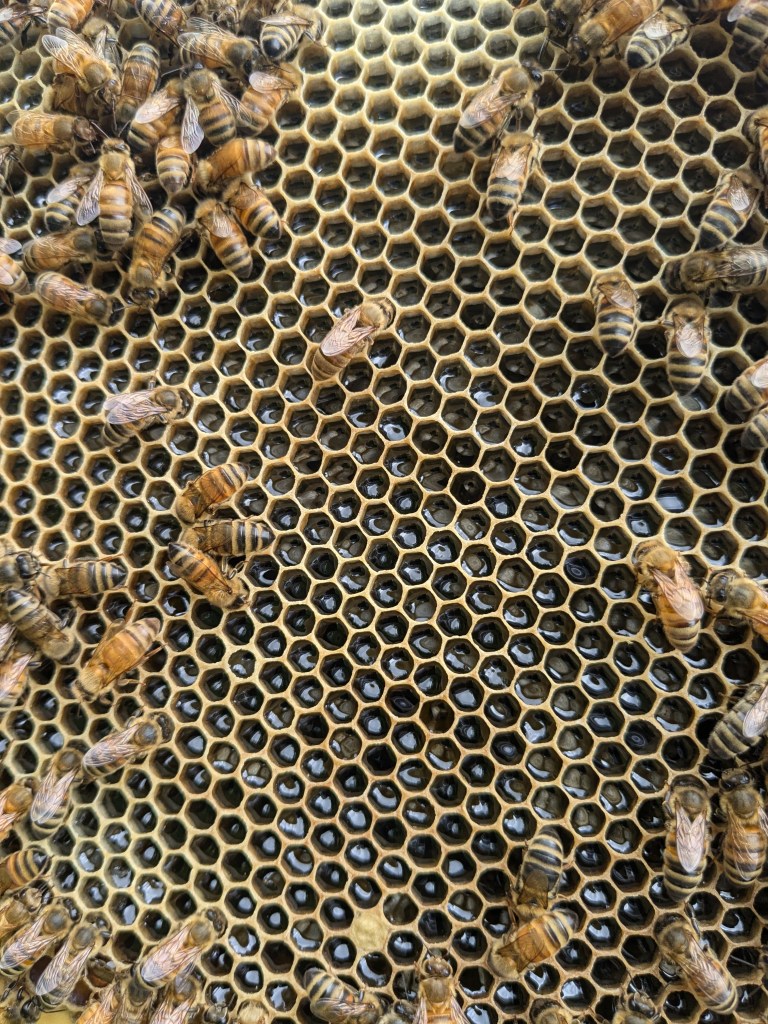
Yes the bees have been extremely busy and I have been extremely lucky as a first time beekeeper, with a strong nucleus colony and a fantastic queen. A few weeks ago, I checked the honey supers, and there was very little in the way of honey. They had started building and repairing combs, and a little honey was visible. A week later, the honey super was heavy and the bees had packed at least 30 pounds of nectar into the combs in just one week. A week after that, the box weighed somewhere close to 60 pounds and it was getting hard to lift.
I could go on and on about all the things I find amazing about this process (such as the speed at which the bees can fill a box), but for this season and this post, I’ll just focus on one aspect of it: where is the nectar is coming from?
There are no large-scale agricultural crops in the area. This means only one thing: the bees are sourcing all the nectar and honey 100% from wildflower sources.
This was really surprising to me, as I’ve always wondered why some beekeepers were able to separate their honey. I always wondered “how do they know it’s wildflower or X or Y or Z?” And I now understand: This is the only source available right now. There is no canola, no flax, no sunflower.
But what has been having a fantastic year? Conventional grain farmers might be having a hard time, but the wildflowers have been booming! The amount of vetch, daisy, wild rose, and others I have yet to identify, all came into focus. All of a sudden I started paying attention to what was in the tree lines, the forests, and the meadows. There are flowers everywhere!
This is reflected in the darker, amber-coloured appearance of the honey in the above photo. That is not an optical illusion or reflection from a camera. That dark brown is what the honey actually looks like.
Well of course I had to take a sample. What I experienced was one of the most wonderful things, a full-bodied, complex, layered, and floral taste. Wow! This is really the premium! I tasted it against some general honey I had in my cupboard, and there was no comparison. The raw honey I had in the cupboard was of course excellent, but it became evident that the additional subtle flavours of the wildflowers my bees have been bringing in is something really special.
We’ll have to see how the rest of our honey flow comes in over the next 2-3 weeks and if the consistency matches.
It’s been an exciting summer for a first time beekeeper and a first time bird box builder. Lots to learn, and lots to consider that is outside the bubble of the daily focus of the workday.
Nature always provides so much more to see, hear, touch and taste, and always just barely beyond the scope of our comprehension and understanding .
Stay curious.
Graham
thanks for reading complimentary blueberry juice


 Complimentary Blueberry Juice
Leave a comment