We’re going to break format here with the first-ever Thursday post. I was a bit exhausted after a 14-hour day yesterday which, frustratingly, ended in sprayer nozzles plugging up from a compost extract while trying to do a foliar nutrition trial as the sun was setting. But I still wanted to write about something exciting that happened last week, which is that we had a real soil scientist visit our farm for a tour/workshop.
Of all the things I’ve learned about soil over the years, all the YouTubes and workshops and textbooks, and all the school of hard knocks (…which is, for better or worse, the way I learn what – not – to do), it was a lot different when someone of high expertise is digging holes in *your* soil on *your* farm. The same soil you become so familiar with over the years, it’s hard to imagine that soil can be any other way than it is on your fields.
Luckily for us, in our two acres on the farm property we happen to have two exciting things to talk about: one being the cover crop trial I’ve been running for about a year now, and the second being no-till beds on Red River clay.
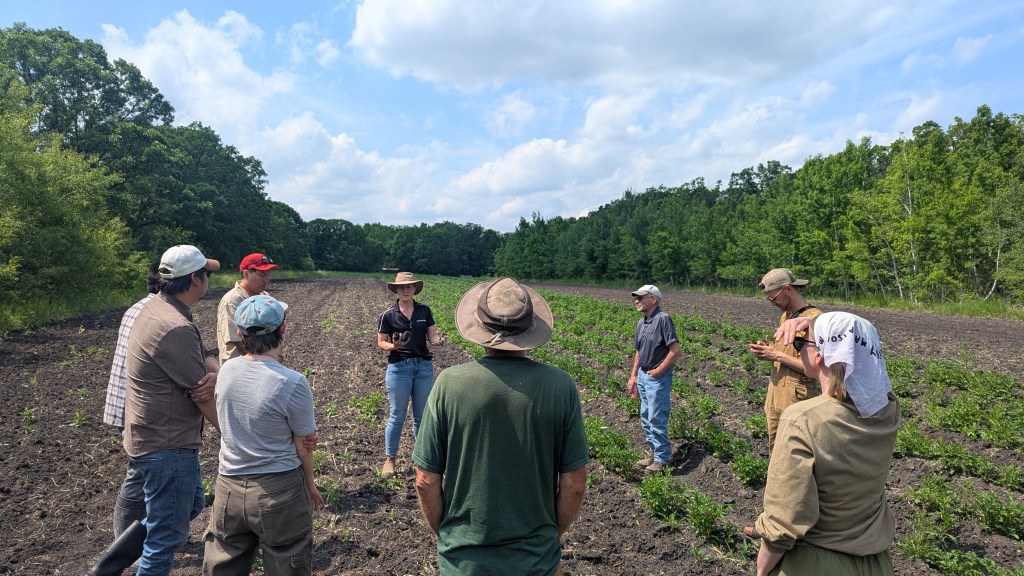
The cover crop area is where I’m still learning the most. If you want more of the cover crop journey, go here, and the second part of the cover crop trial was planting potatoes this spring. The update as of right now is that these potatoes look great, and they germinated evenly, which did not happen in our conventional field. It also held moisture far longer than any other field, which helped immensely when it got up to 35C with no rain in this hot dry spring. So, so far, the visible observations have been all positives.
Marla dug up a section of our soil and explained how and why she felt we had a good aggregate soil structure, showing the fissures, cracks and fractures that occur when soil is healthy. Roots find the cracks and fractures and grow down these paths of least resistance to access more moisture and minerals.
What was most surprising to me was that these structures were still intact for her to see and comment on…we only grew one cover crop, from July through September last year…just three months of growth. But we also did not cultivate or plough this field. We opted instead to leave it as it was until we needed it, roto-tilling only the first few inches, which did not destroy the structure. I had thought for sure the structure would disappear over the winter and through a few months of growing, and driving a tractor and roto-tiller over it.
The roots of the cover crop decomposed and left behind small gaps, holes and crevices that can allow water to penetrate, and the next crops’ roots to penetrate and explore. Perhaps this is an advantage to us with our potato trial in a dry-er year.
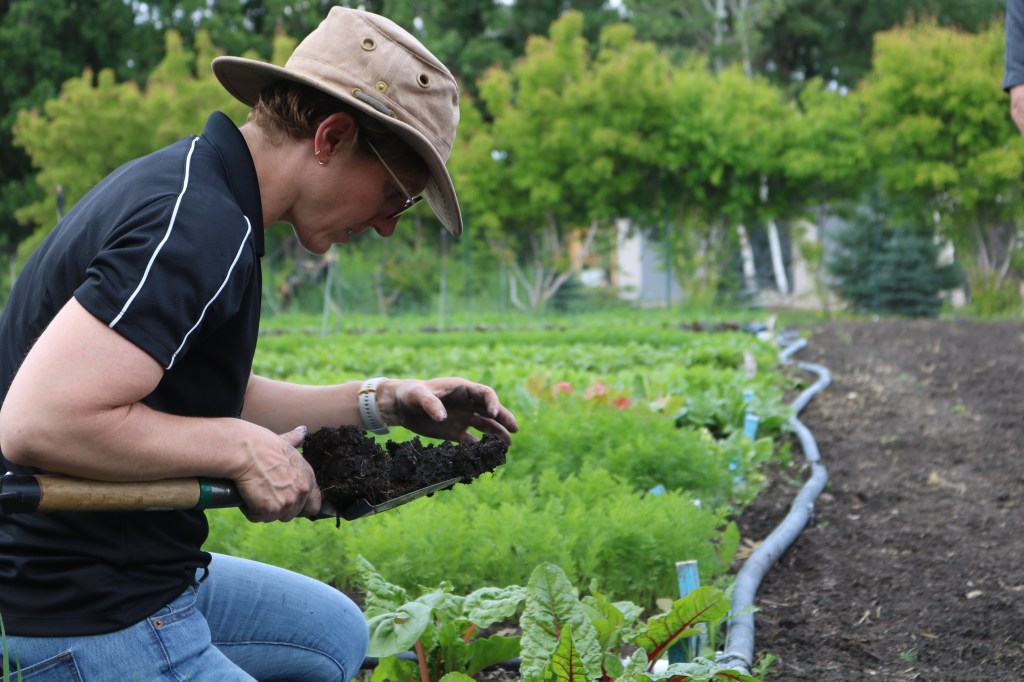
photo credit Bryn Friesen Epp
Onto the no-till beds, Marla’s shovel sunk easily into our bed of Swiss Chard, and the difference between this sample and the cover crop soil was rather extreme. Granted, the cover crop soil sample had nothing growing on it, but still, there is no way a shovel would sink in that easily into a clay field. The no-till however, brought up a nice sample of soil to look at which was also teeming with earthworms trying to escape the uninvited sunlight.
Right away we could see big differences: abundant life, mycorrhizal fungi fuzzing over chard roots, and the soil crumbled and fell apart in the hand, as though it were a loose congregation of unassembled lego bricks. It was visually easy to see that in a living soil, how much more is going for you, how much more resilience you have. The pathways created by roots and earthworms for water and air exchange, and seeing the invisible. By invisible I mean micro-organisms, which if there are visible fungi present, there is likely much more. The soil is soft to the touch and has a beautiful aroma. These are the results of microbial interactions and molecular-level events.
This can be accomplished rather quickly, even in clay soil, as those beds were rebuilt in 2024. So we got there in only 1 year, with a thick layer of compost mulch on top, and that bed had one full-season crop last year (Kale) whose roots were left in the ground to decompose.
I look forward to furthering our trials with cover crops and learning more nuance about no-till soil health. As we continue to get better and improve, we can get a bit nerdier and hopefully boost all our crops to the top level.
Of course with nature there is always something more to learn, and the more you learn, the more you learn how much you don’t know. Nature always forces us to stay in the humble zone, but it’s really remarkable to see the amount of life that soil can harbour, and all the symbiotic relationships that come with it.
Life on this planet starts from the ground up.
Stay curious.
Graham
thanks for reading Complimentary Blueberry Juice


 Complimentary Blueberry Juice
Leave a comment