I’ve got a triple-whammy Learn By Doing post to make up for the slacking of regular Wednesday updates lately. The summer groove is settling in and pulling long hours in the field isn’t necessary anymore. Plus there’s a good three weeks of solid post ideas coming up and I promise I won’t miss on the Wednesday publishing schedule on those ones (and they’re already in the tube). Without further ado…
1. Trellising Hoophouse Cucumbers & Indeterminate Tomatoes
Until this year, I’ve avoided trellising anything at all. There’s many reasons for this. I did try it several years ago. But the idea of constantly tending to these things while other parts of the farm were going off the cliff seemed like a bad waste of time. So, instead I opted for the lazy way: determinate bush tomatoes. The other reason we didn’t trellis any tomatoes was a result of the “Hedging Your Bets” strategy of farming. That is to say, when one is not confident in their growing abilities, one may plant far more plants than is necessary in order to attempt to achieve the desired yield. To that end, we were planting up to 2000 tomato plants. When we crunched the numbers, we saw we weren’t even hitting $2.00 per plant in revenue (nevermind profit).
But the new hoophouse has forced the adoption of a new strategy, since space is limited. I am forced to confront my lack of trellising skills. When seeing the monumental task in front of me, I opted instead to….double down, and greatly reduce the number of tomatoes in the field, moving them to permanent beds, and setting up a permanent trellis.
Cucumbers on the other hand, was a crop that we had never even dreamed of attempting to have early. Cucumbers are the farm’s #2 crop in revenue and profit, so they’re pretty important to us…however this number is 100% pickling cucumbers, a specialty item. Greemhouse, or “english” type slicing cucumbers, are an entirely alien story.
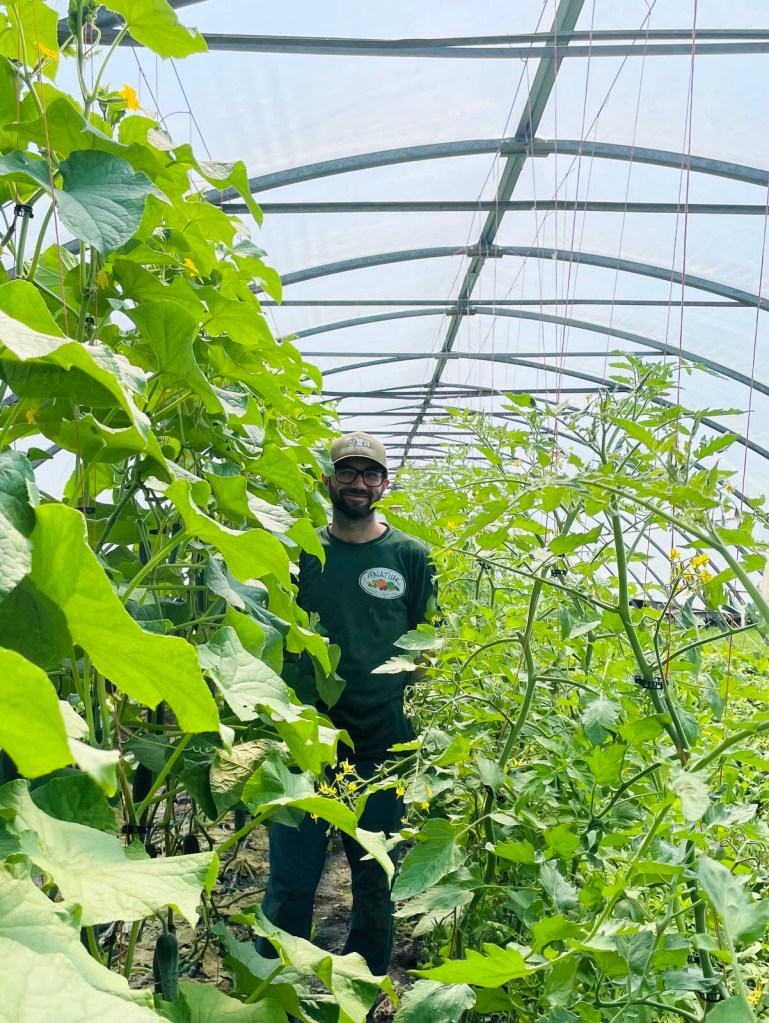
Even though I watched tons of youtube and even read a vegetable-greenhouse-specific horticulture book, I’ve made many mistakes I will not repeat next year:
1. I let the cucumbers set tendrils. Why did I let the cucumbers set tendrils? Because I think they’re a fascinating example of plant intelligence, and I loved seeing them latch on to things. That endearing quality led me into nightmare mode, where tendrils everywhere were latching onto everything, leaves, strings, wires, stems, and cucumbers themselves. It took me 3 hours to trim just 90 feet of plants free of their self-imposed strangling. For Season 2.0 in the hoophouse, I will for sure remove all tendrils as soon as I see them, all the way up the plant tip.
Other than that I’m fairly satisfied with the cucumber performance, we are over 300 pounds in 4 weeks of production as first-timer-trellisers, the plants are 12+ feet tall, there’s no dieback, the fruit are perfect, we’ve fertilized and amended with nothing (we never have any issues growing cucumbers whatsoever…they must like my soil), and they’re over the mountain, which is to say, they are coming down the other side of the wire umbrella-style, right on schedule.
I fully credit the book I read for this strategy. This book is great for laying out all the potential options available to the grower new to protected growing culture. From that I was able to choose umbrella style as the way, and without having read common pitfalls with these strategies, I would have surely run into the wall. Or…in this case…run into the double-layer poly.
2. The greenhouse is way too high. The wire is set near the apex of the greenhouse, at least 10 feet. This is problematic! I’m only 5’6″. Even with an apple box, I’m 7 feet. If I reach high, I can get to 9′. So getting these vines over the wire for umbrella style – not to mention harvesting cucumbers at 8/9 feet – unreasonably difficult.
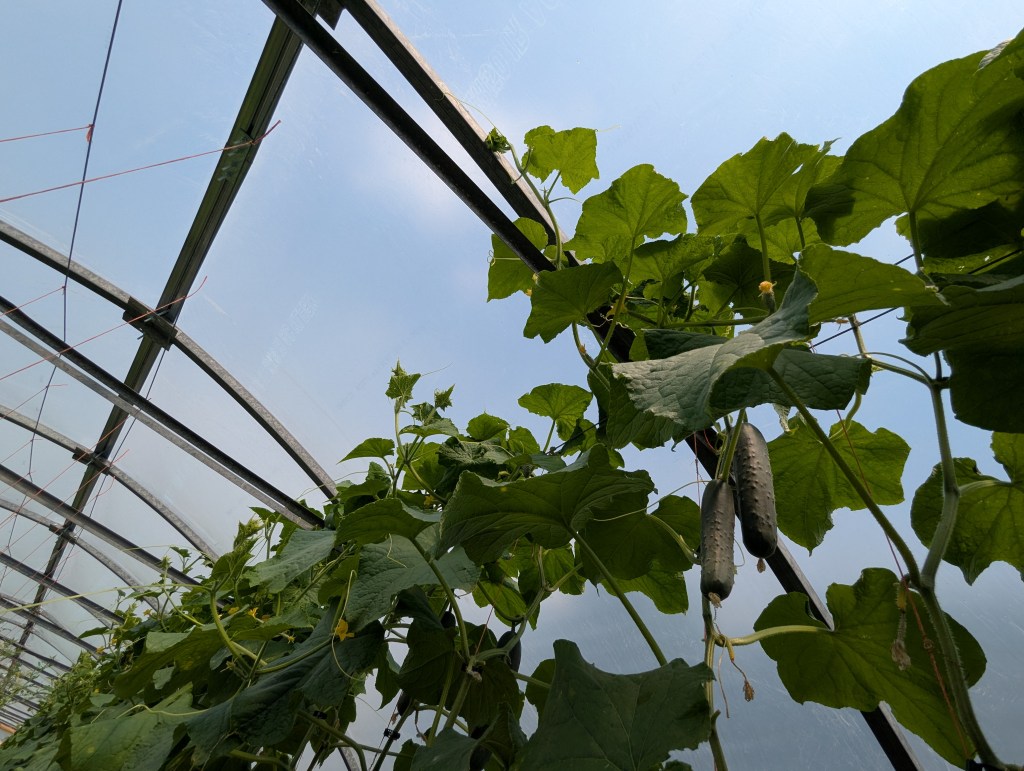
For this season I’ll have to deal with it (…learn by doing) but my trellising time could be cut easily in half if I didn’t have to constantly move apple boxes or ladders, and the same goes for harvesting. A full-size apple box at 12″ is easy enough to scoot along, but as soon as a ladder is involved, it is extremely cumbersome.
The problem to solve will be how to run a wire at a height closer to 9′ from end-to end.
3. Trellising Indeterminate Tomatoes.
Since that took longer than I thought to explain, I’ll leave the Tomatoes for a separate post. They’re going super great, and we’re off to a really great tomato season. The short of it is: I can’t believe I didn’t grind through and learn how to do this properly several years ago, and the former version of me who thought planting 2000 plants was a good enough idea was very wrong.
2. Managing a Super Beehive
It is a wild thing to be 14 months into beekeeping and have a super hive.
But…this was the goal all along.
I never wanted more than one or two beehives. After all, there’s a farm to run, and I have limited time. The more beehives there are, the more work there would have to be devoted to it, and I just don’t have time for that. My maximum goal was to be able to check in perhaps once a week on what the bees were doing.
In Year One mistakes were made on the road to this goal. I spent tons of time in the first couple months just learning to see what was going on. There are so many things to get a handle on. What brood looks like, what the different bees look like, what the structures they build are and mean, etc. It’s overwhelming as a first time beekeeper pulling up frames and looking at all this crazy stuff. It takes awhile to sink in.
This year however I know what I’m looking for, and I know what to expect. The only surviving queen I had from last winter was the one I was able to produce myself in 2024. And so…with a really strong queen, I have been allowing it to grow, keeping the brood nest from swarming, giving it ample space to expand.
This hive produced 72 pounds of honey from May and June alone…not even the main honey flow.
After I took the 3 boxes of spring honey I added 5 new boxes to give them space for the expanding hive and in anticipation of the main summer honey flow. For the past three weeks I’ve been battling swarming behaviour…which is to say the hive has decided they have ample resources and not enough space, and will split themselves to reproduce. They’ve mostly filled approximately 3/4 of the 5 new boxes by weight ( a full box weighs about 70 pounds) and the queen has little room to lay more eggs.
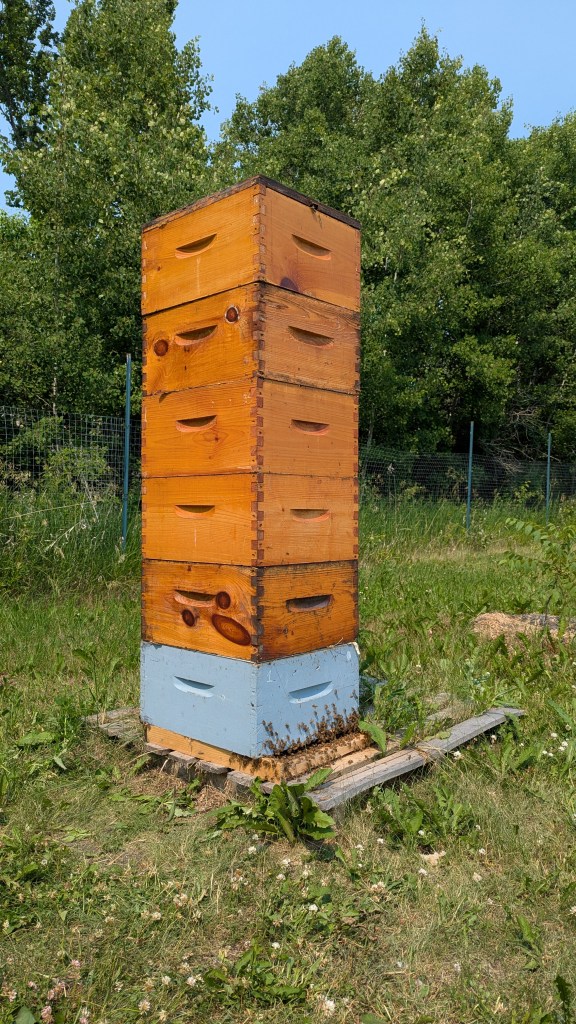
This result is a testament to the incredible food source we have surrounding the farm (..and also learning by doing, but). There are several square kilometres of naturalized, untouched forests, meadows, wetlands, and treelines. The amount of natural flower sources and narturalized species that are entirely removed during suburban “development” as “weeds” or “unwanted plants” is an ecological problem our society has not come to terms with, and one that impacts our local ecology greatly.
Bees’ programming is largely to go find resources for the hive. I feel lucky to have this naturalized resource. Many commercial beekeepers are relying on agricultural monocrops to provide food for them, such as canola, or sunflowers. My bees do not rely on this, they are relying instead on mother nature and the results are astounding.
As long as I can keep my mite levels low and overwinter at least one queen I will have incredible honey and a fun side-hobby of beekeeping to enjoy.
Graham
thanks for reading complimentary blueberry juice


 Complimentary Blueberry Juice
Leave a comment