There has been an opportunity for me to observe something quite extraordinary. The observational experiment began several years ago after an acre of arable land close to the farm was abandoned. The field was quickly covered in thistles…an entire acre of thistles. The rhizomes and billions of seeds billowed out from this festering situation ever since.
Due to the situation with the land, I knew that it might be possible – provided the land remained completely undisturbed by human intervention – that I would be able to witness the field evolve from the thistles. What I expected was that after a few years, the thistle population might slowly start dwindling, as it was replaced by other things.
What I did not expect was how suddenly and how completely total the transformation would be.
Last year, there was an acre of thistles, and nothing else .
This year, there are no thistles whatsoever…they have completely disappeared.
In their place is now an entire acre of extremely dense 2-metre-high sweet clover.
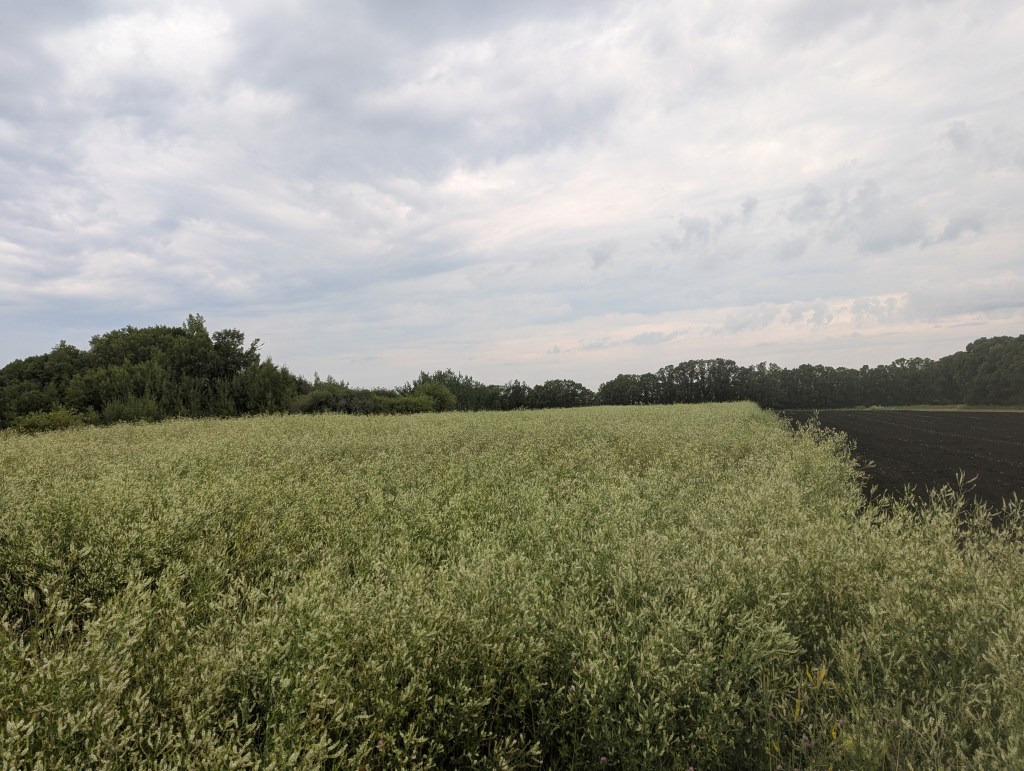
If only I had taken a “before” picture!
“Weeds” like all organisms on this planet have a purpose and niche role to play in ecology. These roles are erased when we assign these plants terms like “weeds” or even worse, the term “noxious” which regional governments use. These terms reduce the plant from what it can tell us to the basement-level nuisance which must be destroyed without any regard for what may be going on.
The thistles were there for a reason and the type of “weed” can tell us a lot about what is going on, or give us an indication of what might be happening below ground. In this case, the thistles are responding to two things: a) the natural tendency for our clay to self-compact and so the rhizomes pry it apart to create spaces, and b) a sign of low available calcium levels which is also natural in our high-magnesium clays.
Left to their own devices for several years, these thistles put themselves out of a job. They fractured the clay and made porous channels for water to flow, they cycled whatever calcium was there to scrounge up. They un-made the conditions that favoured thistle growth.
Now, it favours the sweet clover, a legume, with nitrogen-fixing bacteria.
If I were to guess what happens next, the cycled nitrogen will favour the establishment of grasses, which will have long and deep root systems, following the canals and channels left by thistles and earthworms.
We live on a planet full of natural ecological wonders, and weeds are simply a term invented by us to categorize an enormous number of plants with important ecological roles as undesireables.
Graham
thanks for reading complimentary blueberry juice


 Complimentary Blueberry Juice
Leave a comment