Wow, did I ever get a nice big surprise this week when shredding all the beds. Finally, winter is coming, so down goes all the above-ground plant mass. We take our compact tractor and flail mower and shred all the plants down to the surface.
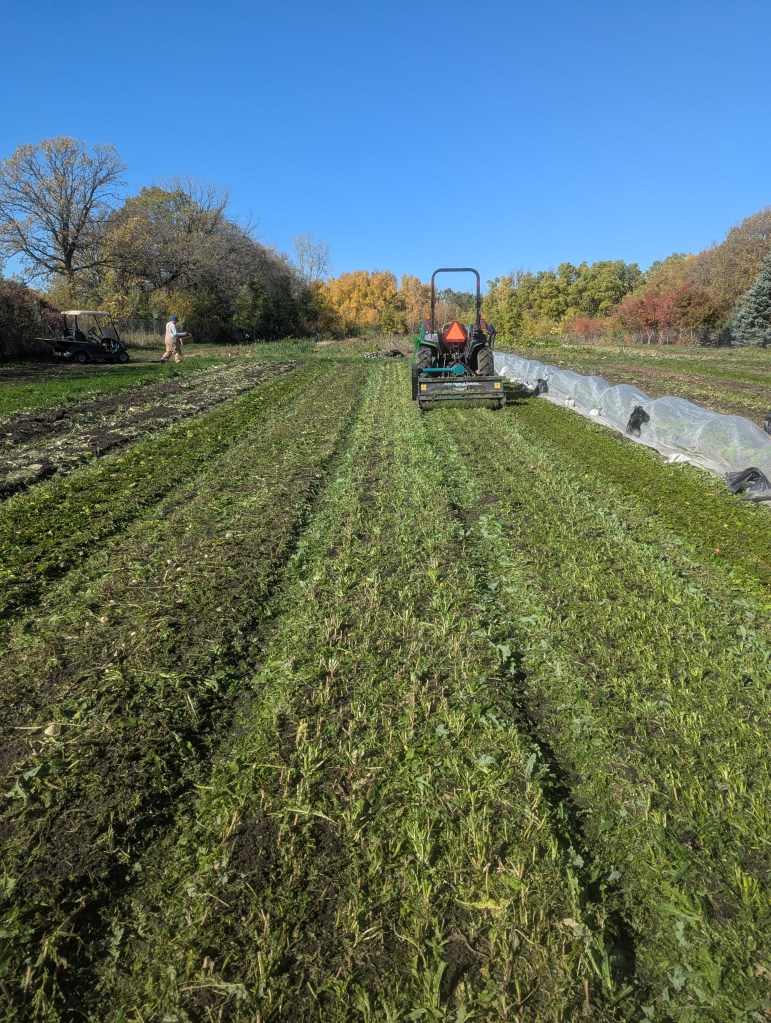
This methodology allows all the below-ground plant mass to stay intact. We need to remember that what we see above ground (green plants) is only a representation of what is invisible to us: the structures plants create beneath our feet, the crevices and cracks that the roots make, the micro-biome of habitats for tiny organisms that together weave a functioning ecosystem, all built by the plant.
So this season we tried something new, which was moving our Eggplants and Peppers into the no-till system (to decrease the number of plants we have to take care of, to have the ability to irrigate, and to pay closer attention to plant nutritional needs). To do this we decided to use landscape fabric with holes punched in them at the proper spacing for the plants. Last fall we built the beds, put on a layer of compost, and for the full 2025 growing season, it had landscape fabric over it filled with plants. The primary reason for the landscape fabric was to decrease weeding time, the secondary reason was to cover the soil.
It’s worth noting that this was a double soil cover: first the compost mulch, and then landscape fabric: a cover on the soil cover. So I was excited to see what would happen with this.
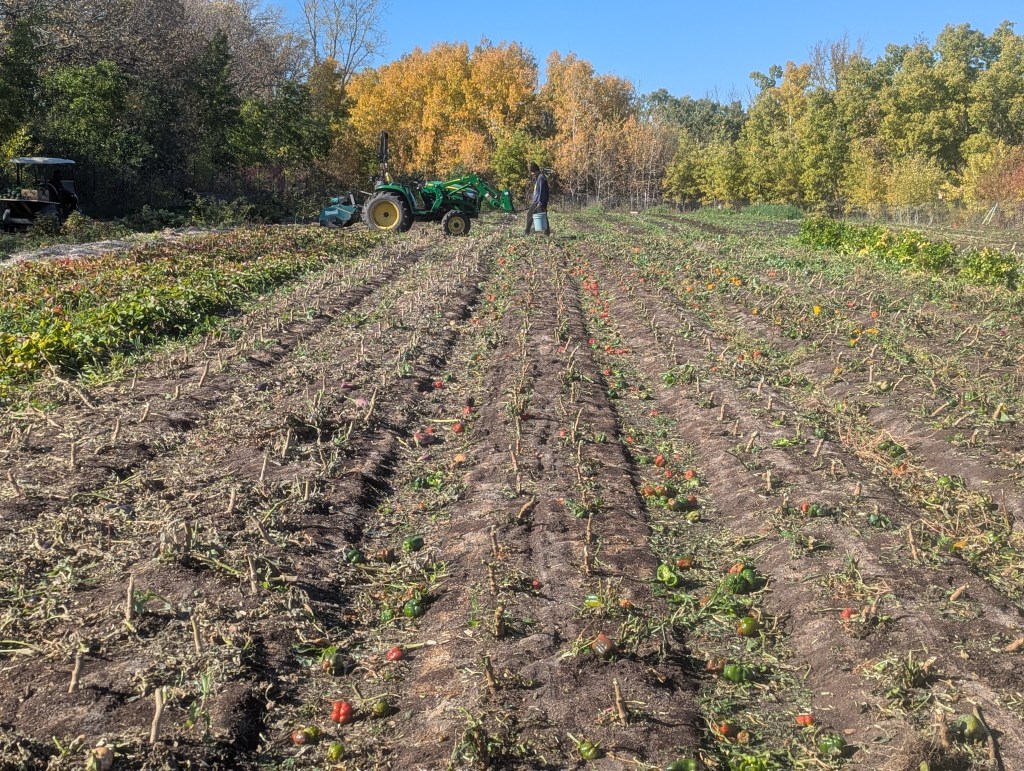
Taking the landscape fabric off these beds after 4 months of growing was like farmer-biologist christmas. So…here’s a list of what we noticed:
1) The beds are remarkably intact. You can even see where our pathways are, and the compost mulch does not at all look like it has been through a full season. Protection from the elements really preserved the mulch. This is great as we won’t have to apply much compost in this section which will save both time and money.
2) You cannot brush away the surface of the compost mulch because it is fully colonized to the surface with roots. I have noticed this amazing phenomenon in multiple contexts but it was amazing to see it over 8(!) beds. If you cover the soil, plant roots will literally grow on the surface. I see this in my Apples (covered with wood chips), Radishes (a thick canopy will keep the surface cool and moist), Celery (same as Radishes), and Tomatoes (when applying straw as mulch for dry-farmed field Tomatoes).
I love this concept because it really visibly proves a lot of the foundational principles going on with respect to how plants modify their environment. It’s the farmer’s job, I think, to create the conditions that the plant can fully utilize as much of the resources surrounding the plant as possible. It’s an easy win to give the plant an extra 1-2 inches of operating space by covering your soil.
3) Then I dug a hole and I’ve just never experienced this level of awesomeness before.
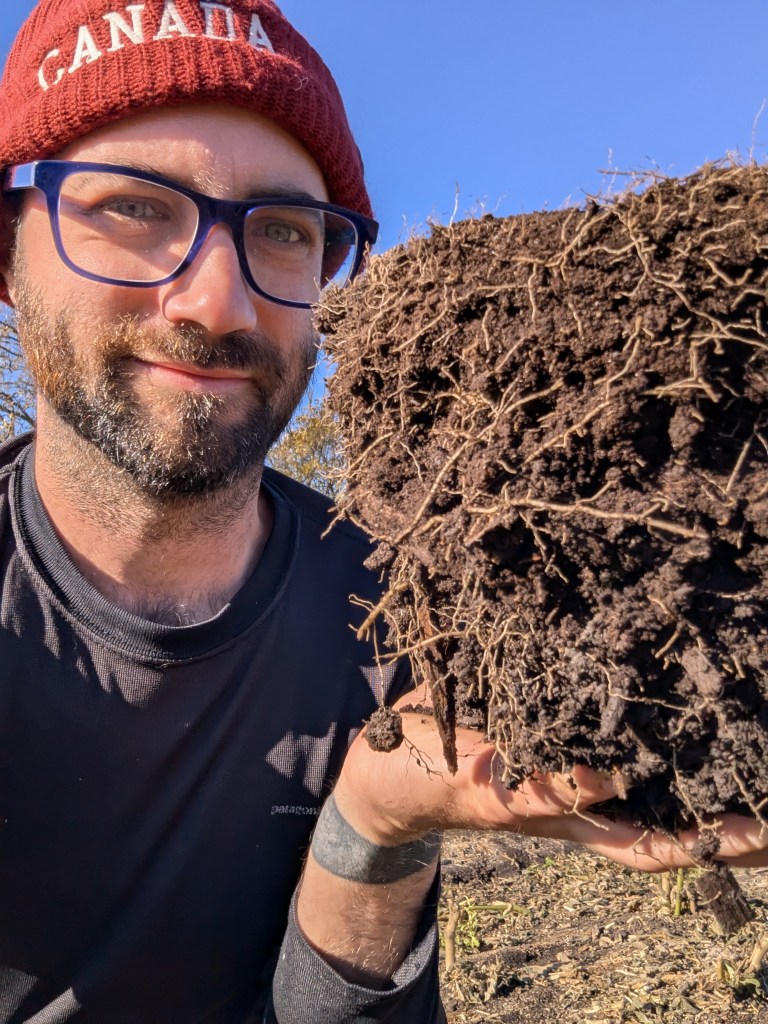
In my hand is an 8″ deep sample (you can go 10″ +) of what plants are doing where we aren’t able to look.
You can see the roots fully occupying the space frost he surface down to where I’m holding it, and other than the top inch, that’s red river valley clay. The shovel sinks in with barely a push. You can feel the shovel cutting…not clay…but actually having to cut the root mass. These macro-aggregate structures crumble apart with a light touch.
I dug several samples at random through the 8 beds, and no matter where I stuck my shovel, this was the result every time.
4 ) I want to stress that the plants did this. Photosynthesis did this. Plants build the soil. Plants engineer the environment, so that other things can live there. Plants move things from a less complicated system to a more complicated one. It’s hard to remember we live on a planet governed by natural laws, when we are scrolling through garbage and AI slop on the internet every day. No matter what nonsense is going on social platforms right now, the facts remain about our existence: we are on a planet, orbiting a star, that happens to have an atmosphere and liquid water, and that happens to have an intelligent form of life that has been successful for over 2 billion years, and that form of life enables other life through the splitting of Carbon Dioxide into its component parts using photons from the star we orbit.
I just think that’s fucking amazing, and every time I step out onto the field, that’s what goes through my mind.
For winter, I will leave all these structures intact, and next year, this is where this section of beds will start. So, in this sort of system and methodology, you can build on your successes from one year to the next. There is no starting from zero. All those things that plants built, they are there for the next generation of plants.
Graham
thanks for reading complimentary blueberry juice


 Complimentary Blueberry Juice
Leave a comment