After quadrupling our cover crop area this year and changing a few operating procedures, it was super exciting to leave those cover crops digesting in the last weeks of fall (more on the cover crops and treatment this season here).
However the cover crop story for this season didn’t stop there. Yes they were shredded and incorporated with compost extract, calcium and a biological stimulant. But the weather remained mild through September and October, and wouldn’t you know, at least some species of the cover crop….started growing back.
This was super wonderful as it meant those fields were still actively cycling nutrients, and there was still some small amount photosynthetic energy being directed into the ground. It also meant that we maintained a good ground cover.
I don’t know why I didn’t get a better photo of this, at least till we got the first snow of the season in early November. That’s the re-growing cover under the white stuff.
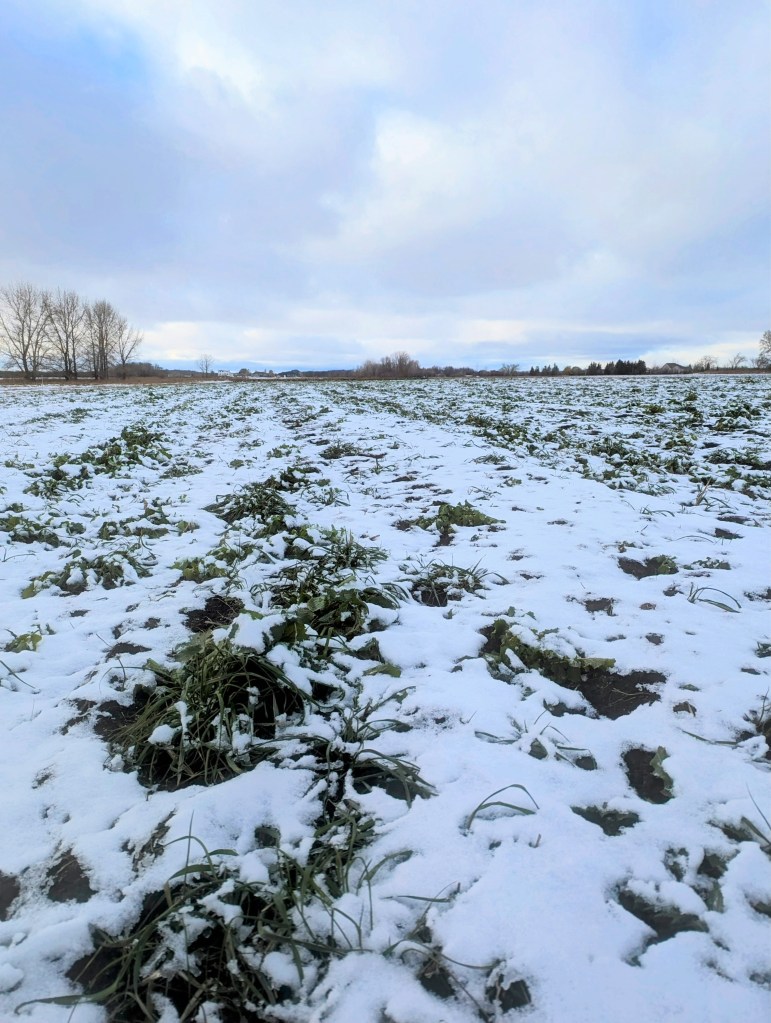
So it would seem we got the best of both worlds here. We got what was intended: a micriobiolgy-driven decomposition in the top layer of soil following incorporation, breaking down that nitrogen, phosphorous, calcium and etc and holding it in the soil.
The bonus was that we also had some low amount of photosynthesis still happening, living plants putting some amount of carbon into the soil, and hopefully developing symbiotic relationships with the aforementioned microbiology.
Well, I did get photo evidence of that on October 25th on what I think is an Italian Rye.
This is a rhizosheath.

A rhizosheath is a zone of microbial activity around the plant…what appears to be dirt clinging to the roots here, which cannot be shaken off, is conglomerations of soil and microorganisms growing on the fine root hairs of the plant, which are secreting carbon-based goodies into the ground in what is known as “mucilage.” In this way, the plant can cultivate an interface with the life of the soil directly surrounding the roots.
I wasn’t expecting to find this when I yanked it up, but there it was. A healthy plant doing healthy plant things, right under my feet.
To be clear, I have pulled many a weed and many a plant over the years that do not have this feature. It was exciting to see.
I’d like to think that it was the cover crop process and biological amendments that lead me to this point, but the real proof will be next spring when we plant here. This was the goal: to create a biologically rich soil for next year’s crops to plug into and receive the benefits from.
Cool stuff.
Graham
thanks for reading Complimentary Blueberry Juice


 Complimentary Blueberry Juice
Leave a comment