Something magical can happen if you return to the same place every day to document it. Nature works slowly and reveals the methods of her beauty over time.
After 8 consecutive days and nights of -15C to -20C and colder, the sea crusted over in a beautiful pattern of hardened slush.
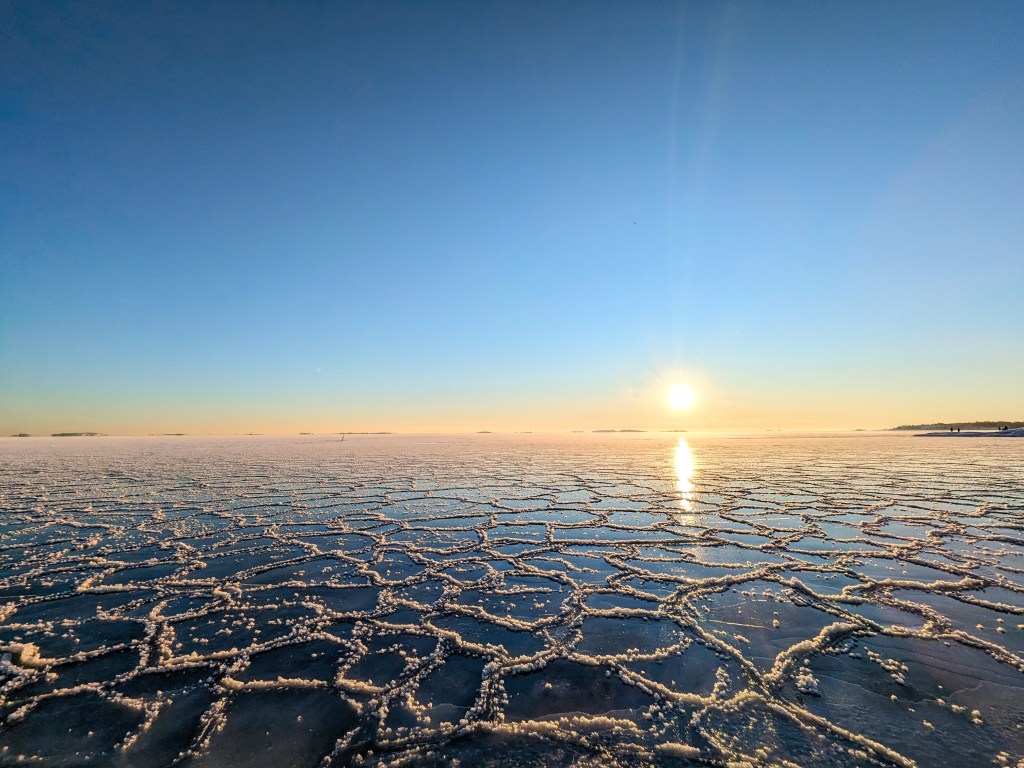
Visiting the same site every day and taking pictures gave a much deeper appreciation of this process and what it takes to freeze a large body of water. On the 2nd day we were treated to the spectacle of “sea smoke.” The 6th and 7th days were so windy and the windchill so extreme that I was unable to take photos (I tried, but frostbite occurred in less than 30 seconds). The sea waved and undulated in the wind and I thought perhaps the air movement alone would prevent freezing, and in a few days the temperature would warm up a bit and I wouldn’t get to witness sea ice form. But on day 8 the sun was shining in a windless perfect day, and when I walked up the hill to see the Gulf of Finland, I was absolutely shocked that overnight, a jigsaw of sea slush had interlocked and frozen as far as the eye could see, and as far as my camera could zoom in.
My thoughts have ranged from the poetic to bewilderment. What a thing for a Canadian kid from the floodplain prairies to see. How it took 8 days of temperatures that most people would consider not leaving their house to only get to a slush state that could not even be walked on. But a lot of my mind was on the climate of this planet, the history of it and the future of it. Witnessing the event made me think of the ancient glacial period caused by the evolution of photosynthetic organisms, which consumed greenhouse gases and released Oxygen, triggering a mass extinction over two billion years ago and causing an epic glacial period via an “icehouse” effect. Over geologic timeframes our frozen earth’s atmosphere and ocean chemistry shifted radically. It would be another 1.5 billion years until the Cambrian Explosion, the evolutionary expansion period which saw the development of many multi-cellular species and what we think of as life.
The ocean is the single greatest buffer planet earth has against climate change. 97% of earth’s water is in the ocean, and the ocean is 70% of earth’s surface area. Water also happens to be highly effective in absorbing and retaining heat energy. Effective enough that even small volumes of it can be used as a low-tech method for keeping greenhouses warm overnight (called thermal mass). Indeed the ocean is a massive reason why climate change will accelerate: every passing day it absorbs more of the energy trapped in our atmosphere, and with increased carbon absorption, we are able to measure another oceanic chemical change: rapid acidification.
The oceans and bodies of water of our planet are incredible. Whether the sea is open, or frozen…the darkness of deep sea trenches and hydrothermal vents or the turquoise blues of shallow carribean islands. Salt water or freshwater. In a pond or a trickle of water falling off a mountain wall.
If there is a sunset, there will be an incredible reflection. In that light we can all experience the wonder that is our existence in the universe, the magnitude of the oceans, the disappearance of the sun from the rotation of earth, and the emergence of stars light years away from us.
Graham
thanks for reading this cosmic edition of Complimentary Blueberry Juice


 Complimentary Blueberry Juice
Leave a reply to The Tale of Humble Tea and the Sea – Complimentary Blueberry Juice Cancel reply