A beginner beekeeper is going to make some mistakes. This first-timer made one about four weeks ago and, instead of catching the mistake and correcting for it, it took sheer luck for the light bulb to go on.
At the end of August was when the nectar stopped flowing. After all that time learning how to manage a busy hive during the honey season, it was time for a whole new learning curve: preparing the hive for winter. I took the last of the honey supers off, it was time to start feeding and treating for mites. So I did that.
Ten days later it was time for the second mite treatment, so I checked the hive. Nearly all the frames were full of nectar/sugar. There was very little in the way of eggs, brood or larvae going on. What I did see where capped queen cells, which surprised me, (still in honey-season-mode I suppose) and so I removed them all, thinking that I had made a beginners mistake and over-fed them, filling the brood nest and triggering a swarm response.
After the second mite treatment,(another ten days later) I checked again. This time even less brood than the first time, and even more nectar from the sugarwater feed. What was interesting at this point was my other hive: it was perfectly set up for winter with a slowly-shrinking brood nest, and I could even see freshly laid eggs. This hive was still going strong and building a nice group of winter bees.
I made the assessment that my hive had simply gone queenless…I thought, well, maybe it will make it through winter, maybe it won’t. I also made the assessment that even if it didn’t make it, I still had one good hive, which I could split in spring and be back at 2 hives again without much issue.
After the third mite treatment (another ten days later), I shook the bees off the top lid. They sat on the ground and wandered around sort of aimless. I checked my 2nd hive, and when I shook the bees off the lid, they marched immediately back into the hive.
Hmm….it must be queenless, I assessed again.
…but then one day I was checking a small tree I had planted, and happened to look over at my mystery hive.
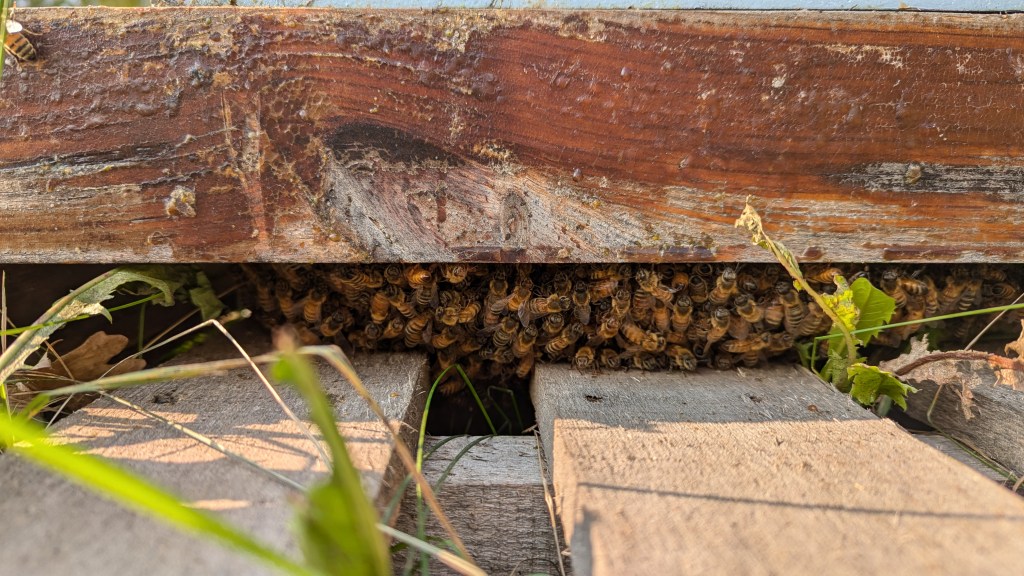
There was a massive cluster of thousands of bees underneath the hive!
My queen! My queen!
Everything clicked, and everything instantly made sense:
1) I did not over-feed the bees! There wasn’t a queen laying eggs, so the workers simply filled the empty space with the feed.
2) The queen cells I saw were not a swarming impulse, the bees were trying to make an emergency queen with the limited amount of brood remaining.
3) There is a cluster there because there is a queen there, emitting pheromones. There is no reason for a random cluster of bees underneath a hive. This also explains the aimless bees shaken from the lid.
4) Conclusion: I must have unwittingly shaken the queen from a frame during a post-honey season inspection and she did not find her way back into the hive. She missed, and went underneath instead.
The next day me and my cousin tipped the hive back to reveal just how significant of a cluster this all was. There are three sort of “ridges” in the cluster that you can clearly see, which are new honeycombs the cluster is constructing.
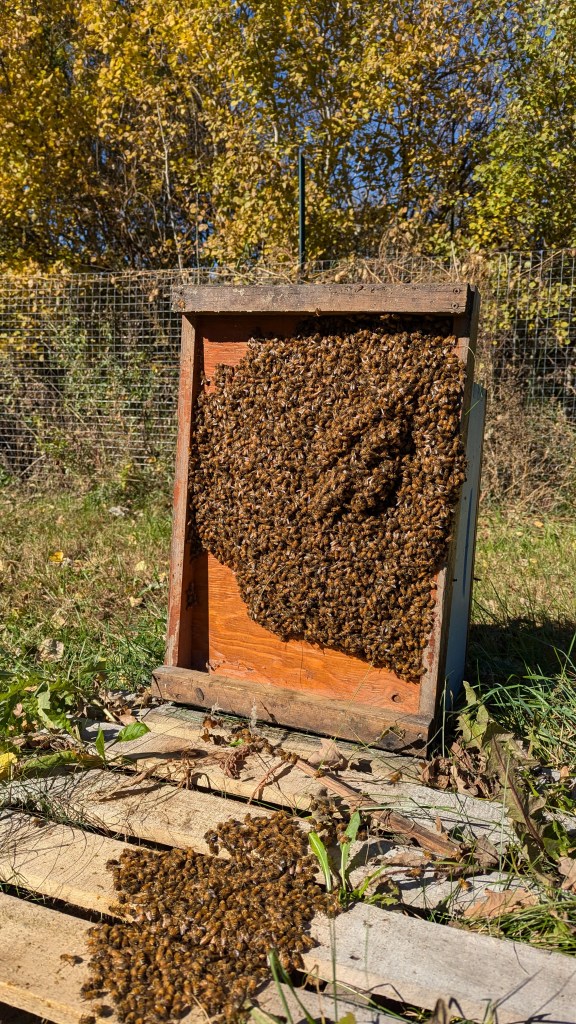
We figured she was likely to be in, on, or around those new combs. We peeled them off one by one, and there she was. She’s the big beauty with the smudged green dot in the centre.
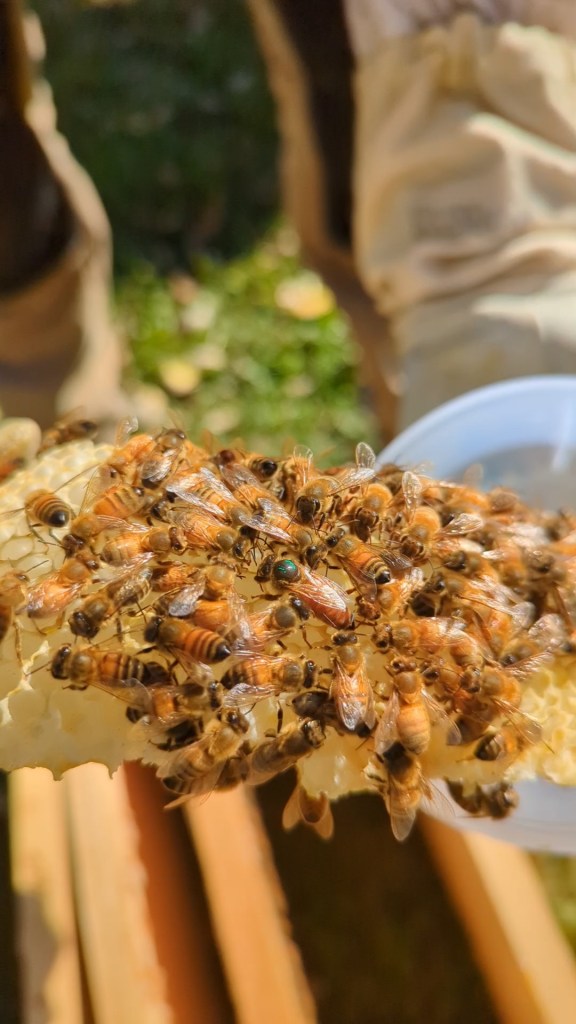
Back into the hive she goes!
We removed 3 frames of plugged nectar and put in 3 empty frames in the hopes it isn’t too late for her to lay a last-chance round of eggs and build a solid winter nest. It’s a bit last-minute, but we have way above seasonal average temperatures now, so maybe it’s not too late.
This was 100% due to my inexperience.
If I had been more experienced, the thing that would have tipped me off was the emergency queen cells. It is far too late in the season for swarming…there is little to no chance that a queen could successfully mate in mid-September. The other aspect here is that a large majority of the queen cells were on the sides of the frames, not on the bottom. That should have been the big red flag that there was a queen issue, and that is the moment I should have investigated further.
Even before that, I think an experienced beekeeper would have realized the brood nest was shrinking way too fast in August, and may have caught the queen issue even before there were emergency queen cells.
With these things there is only learning through experience, and now I have a lot more.
Just hoping my missing queen can lay a very late round of eggs and build up a solid winter nest. And then…there will be a whole new learning curve for my first year of beekeeping: getting them through winter.
Stay curious!
Graham
thanks for reading Complimentary Blueberry Juice


 Complimentary Blueberry Juice
Leave a reply to Learn By Doing III – Complimentary Blueberry Juice Cancel reply