I had a pretty exciting week with this project, so lots of pictures today. Suddenly it was time to do a big job: deal with the first set of cover crops we planted. I went from feeling a bit down from reaching the “apex” of the season to being over the moon at the success of this cover crop.
Since this is our second year trialling cover crops, we made some adjustments, and seeing the results of those adjustments was what was so exciting. If you want to read more about our first cover crop installation from last season, I’ve included the links to those at the bottom of this post.
First, let’s admire how amazing this cover crop is.
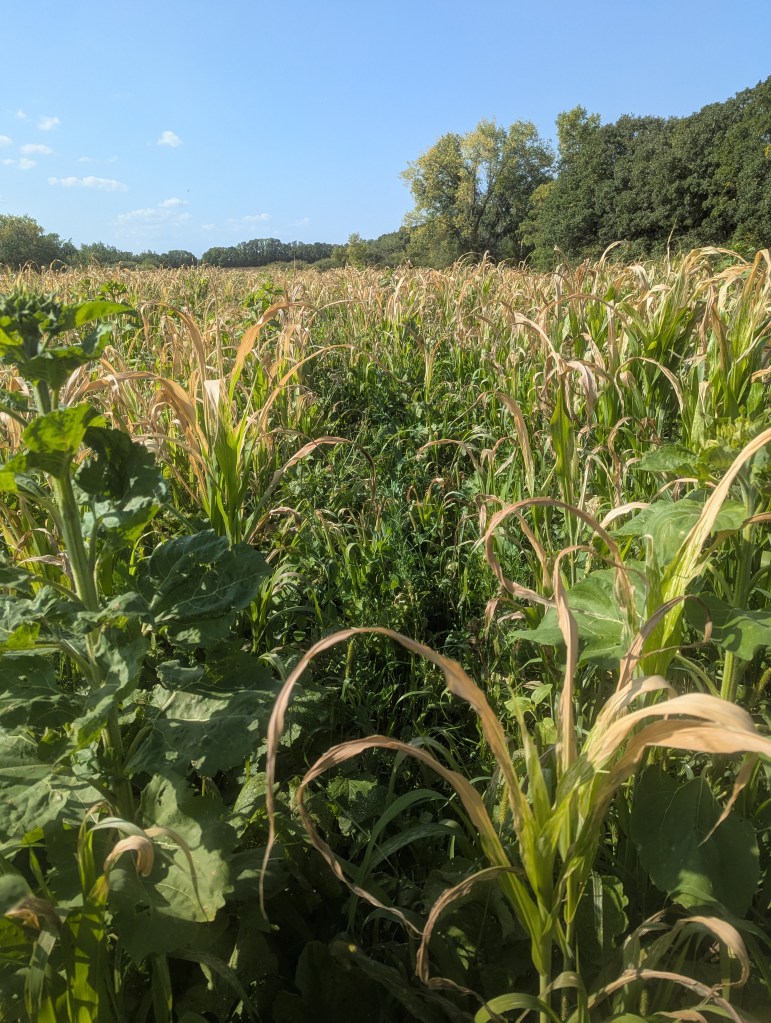
This is incredible to me, because for most of the season I was a bit despondent that we might be able to install cover crops at all. We had drought and high temps through June and July, and getting into the beginning of August without rain, well, we need rain for the cover crop to germinate.
It was a struggle the whole way through. We thought rain might be coming, so we seeded the first two acres. Rain didn’t come, the fields sat there barren for ten days. Then we thought rain might be coming again, so we seeded another 2 acres. Then rain didn’t come. Despondency! It was almost the middle of August, how much could a cover crop really grow, if we were even able to germinate it?
The rain came, the cover crop germinated, followed by high temps and warm overnights. In four weeks, at the end of the season, despite decreasing light availability, the Sorghum and Sunflowers shot up to 3 or 4 feet high, and the peas trellised themselves, as they do.
Amazing.

So what did we change for this season?
First, we planted the same ten-way mix as we did last year:
Black Oil Sunflower
Sorghum Sudan
German Millet
Italian Rye Grass
Hairy Vetch
Forage Peas
Daikon Radish
Purple Top Turnip
Flax
Berseem Clover
Second, we decreased the seeding rate. Last year we were just figuring out how to use our new seeding implement we invested in just for this purpose. This year, we metered out maybe as much as half of the seed we did last year. This allowed the plants a lot more space to establish, and the resulting green biomass was lush and thick.
Third, we had extra alfalfa fertilizer that had Calcium and Sulphur included in it, and so we decided it was best to make sure all cover crops included this fertilizer. This way we can get our Ca and S in, and it can be cycled by the plants and microbiology in this season, which means we can have it all biologically available for our crops next season. It would also help keep our cover crop in a healthy state, instead of having all those plants fight for any available Ca and S.
Fourth, we got a recommendation from the Soil Extension that instead of taking action to shred and incorporate the field after it has died, to instead shred the cover crop while it is still green. The thinking here being twofold: one that the soil is still warm and the microbiology is still active instead of reaching dormancy so it still has time to work magic, two that green material from the cover crop would more readily break down, just as if you were adding greens to a compost pile, and likewise, if you are adding browns to a compost pile, you will be slowing it down.
Fifth: When applying compost extracts and amendments, I need to add or include a food source for the microbiology. So I got a product to try mixing into the tank for this year’s application.
That all made perfect sense to me, so we made all those changes and wow:

I had maybe one of the most enjoyable experiences of the whole summer shredding this cover crop down. It was a beautiful evening to begin with, but also there was an immediate feedback loop telling me this is absolutely the right way to go. The intuition was there.
The scent and sight of the shredded plant material spoke as much. It was very obvious that, if we were to now mix this into the top layer of the soil, we would be encouraging the breaking down of this material, instead of letting it oxidize and carbonize.
After a couple snafus with the sprayer, we got it up and going, and applying the compost extract, soy hydrolysate, and additional Calcium was next. We also opted instead of “spraying” to remove the nozzles entirely and just let it dump out, at a rate of about 350L/acre. I tried to get a photo but it was hard, this was the best I could do.

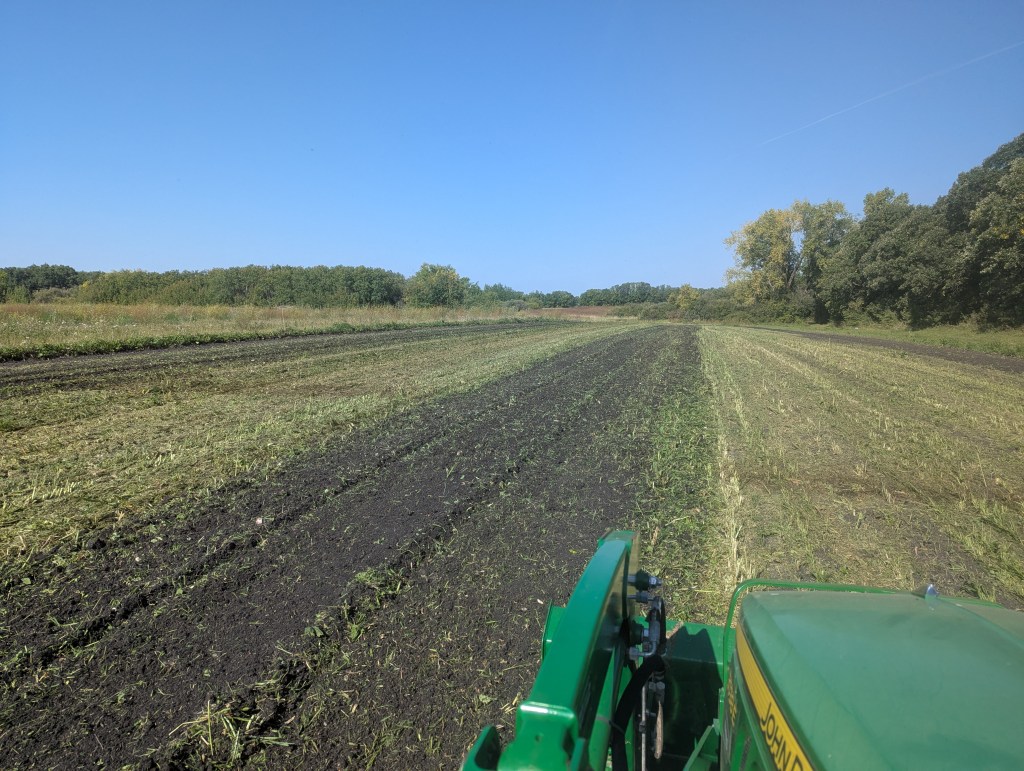
The only last thing was to mix it all in, and you can see in this next photo just how fast things change. The morning after the cover crop was shredded, it was already losing that green vibrancy. Just as if you cut a lawn, that “fresh cut lawn” state does not last for very long, and by the next day, the grass clippings will be oxidizing…within 48 hours, it will turn brown. So these steps to shred and incorporate cover crops as one single action is an important time-sensitive consideration.
It feels really, really good to be taking these positive steps to improving our soil health, not letting land lie fallow, and allowing plants to do what they are evolved to do. Plants are ecosystem engineers that harness the power of the sun to split Carbon from Oxygen, in order to build their structures, and to foment symbiotic relationships with underground micro-organisms that collect more building materials for the plants. These building materials will be broken down again by more micro-organisms, and if we get all the timing right, it means we can really boost our farm’s overall health, our planning, and shrink the footprint of the farm. I am very happy we were able to quadruple our # of acres under cover crop this season.
Living ecological systems are intelligent, and we as humans need to realize this fact not just for our agriculture, but to protect the intelligent systems that stabilize our planet’s climate.
Graham
thanks for reading complimentary blueberry juice
Our First Cover Crop Installation (June 26, 2024)
First Cover Crop Update (August 7, 2024)
60-Day Update (Sept 11, 2024)
Fall Treatment (October 30, 2024)
Spring Update (May 14, 2025)


 Complimentary Blueberry Juice
Leave a comment