***sorry to anyone trying to comment, it seems comments were held for review, but I’ve changed the settings so hopefully that doesn’t happen anymore***
About a year after we started the no-till experimental acre in 2018, I got the idea to start planting apple trees. I was pretty ‘green’ at the whole professional farming thing at the time but I just thought it was something we should have and I couldn’t really explain why.
It didn’t go very well, because all that happened for the first couple years was that I killed a whole bunch of trees. Due to my own negligence and complete lack of care. But I kept buying a few more trees and in 2020, I decided the location was awful (I would later find out I was correct) so I moved them to the back corner in the dappling shade of the most towering Oaks in the south tree line.
By 2021 trees kept surviving (mostly), so I kept buying a few more to replace the ones that didn’t make it, and a few more, and by 2022 I had about 10 trees well on their way. I mulched the whole “orchard area” and protected my skinny fledgling whips with chicken wire in the winter to prevent deer from snacking on these precariously fragile sticks that I had wobbled my way through three or four years trying to get going.

Unfortunately I have very little photo evidence of any of this (I checked) and its rather hard to take any sort of photo of a bunch of sticks that seems to mean anything. This is the first real photo I seem to have.
In spring of 2023 I decided a few of them needed their first pruning, so I boned up on YouTube and started cutting and shaping my trees hoping I wasn’t screwing this up. Because I let them grow wild for a few years some required some hard decisions on direction, and so some became single leaders, and some became open centres. I even got some Black Walnuts and Korean Pines to try out by the back fence line, where they would be well out of the way of any vegetables if they ever got big enough to yield anything.
The whole thing still seemed like it had no purpose, I was just growing some trees for fun, but I had grand ideas. Things like offering fruit to our CSA, or bringing to Market. But I thought of what passes for a typical Manitoba fruit, and I thought it must be possible to grow beautiful, incredible, sweet, unbelievably tasty fruit here. Beyond the bag of sour apples the neighbour donates for sauce. Zone 4 restrictions be damned. If only a tree could be well taken care of and its nutritional and ecological needs met, this should be possible, I thought.
Then something happened.
In 2024 I got my first beehive. I’d always wanted bees and now I had some. Another pet project for an ecologist. Standing there in springtime and discussing with my partner what we could do with this odd end of the field, what we were doing with a mess 30, 40 and 55′ no-till beds just to fill space? Isnt’ there something else we could do instead? The solution became the lightbulb: make all of it an orchard.
A five-thousand square foot orchard. Now it was obvious, and it was amazing that it never crossed my mind before, but how could it when I was busy killing apple trees? It was easy to imagine rows of fruit, and just enough of each different kind of fruit for our community. The more imagining I did, the more I realized just how flush with fruit I would eventually be, that I might not know what to do with it all.
But I’ll cross that apple branch if I ever come to it.
First went in the plums, but they didn’t do so great, and neither did the warranty replacement trees, and I lost a full season and had to switch suppliers. But the row of Cherries took more easily, and all of a sudden there were what appeared to be four rows of trees.
By 2025 I was researching more about trees than I ever had, purchasing TM Dejong’s Concepts for Understanding Fruit Trees, an academic review of fruit tree physiology that helped me fill in my gaps of tree biology understanding. I was, and still am certain, that the path to walk is the nutritional one, accompanied with a healthy local ecosystem, to grow mind-blowing fruit in the challenging Zone 4. This book got me thinking about how to help the trees along through the entire season, and how each branch holds its own nutrient reserves.
More fruit trees went in, I ordered Pears and Grapes, the orchard now stretching across the width of the property, with my dead warranty Plums being the only missing teeth.
But 2025 was the season that I finally got to taste those first apples.
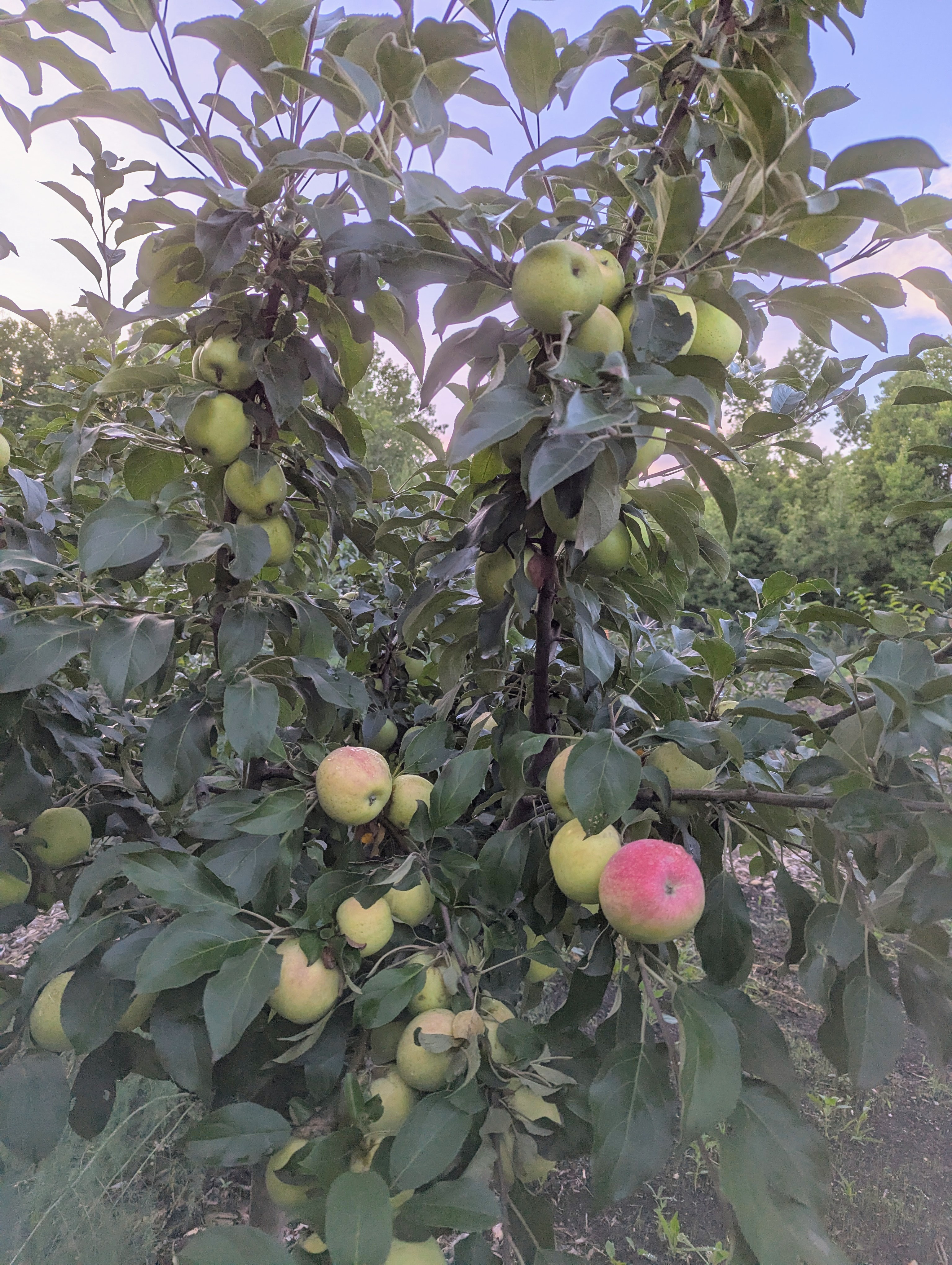
It’s been 6 seasons for this struggling little Norkent. Pruned to open centre. It’s my best tree. She’s setting fruit out, so I go each day, knowing from the book that the window to affect resource allocation and fruit size is very tiny. I prune all fruit sets down to a single fruit per set, over 100 tiny blueberry-size apples off the tree. I water the tree. I give the tree additional Calcium and Sulphur. I give it foliar applications of compost extract plus a little calcium and trace elements every two weeks.

Nearly every time I go by the tree I stop to take another look and marvel at this magic. After waiting all this time, after being so patient, my Norkent was loaded with beautiful fruit. Some of them were even as big as an apple you’d find in the store from BC.

When it finally came time to harvest, I couldn’t believe the results. Crisp, sweet, crunchy, a beautiful hint of that Norkent pear flavour, finishing with a light tartness. This was the apple I’d waited for for years. And it was delicious. There was 0% insect damage with no pesticide or chemical applications, only nutrients. Several dozens of apples went into a crate, and I ate them slowly over the next few months, finishing the last of them in November.
But the work didn’t stop after picking. No, I had to make sure those branches were loaded up with resources for next season. So I kept up my foliar application regime right until leaf senescence. The leaves were themselves huge and beautiful. When they fell they revealed the gorgeous skeletons lying dormant for next season. When they fell, they revealed how much they had grown. One tree had set more than a metre of new growth in just this one year.
More goes on than meets the eye.
After a big rainstorm, mushrooms pop up everywhere in my newly germinating multi-species perennial orchard ground cover. There can be no other source of the abundant and mysterious mushrooms…but the wisened Oaks and of the treeline and the forest at the end of the field. There is a massive mycorrhizal network underneath my feet the whole time. Of course there is. I have no doubt it is helping these apple trees in some invisible way, and that it will spread through my entire orchard.

Whether or not they are intertwining themselves with my apple trees, I don’t know, but they are the greatest evidence that these trees are in the correct location.
I expect 3 or 4 apple trees to fruit in 2026, and I am a little scared to think that it may only be a couple years before I am awash in 1000 delicious Norkent apples from just a couple trees. It won’t be long until I have to get people to help me eat them all.
This 2026 season I have replacement Plums on the way, as well as a couple filler apples, and another Pear. I hope my Zone 3 and Zone 4 grapes have survived the recent cold -40C.
Little did I know that this insistence of planting apple trees of mine would turn into a whole thing. To me, The Orchard Project is now the most exciting thing going on at the entire farm, in our experimental one acre of no-till. It’s my own little pet experiment, one that makes absolutely zero business sense, and makes absolutely no money but has cost me plenty.
I can’t help but love watching the slow progression of these incredible organisms, it WOWs me every year. It plugs in everything I’ve learned about biology, ecology, farming, fertilizing, watering, diversity of species, and healthy ecosystems, and now is a new experimental area for timely foliar nutrient applications on perennials. It’s my little sandbox, with bees buzzing around the clovers and mushrooms springing up from the forest. I know that one day I’ll be able to sit underneath a crown of trees in the shade.
Planting trees feels like an act of resistance. Against the stupidity of human affairs. A defiant source of hope. There is so much joy in watching a tree grow, doing its thing, slowly, year in, year out.
There is so much joy in learning a skill I don’t have, but nature is going to give me a big assist on this one. She let just enough of my trees survive so I wouldn’t give up.
Graham
thanks for reading complimentary blueberry juice


Leave a Reply to Graham HnatiukCancel reply