This summer I’m going to start a new project, documenting the biodiversity of what we have at the farm. I’m working towards doing it in such a way that I can share what I find with you. What that will look like exactly, I’m not sure. But I’m hoping to invest in some new gear to do it.
A lot of what I find is very tiny. For example, last fall I wrote this post detailing fascinating things I found collecting my worm compost. At the time I found snails that were perhaps 2-3 millimeters wide, and wished I had a macro photography setup ready to go….these things are just too small for a phone. I do have an older camera I got some 20 years ago specifically for an auto macro function, but it’s not in the best working condition anymore and not easy to use.
I come across things that are amazing and I’ve never seen before and wished I had such a setup to photograph and record it. Like this beauty, last season:
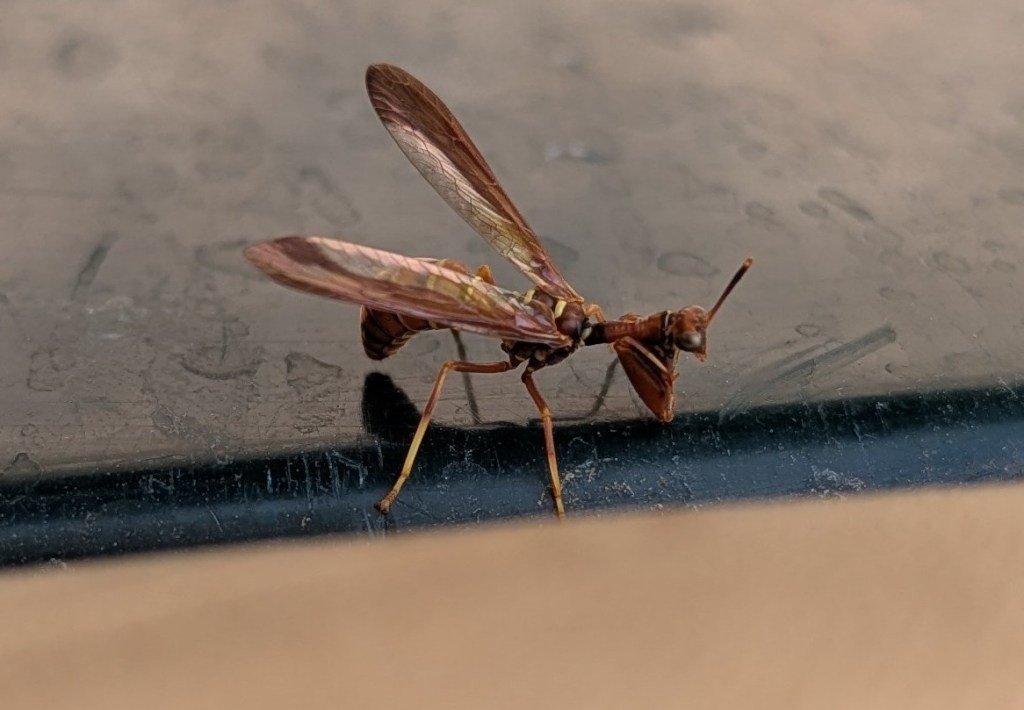
This is Climaciella brunnea, or the Wasp Mantidfly. As it landed on the golf cart, I got a decent photo and uploaded it immediately to our Hnatiuk Gardens iNaturalist page where it suggested a match (iNaturalist and the community there is amazing for this). Every year without fail there is something I see in the field that just blows my mind.
The Wasp Mantidfly does not only have a striking convergent appearance to the praying mantis, they are not wasps at all, rather in the lacewing order. Their larvae attach themselves to wolf spiders and parasitically feed off of them.
…what?!?!
And there are so many wolf spiders in our no-till garden that I would hesitate to guess how many zeroes I have to add to get into the right ballpark of population magnitude. There’s tons of spiders because there’s tons of food and habitat for the spiders because it’s an acre of no-till garden that doesn’t receive any pesticides. So…there’s tons of “food” for the little Wasp Mantidfly larvae, and so after learning all this, it is not so surprising that I would see one eventually. Life goes where the food is. I’ll be on the lookout for the Wasp Mantidfly again this season.
The inter-connectivity of all things tiny is truly mind blowing, from fungus and plant roots existing symbiotically, to detritivore snails in compost, or lightning bugs that love to hide in lettuce for some reason. The world becomes the thriving place of life that is depicted on BBC nature documentaries, and it can be in our own backyards or gardens.
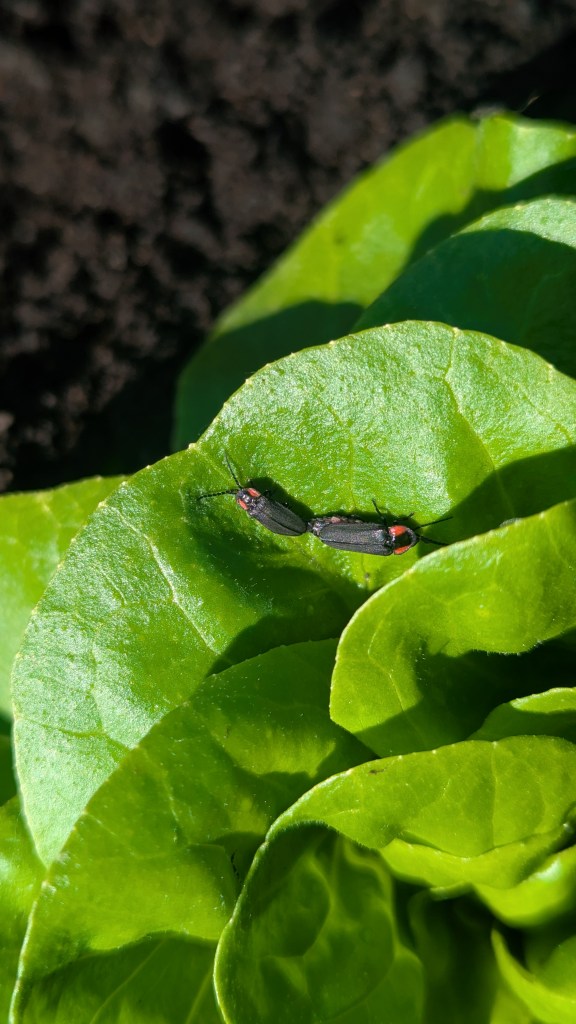
These are lightning bugs, related to the firefly, but do not make any bioluminescence. I have no idea what they’re doing in there, but what I do know is that they do absolutely nothing to the lettuce. I take seeing things like this as evidence of a healthy ecosystem, providing a home for things that are filling some niche in the complex web of life in the garden, and one that I am still not wise to.
What I’d like to do is get a camera setup that I can take pictures and maybe even video of these things with a lens just millimeters away. There is so much more out there that I come across that I would not doubt at all if I could document as much as 1000 species living on the farm property alone (now that I write that, it actually sounds like a good challenge).
These are the tiny things we miss when we destroy agricultural land and naturalized green spaces to build sterile parking lots for cars that we call “development” or “suburbs” in the name of “progress” or “growth.”
Life is beautiful, and we are a part of it. We separate ourselves from nature at greater peril each passing day. We must choose to do things differently.
Graham
thanks for reading complimentary blueberry juice
if you like this blog, please consider subscribing via email to get a post in your inbox every Wednesday, or sharing it with someone you think might enjoy it too


 Complimentary Blueberry Juice
Leave a comment