-
Art Can Show Us the Diversity We’ve Lost
Anecdotally, everywhere one seems to look, humans appear to have an irresistible urge to clean things up, make everything tidy, neat and uniform.
Anecdotes meet reality. This issue is supported by mountains of science and documentation: modern conventional corporate agriculture is a major driver of biodiversity loss for its preference of monocultures and deforestation, forestry is addicted to clear-cutting followed by monoculture and mass herbicide application, and we are even raising salmon in monoculture fish farms to the detriment of the environment surrounding them.
It wasn’t always this way.
For what that looks like that we can thank artists. Van Gogh alone has many beautiful depictions of biodiverse orchards dating back less than 200 years ago. There is a wide selection through art history showing various landscapes and crops in vivid detail how things used to be. Each brushstroke in a mosaic of a painting like a Van Gogh almost feel like an impressionistic representation of the diversity of life itself.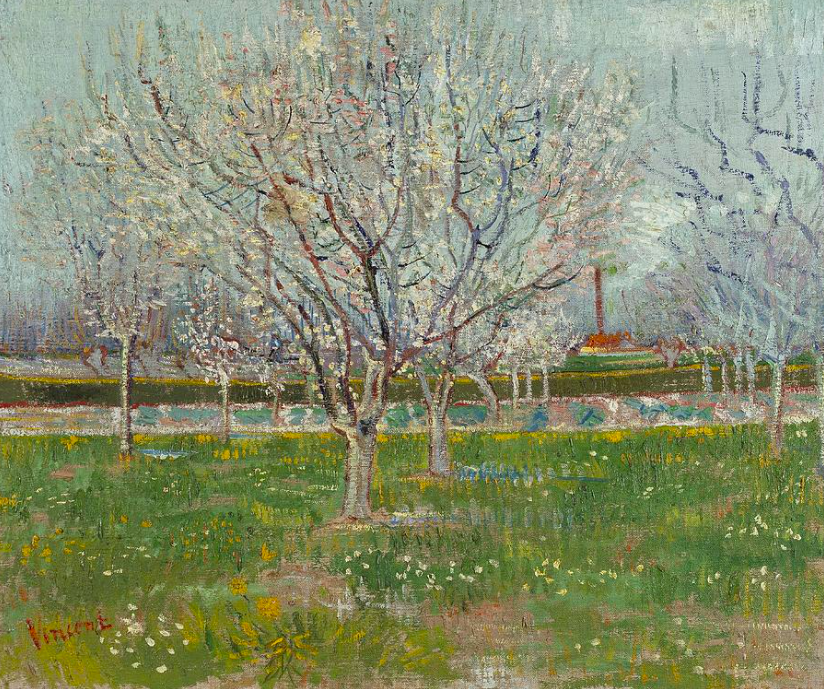
Flowering Orchards series by Van Gogh, 1888.
We must find our way back. Unprecedented anthropomorphic biodiversity loss is a major issue facing our so-called 21st century. Science and the philosophy of aesthetics can lead the way.
Studies like this one show time and again, that biodiversity leads to higher productivity and resilience. Biodiversity has synergistic outcomes…which is not surprising, as all systems evolved together. Nothing alive today has come into being independently. The whole of the sum of multi-species adaptations makes the system function.
Somewhere between Van Gogh and Andy Warhol we made a cultural choice to treat the natural world in oversimplified terms.
We can choose again to come back to highly productive, diverse, and beautiful natural systems, without sacrificing output. Science and documentation can lead the way. And as always, agriculture, will be at the forefront of yet another revolution.
Graham
thanks for reading complimentary blueberry juice, which is best shared with friends -
Targeted Farming Advertisements
Over the last year or so I’ve taken screen caps of the sorts of advertisements that are targeted at me (I guess I don’t hide enough cookies from the surveillance capitalism data thieves so they know I’m a farmer).
Given that we don’t use any of the products that are attempting to woo our dollars, these ads seem particularly ridiculous (and they are).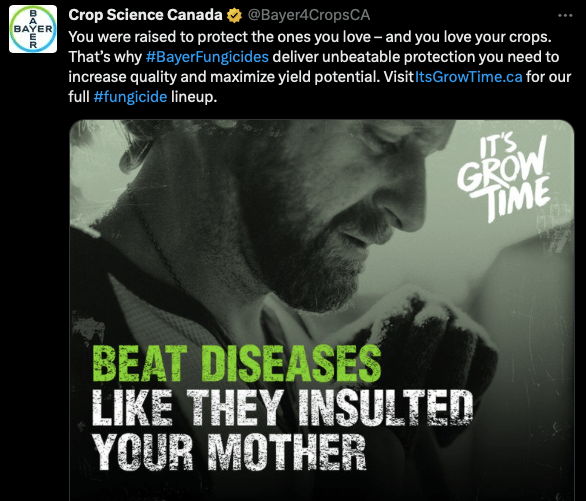
The company in question here brought in over $56 billion dollars globally in 2022. While a portion of that is pharmaceutical, this is by far and away the largest agricultural chemical company in the world, as well as the largest apologist for the supposed safety of their concoctions (despite many a class action and many a settlement). The problems are created by industrial commodity agriculture, and the solutions are provided by industrial chemicals.
Not sure what sort of macho-man-farmer needs fungicides because of a petulant insult to his mother, but I’ll pass, thanks.
Fungus predates the evolution of vascular photosynthetic plants, therefore, plants are dependent upon fungus for their survival. To portray them as a curse is absurd.
The question that needs to be asked is not “which chemical should I apply to rid myself of this fungus,” rather, “what is causing this fungus to exist in my crop.”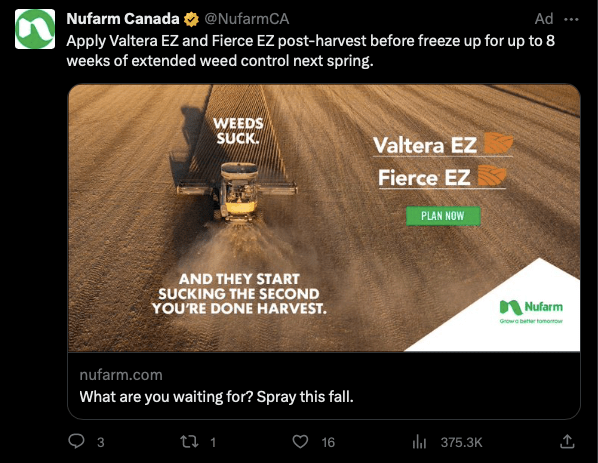
Weeds suck!
Yeah weeds suck.
I have no idea what horrors these guys have invented that you apply after harvest to prevent weeds from growing, but I want no part of it. Nor do I want to eat anything prepped with something named “VALTERA” or “FIERCE.”
It’s really disheartening to see ads like this, mostly because it continues the normalization of spraying. Got a problem? There’s a chemical for it! These agricultural methods are based on only treating a problem after the symptom has been allowed to develop. In worse cases, chemicals are applied as a prophylactic, at the expense of the farmer’s wallet, and our health (you are what you eat).There’s more to be said about the poor logic of these methods, but to address them now would turn this into a lengthy post.
Suffice to say that these companies prey on farmer’s anxieties over yield and low profit margins (as well as weed OCD) to generate their sales, as well as the collective cultural reinforcement that everyone else is doing it.
It’s easier to suppress the uneasy feelings about spraying chemicals than do the hard work of addressing the root problems.
I wish as much effort and research dollars went into improving methods and understanding as goes into developing new kinds of chemicals to sell.
Graham
thanks for reading a chemical-free complimentary blueberry juice -
Change Is Coming….Fast
Not talking about it, or pretending it isn’t real, will not help us prepare for significant changes the world will face in the coming decades.
Not talking about it leaves our communities and societies weak, our businesses brittle, and unable to adapt in time.
Not talking about it means we double down, triple down, quadruple down, on the strategies that worked before, assuming they’ll work tomorrow.
Not talking about it doesn’t make the problem go away, nor does it make something happen slowly, way down the line, in the future, somewhere.
Not talking about it allows us to pretend it won’t affect us, and that the cost of learning new ways, adopting new methods, and pioneering change is simply too high.
It is simply easier to pretend it isn’t coming, talk about something else, so we can continue our business as usual, so the things we are used to won’t change.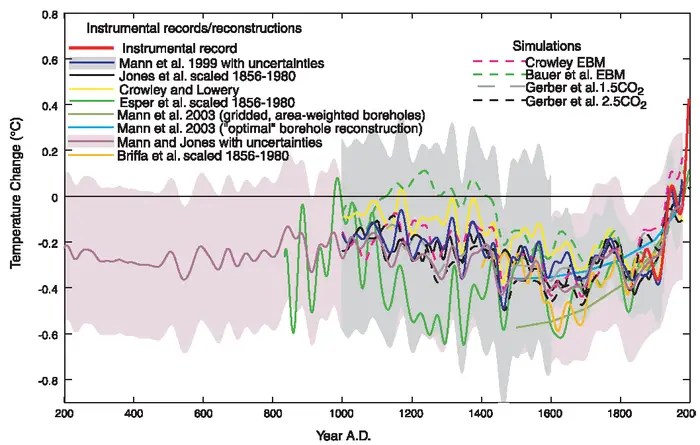
This study was widely mocked when it came out in 1999, partly by oil executives, partly by donors to political parties that stand to gain from it, and partly by people who thought it wasn’t an issue worth talking about.
Each and every year since 1999 has only shown this study to be extremely close to reality, 2023 will be the warmest year in recorded history.
Humans rarely experience things on a logarithmic scale. The combination of the things we aren’t talking bout, the things we aren’t doing, the scale of our consumption, the outdated modes of our agricultural models, separating ourselves as apart from and above our environment, all combine to make sure that we will, undoubtedly, cause history-altering changes to life on our planet, and those changes are coming faster than we can imagine they will.
It is a complex issue that goes far beyond the use of just fossil fuels: deforestation, pollution, the way we design our cities, and our agricultural models.
How will we design and build resilient systems to buffer, reduce and help prevent the changes that are rapidly approaching?
Not talking about it is a sure way to walk right into the giant rake, and then get mad, and wonder instead how the rake got there, who put it there, and who’s to blame for it.Talking about it opens the doors to solution, technological innovation, and community building.
The moment we choose to build community instead of commodities, we can design and build resilient systems that are reciprocal, symbiotic and synergistic.
Graham
thanks for reading complimentary blueberry juice -
The #1 Resource in Farming and Gardening
At the end of every season there is time for reflection, and it doesn’t take too long to start getting excited about the next season.
Among all the things you could grow, might grow, grow more of, grow less of…all the seed catalogues, it is all very enticing, and very easy to say “yes” to everything.
Looking back on your year and analyzing what worked and what didn’t is of course, valuable. But there is one thing that is above and beyond all the choices you can make throughout a growing season (or before it begins).
Time.
There is nothing more frustrating than getting behind on a growing season, looking at piles of weeds, and trying to play catch-up. The truth is that once you start playing catch-up, you never do catch up, as more and more piles up.
There is no amount of resources you have during the growing season to eliminate catch-up. You effectively play from behind for the entire season. It is arguably more important to consider how much you, your garden, or your business, can reasonably manage without being stretched too thin.
Considering your time resources and time pressures during the growing season is perhaps the most important aspect of planning. It will dictate the tools you use, the size of crops to grow, and the methodology of growing them.
Working harder isn’t a solution if you’re still playing catch-up.
Graham
and if you work smarter, you have more time to pick blueberries! -
Minimum Crop Space
One of the challenges of implementing cover crops in a zero-till system for our farm is that we still need to grow a lot of produce and keep the farm running! We need to figure out exactly what absolutely needs to stay inside a zero-till system. The rest, at least for one season, we can find solutions for.
Something complicating this thought experiment is the enormous deer pressure we have to deal with. Our zero-till space is entirely enclosed inside a deer fence, however the rest of our farm is not. There is one field that has relatively low or very little deer pressure, but the trade-off there is that there is no access to simple irrigation. To irrigate in this field, we must bring a water tank.
In 2023, we ran a large part of our CSA and Market programs with approximately 14 000 square feet of zero-till beds (or about 1300 square metres). The goal will be to reduce this to the absolute minimum, to begin a new process of regeneration and weed control with cover crops. The more area we can cover, we can more quickly return to the zero-till or minimum-till methodology.
Over the last several years it has become impossible to imagine harvesting carrots outside of a zero-till system…it works primarily because they are much easier and faster to harvest and clean. We will need 5 beds total for carrots. In the same arena as carrots are parsnips and leeks, both require digging and in our heavy clay, there is zero possibility of harvesting items like these without the use of a tractor implement. So these must also remain in our zero-till system, and we will need two beds for parsnips and leeks.
It is worth noting that prior to our ventures no-till, we had great difficulty and inconsistency (or outright crop failure) growing carrots, leeks and parsnips. We owe a great deal of our success in the past several years to these great improvements in our methods, which involved zero-till. So much so, that it’s painful to imagine going back.
Our lettuce and greens must also remain in our no-till, which benefit greatly from the large amounts of compost we use. Having lettuce uninterrupted for 12+ weeks during the season is a great success story for us, and one of the things that is a big positive takeaway from our no-till, learning and dialling crop planning: seeding times, transplanting times, and harvesting times. We will need at least 3 beds to start the season for lettuce.
Another crop I feel we cannot get around not doing in a no-till is our celery. Like other crops, only in the past few years have we excelled at celery and grown a high-quality crop. This is a crop that requires a lot of biology and a lot of water to do well. This crop best remains where we can apply more compost if needed, amend with foliar applications, and turn on our irrigation. We only need one bed for celery.
The rest of the items we need fall into a different category. These are radishes, hakurei turnips, and green onions. These are all seeded with our Jang Seeder, which is much easier to operate with nice fluffy substrate. These crops are also much easier to harvest, and much easier to clean…otherwise they get glued into the clay, and we will have high crop damage attempting to harvest them. They benefit from irrigation for germination, and another benefit is that they are crops that are finished within three weeks. This means we can plant a second crop on these beds by early July. We need three beds for these crops to start.
So, this means we are at a total of 14 beds so far. We will add one more for some insurance/wiggle room just in case. This means we can move forward with 15 beds, for 5625 square feet, or 522 square metres.
Said another way…to start the 2024 season, we will only use at maximum 40% of the full potential of our no-till field while we begin to transition to include a cover crop rotation.
That seems a little scary…but, it also seemed scary to start this whole no-till thing to begin with. The learning curve is steep but also rewarding….there is no replacement for the diversity of life that comes with no-till, and there is no doubt as to the efficiency of our operation and increasing the amount of great vegetables we can grow with these methods.
My prediction is that we will learn many more things/start walking a path of steep learning curve in two areas. One: the implementation of cover crops, which we have never done and are unfamiliar with. Two: we will see many unexpected things and have many surprises with the crops we choose to move out of the no-till zone for 2024.
Now we can take a big breath, let out a big sigh of relief, and do the fun work: the work of imagining all the possibilities and amazing discoveries we will make as we walk this new path.
Graham
thanks for reading, consider sharing some complimentary blueberry juice with a friend 🙂 -
Adding Cover Crops to our No-Till System
After admitting a little bit of defeat and looking at the positives of our system, we need to find a way to both be able to continue within the system while we work on a solution to the problem.
The most obvious solution is to start over.
If the weeds continue to return regardless of how much mulch or resources we throw at the issue, then we need to start over from zero. If the goal with no-till is to retain all the things you do not see above ground – microbial communities, root structures, and all the organic molecules that come with these things – there are many ways to achieve this. One is to have a continuously growing crop, so there are always living roots in the ground. Another is to deliberately plant a selection of species that is not intended for harvest, and this is known as a cover crop.
We have talked for a few years now about trying the idea of cover crops, but having not done it before, we punted it to future years. It seems that push has come to shove and we now see, and understand, how it can work in our system, the advantages it can potentially provide us, and how it works logistically – the order of operations – required to prepare an area of land such that weed pressure is drastically reduced.
So, our intention is to plant cover crops.
But to do so, it will initially require a light tilling.
If we can a) establish a cover crop (even with weeds present), we can then b) mow the cover crop, then c) place a tarp over the cover crop to block all light from reaching all remaining plants. The tarp will also heat extraordinarily during the day, applying additional heat energy to kill the remaining plant mass. At this point, we can d), remove the tarp, rebuild beds with a thick layer of compost directly on top of the previous cover crop.
This order of operations will hopefully give us a clean slate…there should be no remaining plants or weeds after this process. We do not intend to till the soil again, so no “seed bank” seeds will be brought near the surface to germinate. An additional thick layer of compost will act as a mulch layer to further bury anything that may be remaining.
Additionally this allows us to keep some percentage of the regenerative field continuously cover-cropped, and we can mow-tarp-mulch as we need new area to plant…as long as we can do this mow-tarp-mulch process at least two weeks prior to seeding or transplanting.
The remaining questions are a) what to plant as a cover crop, and b) the maximum amount of field we can reasonably cover crop without leading to a drop in production for our CSA or market programs. To put it differently, we will need to define what is the minimum amount of bed space required to start the season.
And that….is what we will figure out next.
Graham
thanks for reading -
What We Did Before Informs The Future
One of the more rewarding things about plant husbandry is watching things that you take care of grow.
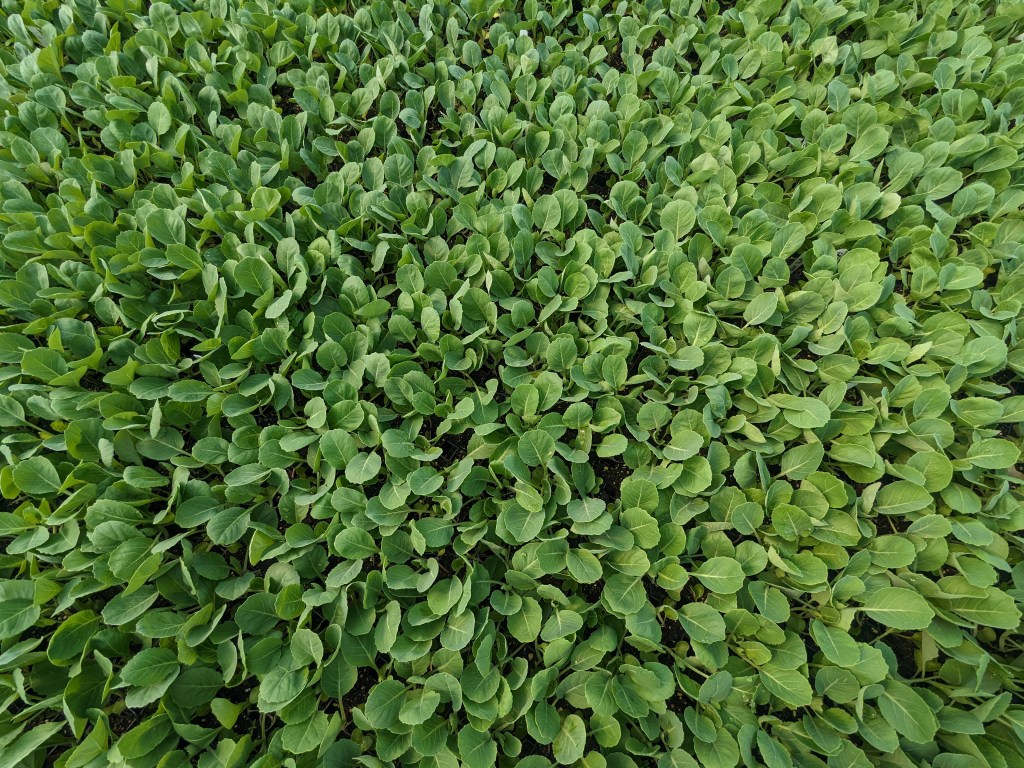
As skills and understanding get better, as developing science expands how we think about plants and how plants communicate with their environment, we too must grow as people to be able to absorb new information and apply it to the field.
With many crops in a growing season, there is only one chance per year to lay out a plan, execute it, and assess the results. An adaptive mindset is important, as is repetition, practice, and refining methods based on new insights.
It is easy to fall into a trap of tradition or sunk costs. What we did before informs the future.
The rest is up to us, our curiosity, and imagination.
Graham
thanks for reading Complimentary Blueberry Juice -
Looking At The Positives
Week two here of examining the Shortfalls Of Our Zero Till system, and maybe the first thing after admitting defeat should be to look at all the positives and see what lessons we can and should carry forward.
This past 2023 season we saw a record amount of productivity out of the field…we were more efficient and consistent than we ever have been with several crops that had previously been problematic. In less than an acre, we managed over 4000 heads of lettuce between June and September, a couple thousand bunches of green onions, and three beautiful crops of radishes. Not only did we also have consistent fresh carrots available for 11 weeks, we also nailed our fall crop and have a good amount of storage carrots. We were able to very successfully provide for both our CSA and Market customers.
So how did we get there, even with all that weed pressure?
It took a long time – several years – but the most valuable thing to learn was how to juggle all these beds. That seems to come down to one thing and one thing only: practice.
Practice makes perfect!
We learned when to seed…that there needs to be a schedule, a target window. We learned how to time succession crops, so when one crop of Lettuce is finished, the next one is ready (or almost ready). We learned exactly how much we needed (so we weren’t wasting valuable space over-planting).
Most importantly, we learned that there needs to be a plan for what happens after the crop is finished.
For a long time we simply left the area empty (in which weeds would grow and go to seed), and fix it up with fresh compost for the next season. We got 100% better at having a crop finish its harvest period, and have the next one ready to go. Resetting the bed would mean a temporary elimination of weeds and allow the next crop to get started. With this method, in 2023 our last seeding date for a Zone 4 was August 12th, allowing us to have fresh greens until the end of September.
I consider it a big achievement to arrive at a place where we can be confident in our produce availability week to week, and continuously keeping things going from early in the season to well past the frost line, keeping living plants in the soil for as long as possible. Several beds had three crops this year. There is simply no way around learning this other than trying it yourself and making adjustments over a period of time, getting better each year and dialing it in just a tiny bit more (and I could’ve had Lettuce into October if I planted one more bed! Now I know for next year!)
If anything, learning this crop-juggling skill for a market garden gives me a lot of confidence that I can now make radical changes to our process and move forward. Having a clear blueprint of exactly what we need and when will give us a lot of room to manoeuvre through our next phase of learning and growing as growers.
Managing the processes of nature in agriculture comes with repeated attempts, a lot of learning, and a lot of introspection as with practice and desire to improve, we can slowly get to an insight that gives us enough encouragement to try again, and practice again.
Graham
thanks for reading Complimentary Blueberry Juice -
Shortfalls of Our Zero-Till
For a few years now we have, at the end of each season, applied a large amount of compost to our zero-till beds. Through the years we experimented with different sorts of combinations of leaves, mulch and broadforking, all in attempt to loosen up our hard clay.
In general it worked. We accomplished our goals: consistent lettuce/greens production, easy-harvest carrots, green onions, parsnips, and leeks. We saw the soil open up with life and we saw the field explode with diverse organisms not seen in any of our more conventional cropping systems. But it had one big, big, big shortfall…weed pressure.
One of the several reasons we decided to go down the path of zero-till was that, as many a farmer-YouTuber-influencer claims, zero-till results in less weed pressure: all that is required is a little setup, and you’re off to the races, weed-free.
To some extent this was true, however we would always revert to having carpets of weeds, just like any other system. We made marginal attempts to address this, but did not see the response we wanted. In some cases the different tactics we employed worked for a short while, but would always end up back in a jungle of weeds.This is psychologically draining…accepting that weeds just exist, and you’ll have to harvest among them, ignoring every seed head burst with millions more, just waiting to add water. After years of covering this up with mulch and more compost at the end of the season, we decided to admit defeat and surrender in advance to the army of weed seeds lying in wait for us in spring 2024.
Our biggest zero-till lesson of 2023 is that we cannot continue to double down, triple down, and quadruple down on the same method that produced the problem and expect a different result. There is no reason for this, as we are not attached to any one method, other than finding the ones that are best for us. We always told ourselves it was a management issue, that we just didn’t get to the weeds early enough, or that it was possible to control the weed problem if we just worked a little harder, and put a few more hours in.
If we are attached to anything in this field, it is a principle of continuous experimentation with sustainable and biodiverse methods of agriculture that can produce high-quality and volume of crop on a small area that serves our community-based clientele. It is a principle that consistently furthers our own understanding on different farming methods. It has been the place we first eliminated chemicals, our first irrigation, our first zero-till attempts and many, many, many successful and high-quality crops that were otherwise not possible for us.
The next several weeks I will explore how we will find the next steps that will take us forward and continue on our regenerative path.
Big changes coming ahead!
Stay curious.
Graham
thanks for reading complimentary blueberry juice -
Starting Over
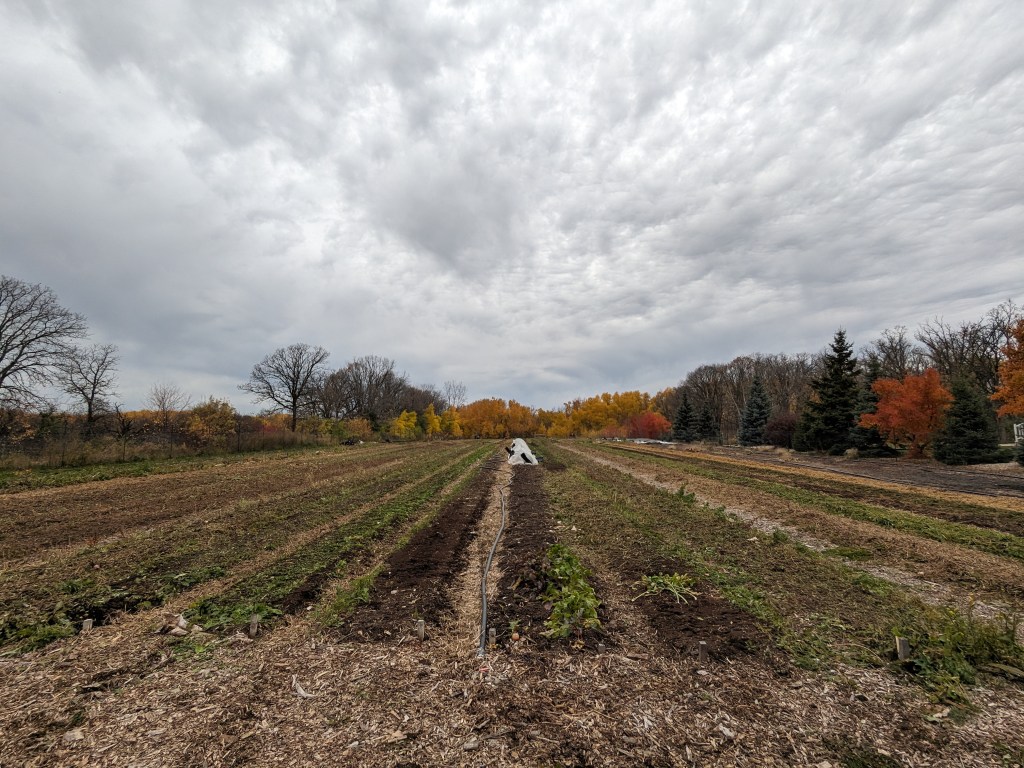
One of the best parts of farming, or agriculture, is that starting over and doing it all again is built into the process.
You get the opportunity to do it all over again, bringing forward everything learned and experienced. It allows for growth, infrastructure improvements, and design efficiencies.We’ve had several years now with our zero till system, and it has given us an enormous amount of productivity. That’s not to say there are no shortcomings (mostly due to our learning curve in the system). Despite the issues we’ve had, we get to do it all again, reimagine it, redesign it, and approach it with fresh energy.
It isn’t quite time to say goodbye to the field for 2023, weather permitting we’ll be able to get a bit more work done on it yet.
Agriculture is in a constant state of forward movement, and fall is really the time that becomes apparent the most.
Graham
thanks for reading complimentary blueberry juice
Home
About Graham
Graham is an ecologist-farmer from Canada working on educating about the wonders and beauty of the natural world, and how we can design biodiverse food production systems.

 Complimentary Blueberry Juice