-
Dealing With Crop Failure
Anyone who has ever grown something or cared for a living thing (of the plant or animal variety) has inevitably had some demoralizing times.
On one end of the spectrum, there’s the “nothing you can do about it” category which includes things like weather or the completely unexpected. On the other end of the spectrum, we have the “human comedy of errors” channel, where every action taken turned out to be the wrong play.
Either way, it hurts most in the middle of the season when mental health starts taking a hit. Repeated long hours and daily problem solving wears anyone down. Add to the mix that something isn’t going well or outright failing and you know that it was your actions (or lack thereof) that did it doesn’t help.
The key is in realizing the result was baked into the soil cake way before mid-season arrived.
Taking the observations and lessons learned and move forward with a better plan next season isn’t all you can do. You can also remember there were dozens of wins and a couple digits of losses. Agriculture is not a neat formula, and Nature will humble you.
Sometimes it’s about management, timing, or planning. Those things can be adjusted. Of course we can learn from our mistakes, but getting better at the craft of horticulture is also about repeating successes. It’s helpful to remember that not everything that gets attempted works.
Growing living things is a continuous practice. The exciting part is in getting to try again.
But before next season starts, we have to finish the one we have.
Stay in there!
Graham -
“Too Much Nature”
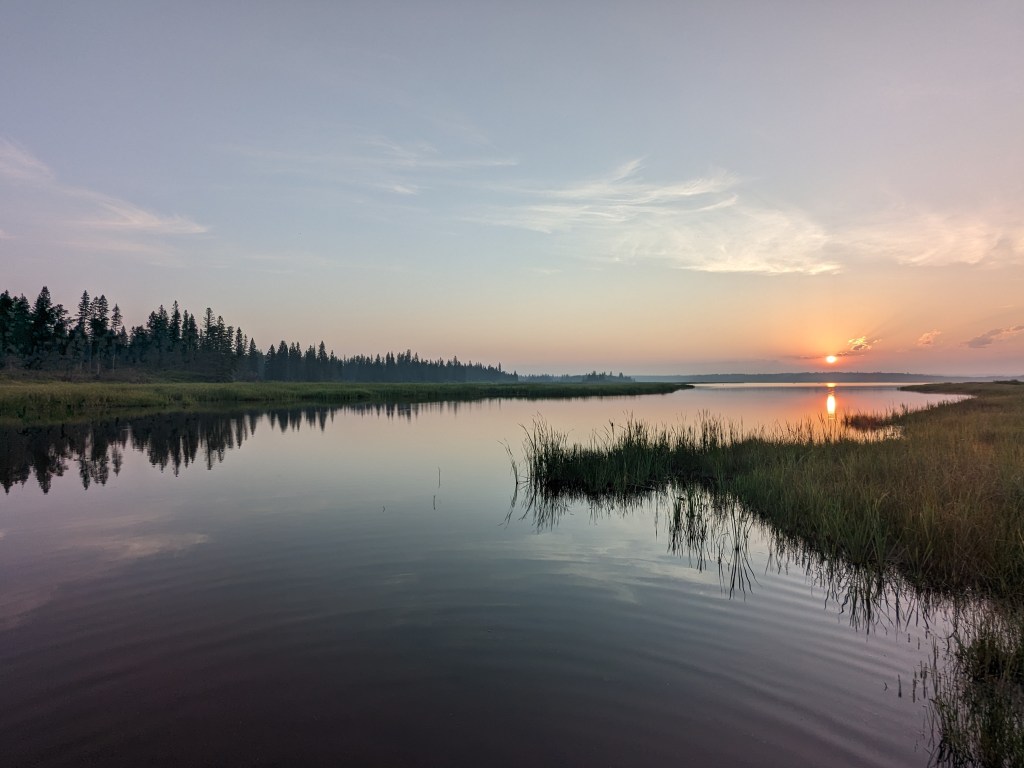
Was able to get to Riding Mountain for a couple days of camping, choosing Whirlpool Lake as the destination. On the way out a local told me there was “too much nature” out there at that there Whirlpool Lake.
I’m pretty sure he was joking, but it’s also kind of true.There were fish half-submerged in the peat swamp at the dock full of water lilies and sedges, garter snakes making a home in a hollowed out tree root, incredible mushrooms and all kinds of insects buzzing by at night around a small fire, with a clear sky and zero light pollution for optimal viewing.
Riding Mountain is one of my favourite places to go. The unique biome convergences offer so much. And surrounding this geological gem is monocrop agriculture as far as the eye can see.
Today I will thank the naturalists and conservationists that preserved these amazing places that will surely outlast human civilization.
Nature’s organized chaos is beautiful.
Graham -
Let’s Talk About Something Fascinating: Red Algae
You know how those conversations go: someone says what’s up, someone else says all they can think about is red algae! Since it came up in a presentation yesterday, let’s talk a bit about it.
We humans might be grossed out by the appearance of what appears to be slimy red stuff and think something might be wrong, or that it might be toxic or dangerous. On the other hand, red algae can be beautiful macro-structures in marine environments. We are so used to seeing green things, and green chloroplasts dominate our view of vegetative life. In the human-centric world we easily forget that all current life on earth comes from a long lineage of fascinating organisms that have shaped life on our delicate little planet for billions of years.
Red algae is one of those organisms. Some of the oldest fossil records of red algae is found here in Canada in our billion-year-old rocks. If you took in a lungful of earth’s atmosphere today you very likely inhaled some red algae spores.
When we see algae, red or green (or brown) we are seeing a window back into early photosynthetic evolutionary history. Algae is everywhere and one of the most successful and long-lasting diverse family of organisms.
Stay curious!
Graham -
Integrating Agriculture Back Into Communities

What does integrating agriculture with communities look like?
For many, agriculture is something that happens “over there,” on a big scale, incompatible with suburban living. Perhaps there are illusions of what agriculture means: an industrial scale, huge machines, chemicals and processing facilities, waste that has to be managed, odours that have to be contained and semi trucks backing into loading docks.Just like with nature, the western developed modern world in 2023 has largely removed itself from the realities of the planet we live on. We don’t have to live with nature, it’s “over there,” in the same way the place where garbage goes is “over there.” Out of sight, out of mind.
When I grew up just north of Winnipeg in the early 1990’s, I remember horse stables, and I remember people riding their horses down the road. I remember the smells that come with horses. I remember seeing these beautiful animals and wondering all about them. Animals and livestock such as horses and chickens are now forbidden where our farm is located, though the stables remain along with their ghosted pastures.
Integrating small-scale agriculture into cities, suburbs and semi-rural areas is crucial as a vivid reminder of the system that we are a part of.
Food does not come from the store, it comes from a farm. Not a farm “over there,” but a farm like that one right here, down the road. There are many ways to accomplish this, just as there are many different methods of farming and many different things that can be sustainably managed.
The surrounding community could easily support dozens of farmers, and the Greater Winnipeg Area (nobody calls it that) could easily support up to a thousand direct-to-consumer small-scale farms.above: our farm’s Kale Forest, in 50m permanent zero-till beds with oat straw mulch to promote soil biodiversity and preserve water.
Supporting agriculture in all the forms it can take and all the communities it can exist in is essential, but it also means a shift in cultural expectations of what residential life means. Governmental support for policy, zoning, access to land and resisting opposition is a much larger and more complex problem.
Maybe you don’t have to go to the store in Canada for a bunch of beets from Mexico or lettuce from California in July. Maybe you could get all your vegetables and proteins from neighbourhood farms.
Perhaps even still, they could be your neighbour.
Yeehaw! Man, I wish there were still horses around ’cause I’d love to learn how to ride a horse from a neighbour.
Graham
thanks for supporting community-based agriculture. sharing is caring! share a complimentary blueberry juice with a friend -
Combining Crops: Mushrooms and Carrots

Last year I decided to try stacking crops, and inoculated a wood chip path in-between two beds of kale with Wine Cap mushrooms, or Stropharia rugosoannulata.
Mostly the trial was to see if/how they would overwinter, and overwinter they did. This week we’ve decided to dig out a carrot bed we seeded in last year’s kale beds that we’ve lost a weed battle with. Surprise! The Wine Cap mycelium is spreading through a layer of mulch.
(The layer of white stuff is all wine cap mushroom mycelium)
In our monoculture chemical agriculture, how many opportunities are we missing at the expense of convenience and convention?
When we see that things are not in competition and see instead combinations and collaborations, we can create more life and more abundance in a small space.
Agriculture is not either/or.
Agriculture can be yes, and.
Graham -
Speaking Tonight at Pecha Kucha Winnipeg
Just a little update today, I am speaking at Pecha Kucha Night Winnipeg, June 28th, 2023.
The event is at The Park Theatre and starts at 730PM.
There’s more information here about Pecha Kucha, and about all the great speakers that will be presenting.
This will be my first time speaking about agriculture and ecology, so we’ll see how that goes, and I look forward to it. Maybe I’ll see you there!
Graham -
No-Mow for Monarch Butterflies
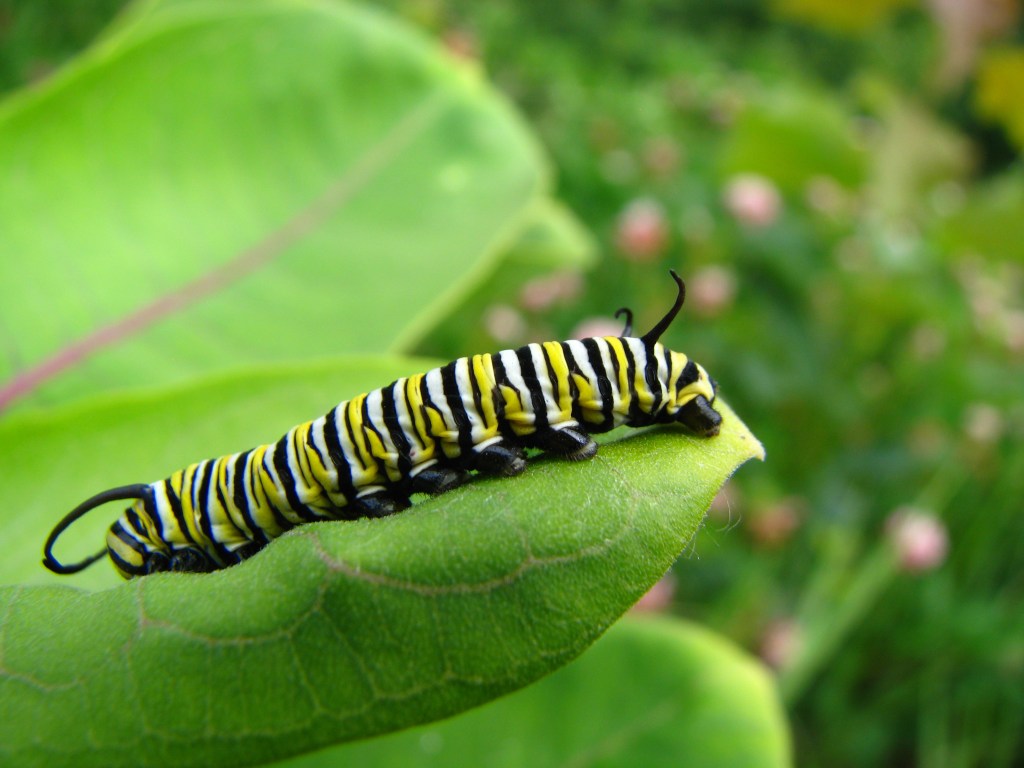
Last week was orchids, this week is Milkweed.
We’ve been leaving a little stand of Milkweed on the edge of one of our fields and it is a hotspot. We aren’t going to mow this section and let the insects do insect things. The Milkweed emerging from bushy flowering clovers makes for quite a hub of activity…ants all over the Milkweeds, insects feeding on the Milkweed stem, bees around the clovers. If you stare for a few seconds it looks like everything is moving.
Luckily, we were also able to find one of Nature’s most amazing migrators, the Monarch Butterfly .Sometimes I’m extra glad to have my macro camera with me, or I’d never have known how wrinkly these little guys are! Or that they have tiny hairs all over their feet.
Sometimes it is so easy to provide habitat for Nature’s most beautiful things, and it can be as easy as not mowing. Milkweed is, as far as identifying different plants go, a pretty easy one to spot. Their large stature and distinct leaf shape make them stand out. And if you look closely, the Milkweed is a home for many different things, not just our butterfly friends. Combined with grasses, clovers and other flowering plants, there’s quite a lot going on a small area. Nature has given us a little pollinator island, and all we had to do was avoid getting the mower out.
We are happy to have as many pollinators and wonderful things living around the farm. Every organism chips in and fills a role in nutrient cycling, pollinating or pest control.
Stay curious!
Graham
Next Wednesday, June 28th, I’ll be speaking at Pecha Kucha #47 in Winnipeg at The Park Theatre. The event starts at 8pm and admission is by donation.
Thanks for reading Complimentary Blueberry Juice -
Nature Comes Developed
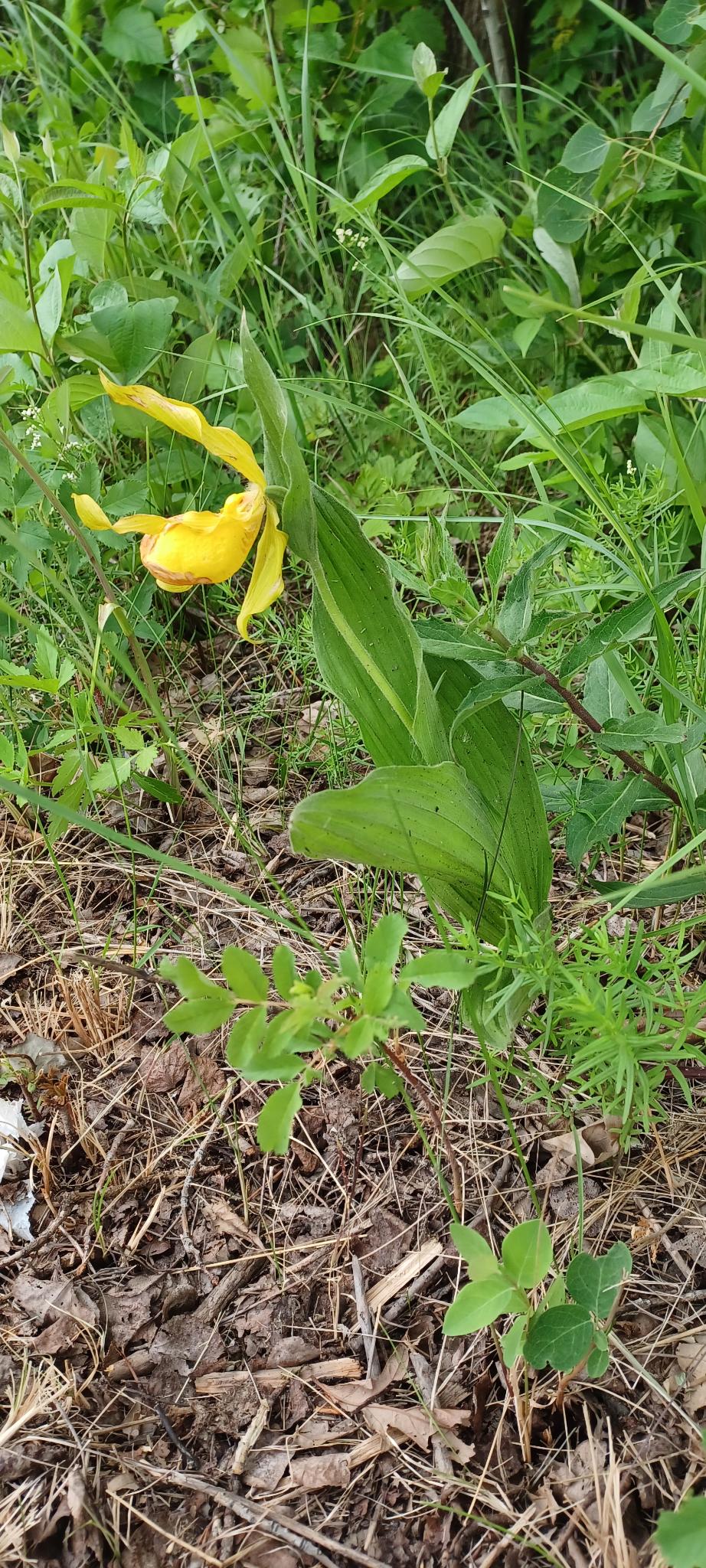
We’ve spotted a Yellow Lady Slipper orchid Cypripedium parviflorum in a ditch near the farm.
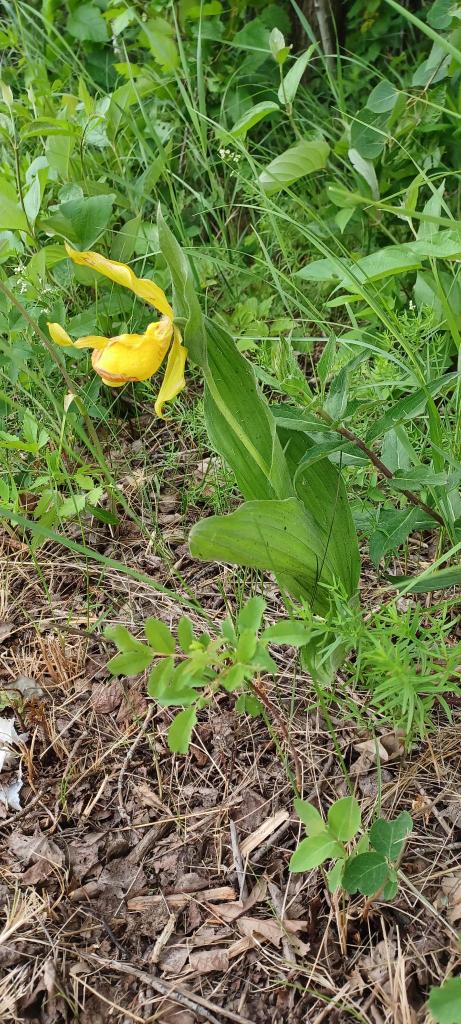
This beautiful flower lies a mere six inches (or 15 centimetres) from where the grass in the ditch is dutifully mowed by the neighbours.
I have always found the term “development” as it relates to urban planning or suburban expansion to be an ironic misnomer. The implication of the term is that “we” (humans) are “improving” the land, and making it somehow more “productive.”
Now I know the folks mowing this ditch a mere six inches (or 15 centimetres) from our beautiful Lady Slipper here do not intend to destroy it, this is just regular maintenance…mowing the ditch. The Lady Slipper is lucky this time, perhaps next time the mower gets it. But like with many other human activities we often don’t care to look or understand what is actually there. The ditch after all, is just sort of…wasted space, a crude substitute for what waterways were formally present to move (or retain) water.
Now that this landscape has been “improved” by “development,” there is no room for species diversity or even for Nature to take Her course. What we are imposing on the world around us – which we are from – is antithetical to development; it is regression. We literally prevent Nature from being her most productive self. By excavating, filling and mowing.
In learning to live with Nature and inspire Nature to do her best, we must embrace that which lives around us. Nature has her own aesthetic. It shifts and changes with seasons.
If you’re patient and lucky and curious enough, she may even bring you Orchids.
Graham -
What Do We Know About Water?

Overnight we received a decent amount of rain – about 24mm – which was a relief to all of us at the farm. We’ve been waiting for rain for a couple of our crops in particular and it had been weighing on us, with stress issues coming up that were difficult to keep on top of.
Now that this miraculous stuff fell from the sky overnight, it had me thinking about water. What do we really know about water?
What do we think we know about water?
A couple weeks ago I was listening to a podcast while in the field whose guest was challenging the idea that there are only three states of water. There’s the ones we know…solid, liquid, and gas. But is there a fourth?
While it might sound absurd at face value, it sounds absurd because it goes against something we believe to be true. There are people thinking really hard about water. And there are properties of water that these 3 states don’t fully explain.
Challenges like this are important and a good reminder that we are intellectual babies staring into the vast voids of knowledgeless-ness we have about the universe and about our own planet, about nature, and the interactions that define the world we live in. It is easy to fall into a mode of thinking in which everything around us is certain.
A quick look at science history (one of my favourite things) tells us we should always be ready for a scientific bombshell that completely changes how we think, and that it may involve something we take for granted.
The predominant understanding of how plants work goes something like they need some sort of chemical fertilizer…you know, Nitrogen and stuff…which is an idea from the 1800’s. Despite many advances since, how plants function has still a long way to go in terms of widespread understanding, and humanity remains stuck in the 1800’s. There were no high-powered microscopes, which came a hundred years later, and nobody knew what DNA looked like until Photo 51 was taken in 1952.
We now know that fungus and bacteria are integral parts of plants, the way micro-organisms live inside our human guts, and that the symbiosis between these things is crucial to understanding how they work. We can show more and more that nature is far more interconnected than we could have ever imagined, and the idea that plants require chemical fertilizers to grow will be relegated to a bygone era (hopefully sooner than later).
We didn’t understand the earth revolved around the sun until Copernicus in the 1500’s, and we didn’t know there were even other galaxies in the universe until just 99 years ago when Edwin Hubble figured it out in 1924, and today, we’re a flying solar-powered helicopter on Mars, which just made its 51st flight.
So…what do we think we know about water?
Maybe there’s more to learn.
Stay curious!
Graham
if you’d like to listen to the theoretical discussion of water, a key ingredient of Blueberry Juice, a link to that podcast is here…and if you enjoy reading this blog, it’d be really great if you might share some with someone you know would enjoy -
Staying Curious
When we are curious we begin to see things differently.
One of the most important things about working with nature is simply staying curious about it.
The last two weeks during rather extreme weather for our region I have been outside a lot, watching nature change from “just getting out of bed” to “sprinting at full speed.” An early heatwave and low precipitation have caused all sorts of issues for what is otherwise usually a season for “cool season vegetables.”
It’s hard not to have climate anxiety these days. Nature sends signals, and the signals are everywhere. They may not be words or beeps on a phone. It feels like most of the world isn’t interested in picking up on what nature is sending out.
But we live in a world where most, at least in North America, are extremely disconnected from nature and the very world we are not only a part of, but of which we come from.
I really don’t want to be too down about the weather situation, or about the climate, or these sorts of things.
All I need to do is walk back to the garden and take a look. Everywhere there are things happening! There are tiny bugs on the soil. There are spiders and frogs everywhere. There are ink caps popping up. There are all sorts of plants. The flycatchers came back yesterday.
As exciting as those things can be, what’s most noticeable is what isn’t working. Maybe a patch of bare ground with hard clay, and little growing there. The question I ask myself is; what action can I take to send a signal to nature that this is a good place for something to thrive?
Humans are great at being destructive. But this is zero-sum thinking. To heal the earth, we can choose another option: the synergistic returns of pursuing the designs of nature. It’s a hard option to choose if we see nature as inconvenient or messy.
If you’re up for it, go take a close look at something today.
Staying curious is a great way to engage with the natural world around us and makes us care a little more for all the things that live within it. Humans are but one species on this planet. We should get to know our many millions of friends a little bit better.
Home
About Graham
Graham is an ecologist-farmer from Canada working on educating about the wonders and beauty of the natural world, and how we can design biodiverse food production systems.

 Complimentary Blueberry Juice