-
2025 Season Goals & Grower Error
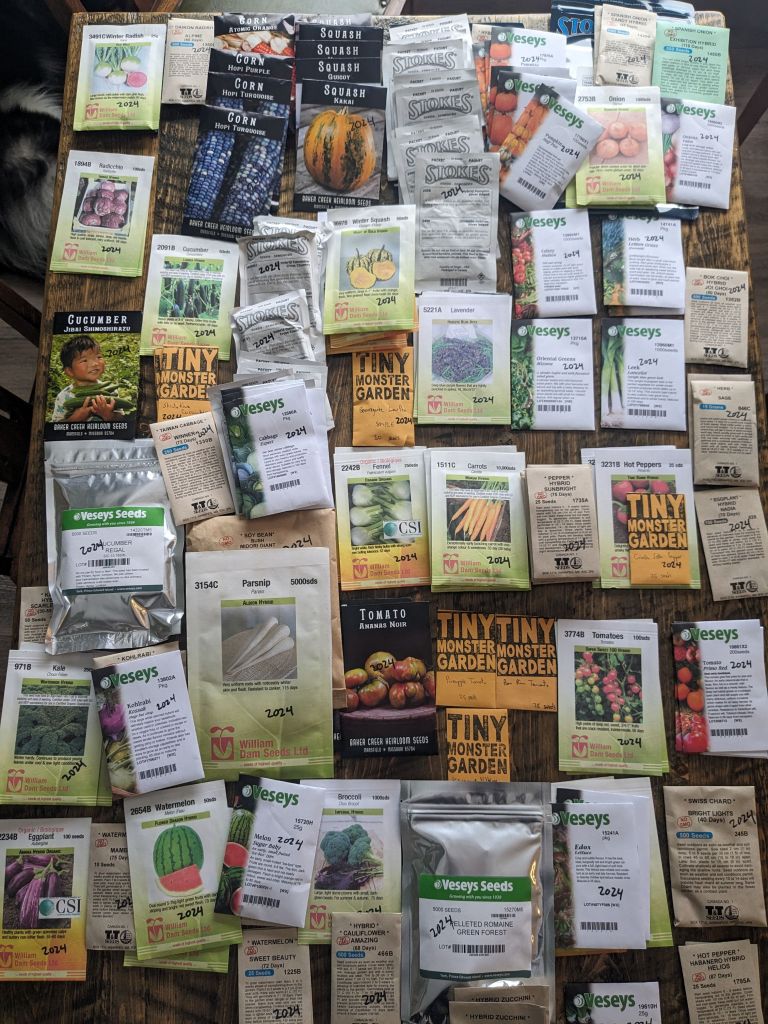
A new season awaits us, and as I always say, this is the best time of the year – nothing has gone wrong yet! While we peruse the seed catalogues (and always on the hunt for new sources of seeds) I am also taking the first two months of the year to study up and analyze all of the data from the previous season, rolling it all into an always-evolving best-practices model for the farm.
One thing always stands out among that analysis year-in-year-out: all our biggest problems are consistently grower error.
More than weather (by a longshot) the #1 thing that comes to haunt each growing season is probably my own fault.
The thing with weather is that it can affect you, sure, but more times than not you will end up harvesting that crop. Maybe later than expected, maybe smaller or lower yield than expected, but it’ll get there. The great thing about mother nature is the resilience inherently built into the system: living things want to survive and reproduce despite the odds.
But planting in thistles, planting too tight a spacing, forgetting to water, not addressing the plant’s biological needs, or thinking you can get away with not putting that row cover on, that’s all on me.
The only insurance against grower error is a combination of good note keeping, scientific method rigor, a cloudfull of documentation photographs, and the ability to try again and be sure not to repeat the mistakes that will lead to the same fate. Through good documentation you can also claim a soil crumb of control of the farm and try to solve large-scale issues that appear slowly and can only be solved by closely studying what is happening at an ecological level.
Of course Nature will always give you a new wall to run into and a new lesson to learn, regardless of how well prepared you go in. Slowly but surely the accumulated lessons mean that over time, we are succeeding at more than ever.
2024 was about taking a few steps forward and a few steps back at the same time. But in those backward steps were the most valuable lessons (we tried to save a lot of space in the greenhouse by direct-seeding and our squash had a really hard time in cool wet spring weather). So now going forward I’ll take dealing with greenhouse space issues over panicking (we still got a low-yield crop).
For 2025 I’m going to take a few varieties of things off my plate (seed catalogues are my candy store) to focus on doing less better, more methodically, and always putting past lessons to current planning.
Back to seed catalogues!
(If you have any favourite seed companies, let me know down in the comments)
Graham
thanks for reading complimentary blueberry juice -
Book Recommendation: A Sand County Almanac
‘Tis the season!
…reading season!
This is a great one from a naturalist, A Sand County Almanac by Aldo Leopold. Aldo’s prose and storytelling is the star here, with beautiful passages detailing the natural movements of animals through the seasons. It was published in 1949 and not only does it stand the test of time, it doubles as a historical account of both natural systems and the impact humans have of interacting with nature.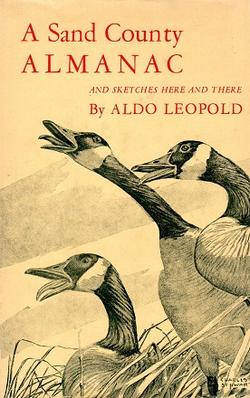
What really hits me the most are passages that seem almost unbelievable. Or at least, unbelievable in the sense that I cannot imagine the quantity of life to be true…and I figure I was able to grow up and live, and the farm exists in, somewhat of a peri-urban natural environment with plenty of nature surrounding. But accounts like these really hit it home that what we experience today, or see today, is a mere fraction of what 99.9% of humans preceding us were able to witness and be an integral part of.
Humans have an innate and re-occurring blind spot when it comes to the past and to history, even recent history. We tend to think that the way things are right now is what has always been, while also understanding that this is not the case. Every few generations have to re-learn everything all over again as what previous generations understood and fought for is promptly forgotten. It is impossible for us to imagine all the nature that has been destroyed and the species that have gone extinct. It is more heart-wrenching when you read examples like this:
“On 10 September 1877, two brothers, shooting Muskego Lake, bagged 210 blue-winged teal in one day.“
“In 1873 one Chicago firm received and marketed 25 000 Prairie Chickens. The Chicago trade collectively bought 600 000 at $3.25 per dozen.”
“What a thousand acres of Silphiums looked like when they tickled the bellies of the buffalo is a question never again to be answered, and perhaps not even asked.”
This plentifulness is gone, eroded by generations of over-exploitation, habitat destruction. It is possible to get it back, however we are not currently plotting that course. This is a choice we have made.
Leopold’s account of the Sand County is beautiful, poetic, and accompanied by some wonderful sketches. It is a must-read for anyone who considers nature and our environmental surroundings an essential piece of the human experience.
Graham
thanks for reading Complimentary Blueberry Juice -
On Canada’s Lax Pesticide Oversight
Many a time have I heard something along the lines of if it wasn’t safe, the government wouldn’t approve it.
There has been exposed a global lobbying and sabotage effort by chemical companies to ensure the continued flow of their products and profits which I wrote about this past fall. But this issue keeps gathering evidence, and it seems to be happening at a quicker pace after decades of being in the dark.
This week I would like to bring your attention to some excellent journalistic work being done here in Canada by journalist Max Fawcett-Atkinson at the independent outlet National Observer. Fawcett-Atkinson has for several months now been slowly detailing just how much of an effect lobbyists for the chemical companies have on the Canadian government, even to the point of collusion with the chemical companies to continue the use of their products, leading to approvals of chemicals that are already banned elsewhere on the planet for good reason.
This past week, Fawcett-Atkinson published a new piece on total lack of rigour in the regulatory process regarding the class of pesticides known as neonecitinoids. For anyone interested in this topic, I highly suggest following Max’s work at the National Observer (and if you want to support this kind of independent journalism, they are having a great deal on subscriptions right now).As a grower going into seed catalog season and as someone who is about to start ordering a large quantity of seeds for the 2025 season, there are still companies operating in Canada who sell seeds which are themselves coated in neonicotinoids. This is a very common practice of applying pesticides or fungicides to seeds, supposedly a prophylactic strategy to prevent whatever plagues on your crops in advance (but then you have to spray more later anyway!) and again for those interested, buying vegetables in the store, may have been grown with seeds coated in this kind of stuff. With all the information coming out regarding the importance of microbiomes in seeds and their ability to affect epigenetics, it is the opinion of the author of this here blog that putting any chemical on a seed is an overall net negative for plant health and an idea that goes contrary to the fundamental nature of the seed.
It is not uncommon for chemicals that have been banned in certain places in the world to be sold to others, where their effects on the human body are well-known, while the chemical company rakes in billions of dollars in sales and continues to deny any adverse health effects. A farmer in Brazil was recently featured in The Guardian having been poisoined by a weedkiller. “All of the right side of my body was paralysed. I couldn’t feel my foot and my hand. My mouth twisted to the right,” he says.”
There is a long lineage of brave people from Rachel Carson onward who have continuously warned against the widespread and wanton use of these chemicals and their unintended consequential effects on not only the environment, but on human physiology, even in the parts per billion. As we see with our regulatory institutions or lack of regulations, it is business as usual. This is unfortunately the era of history we currently live in. The hypocrisy really comes out when there are comparatively benign biologically-based products that are held up in the regulatory process and that farmers across Canada are currently unable to access.
As in my last post…life happens on the molecular level. We are introducing these synthetic compounds at an absurd rate into our surroundings, which we ultimately end up ingesting. Our bodies have no way of dealing with these alien lab creations, no way to defend against them, and no way to break them down into inoffensive components.
The way forward is not to dig our heels in and make sure business as usual continues. But if that is the case for now, we are hurting our agricultural sector in the long term by not incentivizing and educating our agricultural sector on how to move away from these chemicals.
Agricultural history is full of innovators over millennia. Regulating in favour of reducing innovation and fostering reliance is a strategy sure to leave our agricultural sector playing catch-up.
Graham
thanks for reading Complimentary Blueberry Juice -
The World Happens On The Molecular
The five senses: sight, sound, smell, taste, and touch. These are the ways in which humans perceive the world.
We can further single out sight as a sense that likely does more to influence us over all the others. If we can’t see it, we don’t believe it. Or we do see it, and refuse to believe it.
This paper in Nature about how trees produce isoprene (the building block of rubber) which may act as a precursor to cloud formation is an example of something we can’t even perceive at all.
But it is always worth keeping in mind that our senses are detecting the molecular. Smell is volatile organic compounds at a molecular level, taste is organic compounds at a molecular level, and touch is also occurring at a molecular level.
It is always worth remembering that all processes happen at the molecular level. We cannot see them. The implications of our “molecular blindness” are everywhere in our modern society….from our collective denial that chemicals affect us to our collective denial that some atmospheric gases are more consequential than others.
The more beautiful and contemplative implications are in examining the life around us: how, exactly, does a plant root encounter water, embedded in a clay platelet? What signals are passed from a single-celled soil organism to a plant? How do single-celled organisms embed themselves in plant tissue? What compounds make plants respond, the way high fat or high sugar foods make a human respond? Why does a potato beetle think a potato leaf is tasty? What are cabbage butterflies paying attention to that make everything in the cabbage family a landing site?
Every interaction at every point is a molecular one.
Everything has evolved to heighten or ignore certain molecular signals for interpretation.
Graham
thanks for reading complimentary blueberry juice -
Finality of Winter
Each season there is a point at which you can no longer do field work. That day has come and passed, and with it, the 2024 season is over.

Humans do many things that are not tied to seasons, or seasonal changes. In my opinion there is great value in tying our actions to seasons and natural rhythms. Moving with the changes really makes one feel in sync. We do not live separated from the physical realities of the changes our planet goes through and the cycles of life that change around those physical realities, even if we as humans have created things that appear to exist outside or above these realities, such as jobs, stock markets, or “commerce.”
I feel these changes most distinctly immediately after and immediately before the winter dormancy. In the spring when the first photosynthetic plants return from dormancy, and when the first snow falls.
Winter arriving has a finality to it that is very stark.
Maybe the bears have it figured out best….it’s time to sleep. Wake me up in a few months.
For me though, it’s reading season.
Graham
thanks for reading Complimentary Blueberry Juice -
Lettuce in November
This season I planned an 8th crop of lettuce, anticipating having built our greenhouse already. When it became clear we were not going to be able to build the greenhouse until fall time, I decided to go ahead with the crop anyway, and plant as if. My thinking at the time was to see how late we could grow lettuce, and just how slowly it would grow, and how much more time it would need in the cooler temps and dwindling light. The second-order benefit would be that if we needed to adjust the seeding or transplanting dates, we would know that now, instead of later.
So I planted it anyway, and this is what it looks like as of November 12th, in Zone 4: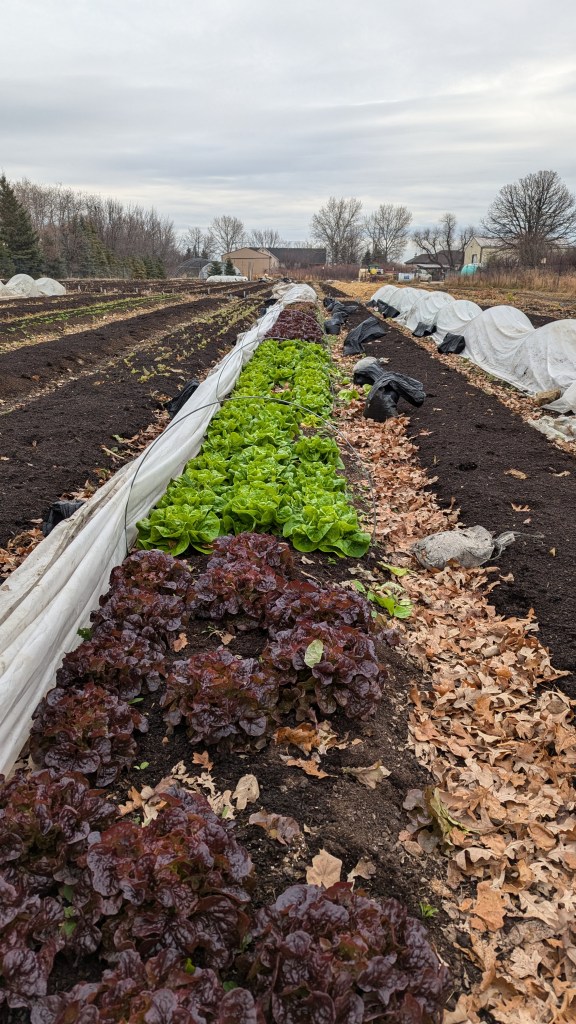
That’s pretty phenomenal!
Not only that, the quality of the lettuce is amazing. It is similar to spring lettuce, there’s just a little extra greatness in lettuce grown in cool shoulder seasons.
The really surprising thing was not that we got the seeding and planting date right and we won’t need to adjust it much, the surprising thing was that our lettuce has survived -6C nights absolutely no problem under the row covers. This is a really valuable unexpected find. The implication is that we know when we do build the greenhouse, we won’t have to worry about heating it all that much, perhaps just to -4C or so.
This bed had everything it needed to succeed: it had a fresh compost mulch, it was planted at the right time and irrigated, it was fully weeded, and the row covers went on early. We don’t always hit all those points, and it really shows when we do (and also it shows when we don’t!)
For next year, we can rotate this bed with carrots, or perhaps for leeks. Having a 3rd crop on a bed in a season is really great for loosening soil, and having this bed go this late into the season will be even better. All the root structures will disappear after the hard winter frost, and all that microbiology will be present to start the spring. We’ll have to wait and see which bed is best for Leeks (which need the loosest soil we have to plant as deep as possible) but this November lettuce bed is a top contender.
Stay curious!
Graham
thanks for reading Complimentary Blueberry Juice -
Making Better Compost
For years, I just made lazy compost. I put stuff in a pile, sometimes it would heat up, sometimes it wouldn’t. And after years, I still have yet to harvest any reasonable amount of compost. The piles go bad, I abandon them, and they end up as waste I have to deal with in the springtime.
This season I decided to take all the lessons I thought I learned and apply them. The truth was that compost was not seen as a critical part of our operation, so it got little attention and minimal improvement over the years. If I was too lazy to turn a pile or maintain it, or water it, then it had to be something easy to use and also able to keep up with the volume of waste the farm generates. The answer was definitely worms.
I decided to finally start a Version 1 of a large worm compost bin, about 6 feet long, two feet high and two feet wide. Initially I thought it would end like the rest of my half-effort compost experiments.
But this year, voila….very nice, beautiful compost. I sifted 600 litres out of the worm bin and will be storing it above 0C for the winter.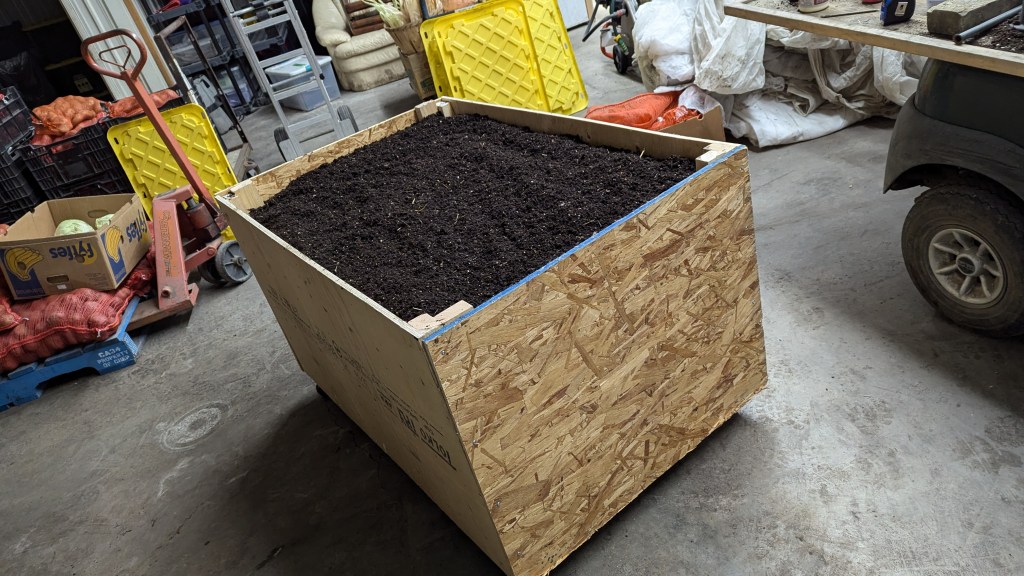
Not only did I get a cool 600L, but almost no waste went to the “backup” pile which was last year’s failure pile (I have also made improvements to that and will allow it to continue).
The trick was to keep everything close, simple and streamlined, with a schedule: every Sunday afternoon I dealt with all the farm waste that was accumulated that week. I dumped it in the worm bin, watered it, and left a layer of leaves on top.
When the bin finally got full, I first utilized black plastic compost bins, the kind you can likely get from a City composting program. After the worms went through more, the next week I would fill it up again.
It took me an entire day to sift it, but the result was fantastic, fluffy, spongy compost, full of all kinds of stuff, including largely leaves as my carbon source. There were also so many worms they were uncountable. I started in springtime with a small handfull.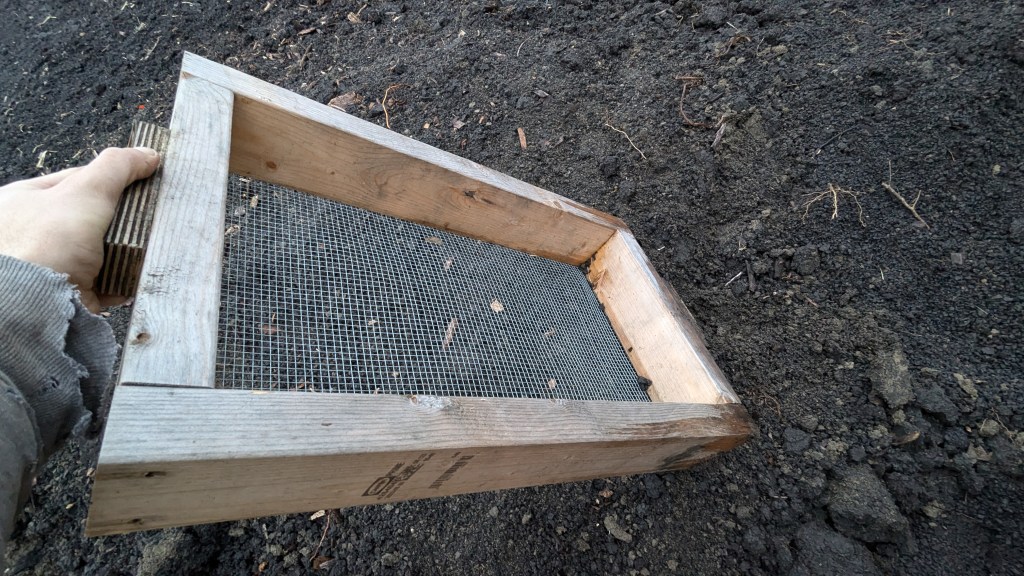
I paid a lot more attention to what was going into the worm bin this time, including making sure there was plenty of carbon source material, in this case, leaves, which would add a lot of carbon and minerals to the mix. Occasionally things with our parent clay material on them went in as well, and just about every vegetable we farm here. The finished stuff with stay above 0C all winter such that it can continue breaking down as much as possible before next season.
So what to do with 600L of worm compost?
For this first year, I think it will be strictly for greenhouse use in the springtime. Greenhouse soil mixes are tricky because they are soil-less, and come with no available nutrients (unless they’re added into the bag). So for us, we’ve been adding our compost mulch into the mix, and that’s about it. We have fairly good results with this method, but each year there are minor issues here or there. Having this worm compost included in the mix will give the seeds instant microbiology inoculation, and also have access to a very wide range of plant-available nutrients.
The second application might be to learn how to make our own compost extracts for foliar applications. But I think I need to get a bit better at this before a compost is good enough that we can effectively use it as a compost extract.
Next year I’ll start off with a lot more worms and food sources, and continue with the leaves. I might even expand the bin in the hopes of getting more, and eventually have enough surplus that we can begin an ageing pile for extract use.
This was a great improvement this year and there’s still lots of room to get better at it. Can’t wait to see how this affects our seedlings in the greenhouse next season.
Graham
thanks for reading complimentary blueberry juice -
Our First Cover Crop: Fall Treatment
In the last update the cover crop was alive and looking really pretty (previous posts are here). A lot has happened since then! We have finalized our treatment strategy and we’ve now completed it, so that’s what this post is about.
A late rain helped the cover crop go strong into September, and the thick growth helped shade all that moisture. Even now, after almost no rain for the past two months, the ground underneath this cover crop is soft and damp, and you can easily put a shovel into it. It does not at all feel like rock-hard clay in the fields next door.
A few days after the first real frost and the warm-season plants in the mix died off, with the hardier plants in the mix staying green in the understory. It was quite pretty in this stage too. It was really nice walking through the field, and seeing all the birds that had come to call the field home. We even had a well-worn deer path right through the field.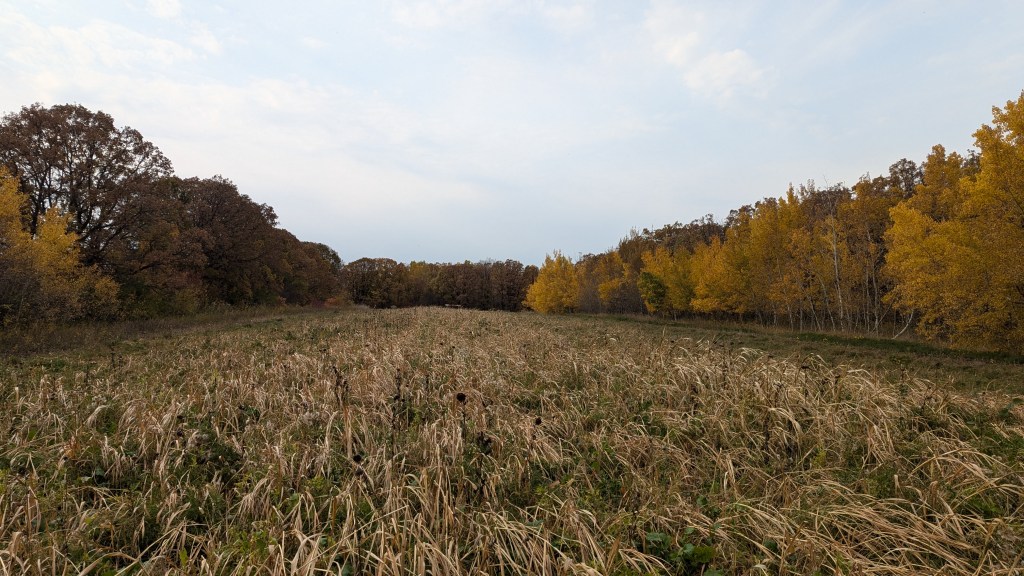
This photo is from mid-September, so the next step for us was to shred this field. We waited and waited to shred as so many plants in the understory were still alive and functioning, it seemed like a waste to kill off that active plant and allow all its hard work to oxidize.
A bunch more frosts later and about a few days ago on October 25th we shredded it right down to the stalk, leaving the roots intact in the ground.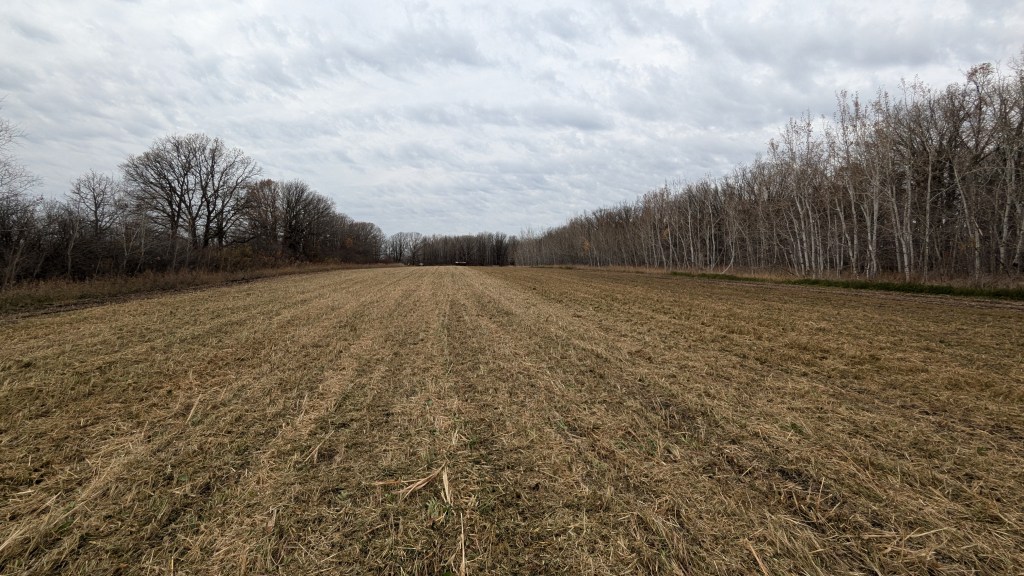
It left behind a really nice blanket of shredded plant matter over the soil.
For our strategic purposes now, we can only use a lane about 50 feet wide right down the centre of the field. This is due to the issues caused by the Poplars and Aspens on the north side sending runners. Some of them were even popping up in the middle of the field. We noticed this as the cover crop started growing in back in August. This is a big limitation for our trial, but we still have a lane in which to conduct a good trial, as well as highlighting a much-needed job of cutting the tree roots for good.
We will do a Potato trial here next season.
To prep for that, we need to address a couple big issues facing our soil.Generally speaking across the entire farm, we have high Magnesium clay-based soil. We’ve been having issues with things like thistles, compaction, tight soils, and crusts on our unprotected soil surfaces which in the worst case scenario, prevent seeds from germinating. In simplistic terms, this high Magnesium binds up any Calcium lying around. This isn’t ideal as Calcium is incredibly important for plant cell development and structure. In other trials we’ve run this season to confirm our suspicions about what is causing poor early growth and a host of other issues, where we have supplied Calcium and Sulfur it has worked almost like magic. The great thing about an element like Calcium is that it is relatively easy to obtain and these things are not synthetically produced, ie it is not a chemical fertilizer. Adding Calcium to our clay soils should boost plant productivity by a noticeable margin.
The other issues facing our soil are more on the biological side: lacking the organic building blocks that will help microbial soil life. In theory, we have begun a good population of microbes in this cover crop, which was one of the reasons for installing the cover crop. But we can always add more.
We put together a mix of Calcium and Humates with the help of a new farm advisor we are working with, as well as a high-quality compost extract from a friend of the farm’s helping out with this trial.
Today, we made the application.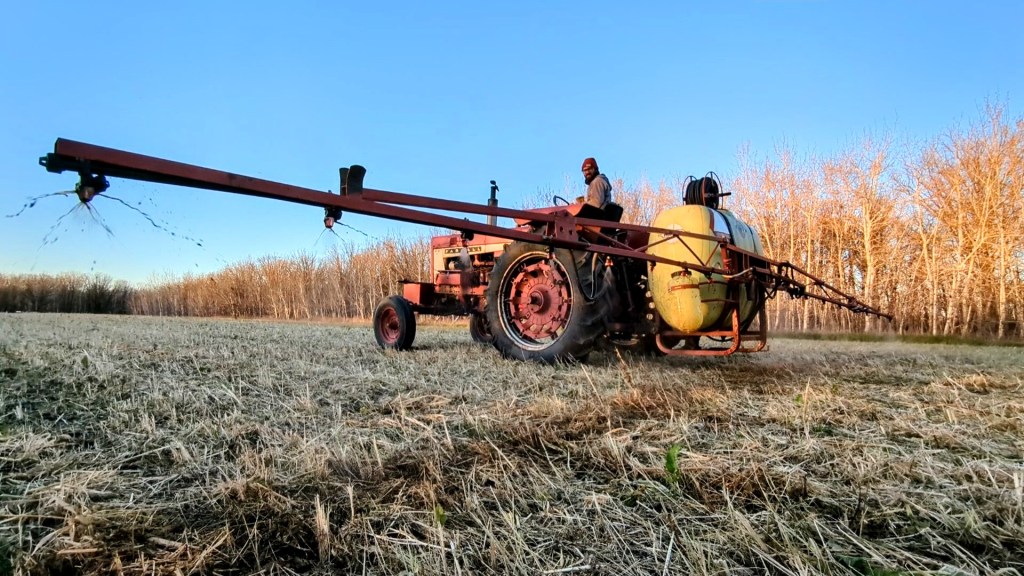
I’ve gotta say, making a compost-extract-with-Calcium application like this was really, really fun.
Adding to nature feels very different than limiting nature.
As humans we always have a choice: to fight and control nature through brute force, machines and chemicals. There is an alternative: to provide nature with more, to add to nature, to seek to pull the many levers nature has, and to help nature succeed at a higher level. We have the tools and the knowledge, and nothing is lost by trying something new.We will be excited to see the results next season.
Graham
thanks for reading Complimentary Blueberry Juice -
Consolidating Space, Building New Strategies
After each season over the past few years I reach the same conclusion: that the farm area is too large and we need to be more efficient with our space usage. Why manage a 20 acre area when you could manage 10? When a new season starts fresh this conclusion seems to be forgotten. Maybe it just needed repeated attempts, but it seems like at long last we will be able to start the 2025 season with much less than the previous year and take a lot of stress off our shoulders.
Within the next week or two, we will have our no-till beds completed: all 60 of them.
We have been running the no-till experimental area for several years but have never been able to utilize the field to its full potential for many reasons…either we didn’t know what we were doing and making learning curve mistakes, or biting off more than we could chew, not understanding what was happening with soil or plant nutrition, learning how to grow unfamiliar crops, or outright failing and having large areas that were unproductive and overrun with weeds. What we would do is move things out into the field, where they would suffer other fates of negligence.
This growing management strategy of expanding whack-a-mole (or…whack-a-thistle) leads to a lot of headaches between lost resources, failed crops, and a lot of wasted time trying to save a crop that has a slim chance of success. If we had a better strategy and were more prepared, we wouldn’t be spending time trying to be crop heroes, instead we would be harvesting the fruits of our labour.
We’ve learned enough lessons and came a long enough way that we will finally, for the first time, attempt a 60-bed field. That’s about 1500 square metres of growing area, fit into a deer fence that surrounds 1 acre. We’re ready to try going at full capacity. The conversion to 100 foot beds was a great decision and it was worth the growing pain this year (more on that in a future post). The crops we kicked out to the field will be back where they belong, and we’ve gotten super good at rotating and replanting beds with fast growing times of 30-50 days.
But the reward isn’t just in running no-till beds at full capacity, this also greatly helps our field management. We can consolidate field crops as well and between the two, save some 30% or 40 % of field space. Without whack-a-mole, we can keep empty areas clean and tidy until we are prepared for (and the timing is right) to plant a cover crop.
This all means we can improve our plant nutrition and soil biology strategies across the board. Each bed can be addressed separately for what it needs, and all field spaces can be addressed for what they need as well. In beds, it might mean we need to broadfork some compaction or put down a new layer of mulch. In the field it might mean applying Calcium to balance our high Magnesium, getting ready to plant a cover crop, or taking a thistle-infested acre out of production to deal with it.
Nothing on the farm is uniform. Every chunk of a field or a bed is in various states of improving or declining, and it’s much easier to address things in small areas for their specific needs than a general strategy that applies to everything.
What I’m most looking forward to is enjoying working on a project where less done better leads to phenomenal results. Mentally I think, it will be a lot lighter and more positive. The opposite of this is grinding for months on end, and burning out.
Long-term planning and short-term goal setting works.
It might have taken us a few years, but we’re getting there.
Graham
thanks for reading Complimentary Blueberry Juice -
Building A Three-Season Greenhouse
It has been a few years since we began down a path that would lead us to a new greenhouse. As a full-time occupation, it became clear to us as Market Gardeners that the single item we were most sorely missing on the farm was a 3-season hoop-house-style greenhouse. We have a small greenhouse which is only set up for germinating and caring for seedlings, as well as curing garlic, onions and squashes. A 3-season greenhouse built directly over the topsoil allowing springtime produce availability and end-of-season extension would be a game-changer.
First we spent a year chasing a lot of fantasies…if you’re going to build a greenhouse why not go all-out! These fantasies of 4-season growing or solar panels for extra heating were awesome and very cool in their defense, but the ROI just wasn’t there. The further you want to extend your season in these climates, the more diminishing the returns are…not only from a business standpoint, but a growing one too: the colder it gets, the less light there is, and things take a lot longer to grow.
In the end we opted for the most simple design: a simple greenhouse with double poly built directly over the ground. The only feature we chose to include is an 18″ wall below ground with insulation to act as a frost barrier.
I will skip the most frustrating part (“public process” and “planning”) and go right to the moment of breaking ground just a couple days ago!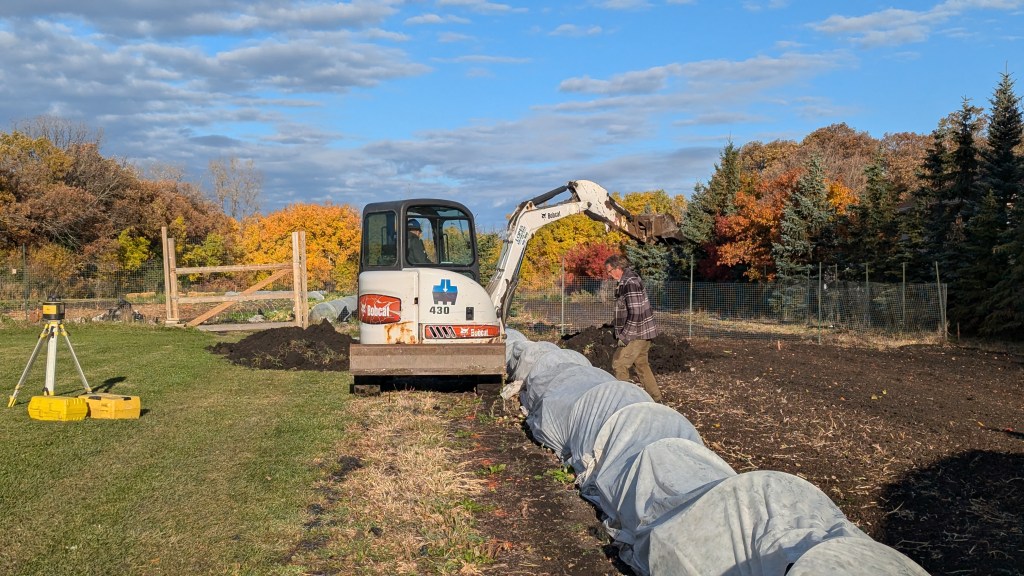
A small backhoe and laser level got us down to an incredibly even 18″ exactly below the surface. We applied gravel to the bottom and began building the wall/frost barrier.

After the wall is built, we will level the topsoil in the greenhouse (it slopes off to the north).
We will be able to start the 2025 growing season with a little extra oomf! We’ll see how that goes, as greenhosue growing will be all new to us, so I’m sure we’ll make plenty of mistakes along the way.
We only added irrigation to the property in 2019, and now we can’t imagine that we were able to farm at this scale without it. And with this new greenhouse, I’m sure we’ll look back and wonder why we didn’t build one sooner.
It feels really good to add this crucial piece of infrastructure to the farm.
Graham
thanks for reading Complimentary Blueberry Juice
Home
About Graham
Graham is an ecologist-farmer from Canada working on educating about the wonders and beauty of the natural world, and how we can design biodiverse food production systems.

 Complimentary Blueberry Juice