-
And Suddenly, It All Made Sense
A beginner beekeeper is going to make some mistakes. This first-timer made one about four weeks ago and, instead of catching the mistake and correcting for it, it took sheer luck for the light bulb to go on.
At the end of August was when the nectar stopped flowing. After all that time learning how to manage a busy hive during the honey season, it was time for a whole new learning curve: preparing the hive for winter. I took the last of the honey supers off, it was time to start feeding and treating for mites. So I did that.
Ten days later it was time for the second mite treatment, so I checked the hive. Nearly all the frames were full of nectar/sugar. There was very little in the way of eggs, brood or larvae going on. What I did see where capped queen cells, which surprised me, (still in honey-season-mode I suppose) and so I removed them all, thinking that I had made a beginners mistake and over-fed them, filling the brood nest and triggering a swarm response.
After the second mite treatment,(another ten days later) I checked again. This time even less brood than the first time, and even more nectar from the sugarwater feed. What was interesting at this point was my other hive: it was perfectly set up for winter with a slowly-shrinking brood nest, and I could even see freshly laid eggs. This hive was still going strong and building a nice group of winter bees.
I made the assessment that my hive had simply gone queenless…I thought, well, maybe it will make it through winter, maybe it won’t. I also made the assessment that even if it didn’t make it, I still had one good hive, which I could split in spring and be back at 2 hives again without much issue.
After the third mite treatment (another ten days later), I shook the bees off the top lid. They sat on the ground and wandered around sort of aimless. I checked my 2nd hive, and when I shook the bees off the lid, they marched immediately back into the hive.
Hmm….it must be queenless, I assessed again.
…but then one day I was checking a small tree I had planted, and happened to look over at my mystery hive.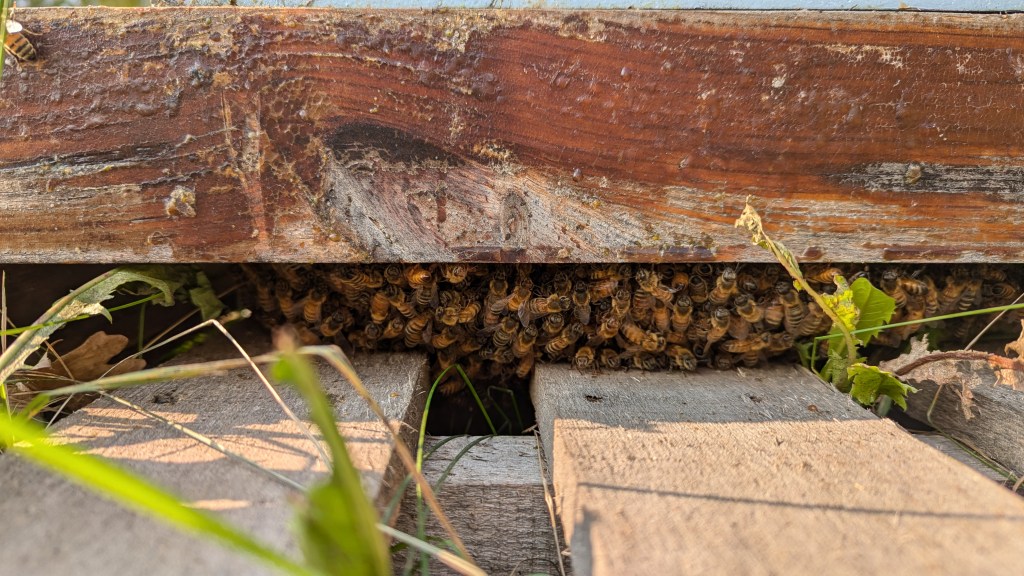
There was a massive cluster of thousands of bees underneath the hive!
My queen! My queen!
Everything clicked, and everything instantly made sense:
1) I did not over-feed the bees! There wasn’t a queen laying eggs, so the workers simply filled the empty space with the feed.
2) The queen cells I saw were not a swarming impulse, the bees were trying to make an emergency queen with the limited amount of brood remaining.
3) There is a cluster there because there is a queen there, emitting pheromones. There is no reason for a random cluster of bees underneath a hive. This also explains the aimless bees shaken from the lid.
4) Conclusion: I must have unwittingly shaken the queen from a frame during a post-honey season inspection and she did not find her way back into the hive. She missed, and went underneath instead.
The next day me and my cousin tipped the hive back to reveal just how significant of a cluster this all was. There are three sort of “ridges” in the cluster that you can clearly see, which are new honeycombs the cluster is constructing.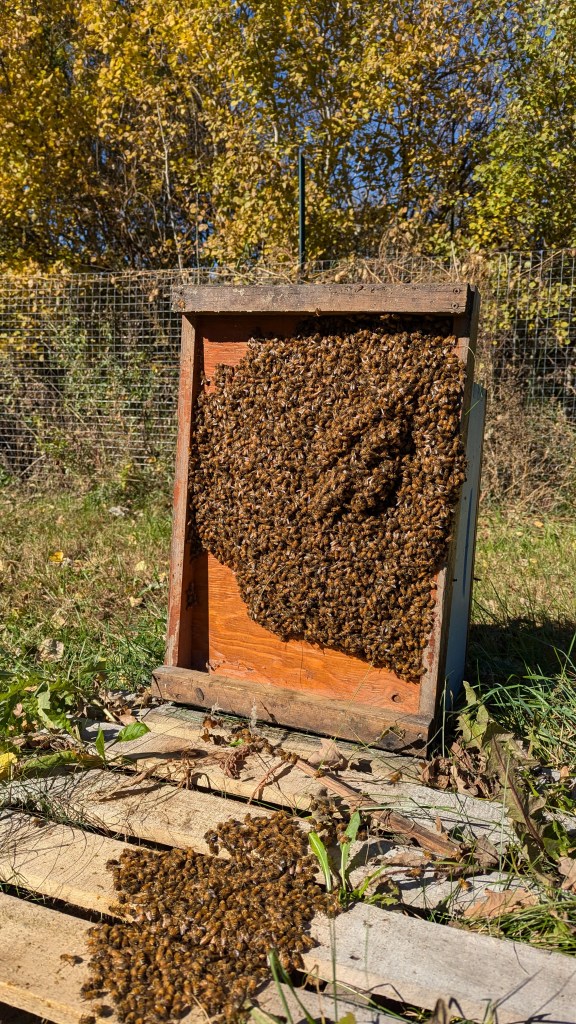
We figured she was likely to be in, on, or around those new combs. We peeled them off one by one, and there she was. She’s the big beauty with the smudged green dot in the centre.
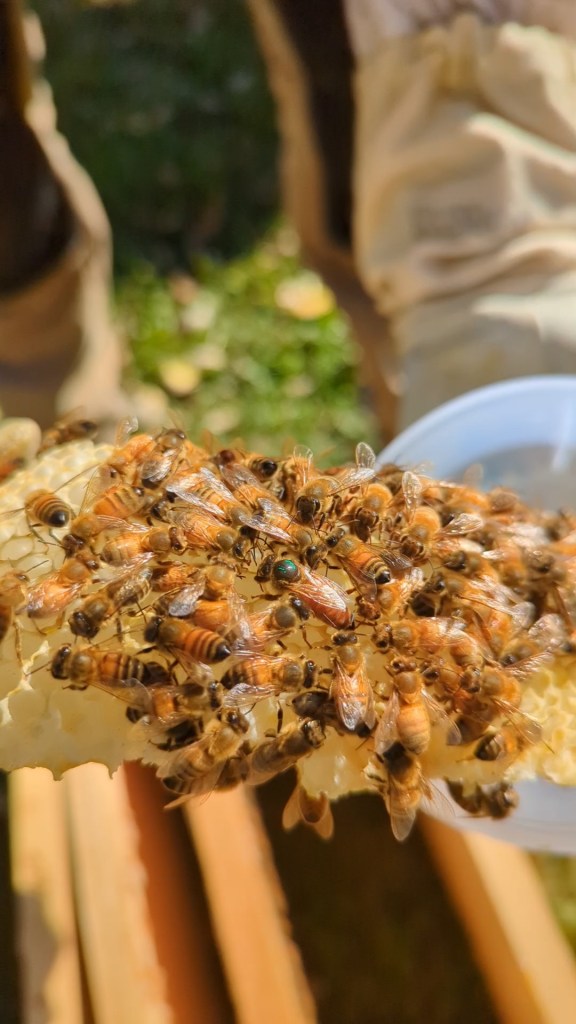
Back into the hive she goes!
We removed 3 frames of plugged nectar and put in 3 empty frames in the hopes it isn’t too late for her to lay a last-chance round of eggs and build a solid winter nest. It’s a bit last-minute, but we have way above seasonal average temperatures now, so maybe it’s not too late.
This was 100% due to my inexperience.
If I had been more experienced, the thing that would have tipped me off was the emergency queen cells. It is far too late in the season for swarming…there is little to no chance that a queen could successfully mate in mid-September. The other aspect here is that a large majority of the queen cells were on the sides of the frames, not on the bottom. That should have been the big red flag that there was a queen issue, and that is the moment I should have investigated further.
Even before that, I think an experienced beekeeper would have realized the brood nest was shrinking way too fast in August, and may have caught the queen issue even before there were emergency queen cells.
With these things there is only learning through experience, and now I have a lot more.
Just hoping my missing queen can lay a very late round of eggs and build up a solid winter nest. And then…there will be a whole new learning curve for my first year of beekeeping: getting them through winter.
Stay curious!
Graham
thanks for reading Complimentary Blueberry Juice -
Science Will Win
Back in January I wrote a piece detailing the absurd reliance and insistence on widespread chemical usage in agriculture.
There is something I would like to draw attention to: a stunning collaborative journalism piece titled “Revealed: the US government-funded ‘private social network’ attacking pesticide critics“ exposing the lengths to which the chemical industry will go to discredit other lines of thought or inquiry shines light on an important piece of the industrial agricultural model: the obscene power behind agricultural market forces. It is a big win for consumers, farmers, and science that this work was published and the realities of the active attacks from chemical industries on other ways of pursuing agriculture or science have been exposed to the light.
The history of science is a hobby topic of mine, and there is something remarkable about how many times throughout history society has actively fought against accepting a new truth. Each time, science prevails. Society at large in 2024 does not believe the earth is in the centre of the universe…no matter how hard the church tried to suppress it in the 16th century. Nor do we widely all agree that we have to let our blood out to cure tuberculosis, common practice through the 19th century.
We now live in an age where hundreds of billions of dollars are all it takes to influence public policy and stymie scientific research. In other words…the dollar has replaced the church as the power centre of our time.
There are many legitimate lines of scientific inquiry into how plants work, and how plant intelligence reacts to different stimuli. While these efforts are slowed significantly by the chemical lobby as shown in the journalism, they will not be stopped.
This line of scientific inquiry can be traced quite a ways back, but it begins to get really interesting with Charles Darwin, who published many thoughts and questions to be explored further with regard to plants and plant behaviour. His final book was on earthworms…an organism with profound effects that are conspicuously absent from modern chemical agricultural systems.
I am stunned by how, when I look at my first university Botany textbook from the mid-2000’s, how much knowledge of plants has leapt forward. It seems so simple and chemical in retrospect. Science is beginning to catch up to what many wise sages scattered throughout the ages have known: that plants are biological organisms and exist in a symbiotic fashion with the ecology that immediately surrounds them. More and more evidence comes out – at a faster and faster pace – that plants are actively creating and sustaining these symbiosis via the products of photosynthesis. The textbooks are being continuously re-written at this important and fascinating period of time. Big discoveries and insights are inevitable.
It would be very inconvenient for the chemical industry to be upturned by knowledge that changes the way we see plants…all plants, but especially the ones we consume.
For the sake of our planet and our species, the sooner we come to terms with the fact that we are the only known lifeboat in the entire universe, the sooner we can begin to repair the damage we have done. The first step is to highly regulate and legislate these chemicals out of existence.
There will come a time when humans will think of applying synthetic chemicals to plants as absurd as the idea of purposely leaking blood to cure turberculosis.
In my opinion, that time cannot come soon enough.
Graham
thanks for reading Complimentary Blueberry Juice -
Our First Cover Crop: 60-Day Update
It’s now been two months since we installed our first cover crop and the sunflowers started blooming. What a pretty sight!
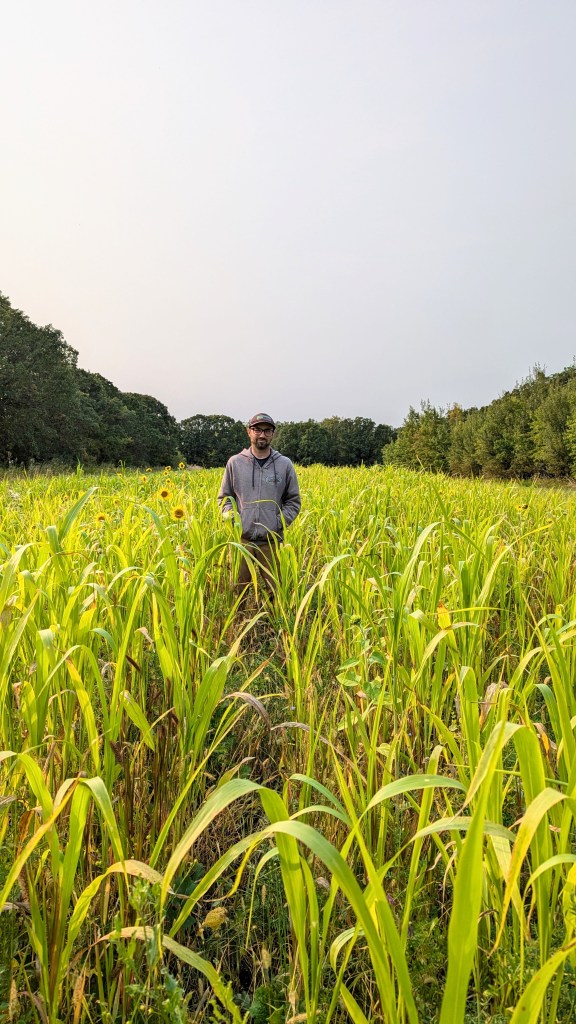
The previous posts are here if you want to recap.
It has grown in quite thick and there’s lots of things going on in the understory, the sorghum is easily over a meter tall and every step taken in this field reveals a flurry of sparrows and birds feeding amongst the plants. It’s quite the exciting space!
We are pretty sure at this point that we will not be using this field for bed expansion…it’s just too much for us this fall to deal with expanding the irrigation and installing what would be a much-needed deer fence.
Instead, we will likely run a potato trial next year. That will involve shredding this field, applying a microbial inoculant to the above-ground plant material, and shallow roto-tilling this in to the top few inches. This will hopefully create a rich topsoil layer that the potatoes can take full advantage of next season.
We have wanted to move to cover cropping prior to potatoes for a long time now, and while we didn’t get as many cover crops installed as we wanted, this does seem like the best opportunity to run a small scale trial while we plan out our field usage for next season (and include cover crops in said plan).
We will also likely wait till the first frost prior to shredding, as we want to take advantage of all the sunlight capture that we can.
As for what the exact application will be, we’ll have to finalize that, and probably by the next update on this ongoing trial we will be able to share more, and follow this trial into next year to see what the results are.
New things ahead are always exciting!
Stay curious.
Graham
thanks for reading Complimentary Blueberry Juice -
The Final Fall Push
Here we are, arriving in September, and now we get the final push of our short 120-day growing season in Zone 4. There’s a bit of tension from switching from the insane go-all-the-time mode of June/July/August. There’s nothing left to plant. All that’s left is to collect….and prep for Spring 2025.
But even in Zone 4, yesterday, September 3rd marked my final transplant for the season. It’s a bit of a Hail Mary to plant Lettuce in Winnipeg on September 3rd. There’s no guarantee…however, if we have a nice fall, and we’re prepared, we just might have lettuce to last us through all of October.
This was a learned skill over several years discovering what was possible in a zero-till bed system. The late transplant was also a trial for timing in our new greenhouse (which has yet to be built), so we can learn the timing of what is possible. We’ve just never tried it this late before. In the absence of the new greenhouse, these newly transplanted lettuce seedlings will be under a cover for the entire duration of their post-transplant life and we’ll see how far they can get.
Fall rotation is tricky in Zone 4, mostly because the pleasant daily weather experienced by the human does not line up with the number of daylight hours available to a photosynthetic autotroph. Sunlight decreasing daily means the average days-to-maturity for each crop increases, and cellular metabolism slows down with decreased average high daytime and lower overnight temperatures . We’ve learned many a hard lesson over the years about getting crops established prior to September!
Mostly we’ve learned a lot about timing and such, and this year, I’m pretty excited about the fall greens availability. We will have lettuce for some time, as well as Arugula, Mizuna, Garland, Spinach, Bok Choy, Napa, Kale, Beets, and Green Onions, as well as a Black Radish and Radicchio trial.
The thing we have learned more than anything else is the value of row covers in an intense market garden permanent bed setting. Deploying this tool in a timely fashion and way ahead of time is a key tool in this sort of fast-rotation and season-extending context….all based around sunlight availability.
Covered above is the arugula, mizuna and bok choy. Yet-to-be-covered in this photo is two beds of lettuce.
So while the mood of the season has switched fully into harvest mode, there are still a thing or two on the leading edge of learning and possibility. Whether or not we can achieve those crops is entirely a matter of learning when the absolute last window is. And learning that is only possible by trying to do it.
We’ve learned you must seed Spinach – a 35 day crop – before August 1st, to achieve a Spinach crop that will not only produce 45 days later, but be able to regenerate once at 60+ days later. Likewise we’ve learned you must seed Napa Cabbage – a 55 day crop – by first week of July, to have it by mid-September….75 days later.
These things are only learned by trial and error in one’s growing zone, and seasonality limitations. And the seasonality limitations can be extended via tools such as row covers, or simple greenhouses.
It’s nice being in position at this point – after learning a lot through many failed attempts – that we have a full lineup of greens ready to go heading into fall time.
Can’t wait to see what extension our new greenhouse will provide!
Delicious.
Stay curious.
Graham
thanks for reading Complimentary Blueberry Juice -
Learn By Doing II
Back in June we were just getting started with an entirely new and exciting learning curve with the beehive. This is a sequel to that post.
We’ve had a lot of frustrating things go on this summer, and we have entered a zone of discomfort. This is a sort of grey zone where you are unsure about the path forward. You have many questions but no satisfying answers, and you need more data to do better assessments. In Stoicism there is the idea that “the obstacle is the way.” The thing that is blocking you is actually the thing you need to confront and address. And this requires us to try new things, venture into the unknown, and find out what more we can learn.
We have issues with thistles, compaction, transplanting disappointments and poor crops or poor yields. While you can’t expect a perfect season, we know there is a lot of work to do in the research, experimental and trials. Attempting new things is the only way out. For a long time we just kind of thought, meh, things will figure themselves out. But after some repeated poor results I find myself getting tired of not moving forward, not seeing the results I want to see and now I really want to go fully ahead and tackle these issues head on.
A mindset shift is the difference between staying stagnant and boldly moving forward even if it is into the unknown. And I think I may have arrived at this point this year.
You can only absorb the information you can absorb at the time you are prepared to absorb it.
At this point I’m left with some highly specific questions to find answers to. If there’s something I was good at in university, it was finding information. So I’m looking forward to this task.
These sorts of things are only solveable if you learn by doing. Nobody can tell you the answer. The answers are germane only to us and our journey. With a little persistence and observation, maybe we can pass on what we’ve learned. I’m sure I will be writing about these things over the winter and into next season.
Before I end this post I will pass on a story about the bees that happened just today. The bees have given me an amazing summer of “learn by doing” and also a healthy dose of “nature will always brutally remind you to stay humble and that you don’t know anything.”
I had to split the hive in July to avoid a swarm that I wasn’t prepared for. I took the capped queen cells and four frames of brood to another field and set up a box for them there. I continued checking for a few weeks to see what they were up to, excited to see if I had successfully split the colony and raised a new queen. But I never found her, the eggs became bees and all I could see was bees packing honey into the combs. In the back of my mind I knew it was possible that she had not mated yet, or that I had simply not seen her, but the absence of new eggs had me suspecting that the queens had not made it and that this was simply a queen-less colony living out their days. As such I decided to walk away from the colony until it was the end of honey season.
Well…now it is time to prep the bees for winter and there’s a new learn-by-doing-curve. The honey flow is over and the bees are hungry. I prepped my hive as best as I understand to, and I went back to the “abandoned” split hive to check what was going on.
I expected to find a few straggling bees. But what did I see? Frames full of capped brood of course! Several frames full, in fact. This colony definitely had a queen and wow was she laying perfectly full frames of eggs. The frames of capped brood mean they were layed about 2.5 weeks ago…meaning the queen would have started laying shortly after I decided to walk away.
Today, I finally found her. My first new queen! (there she is, right in the middle)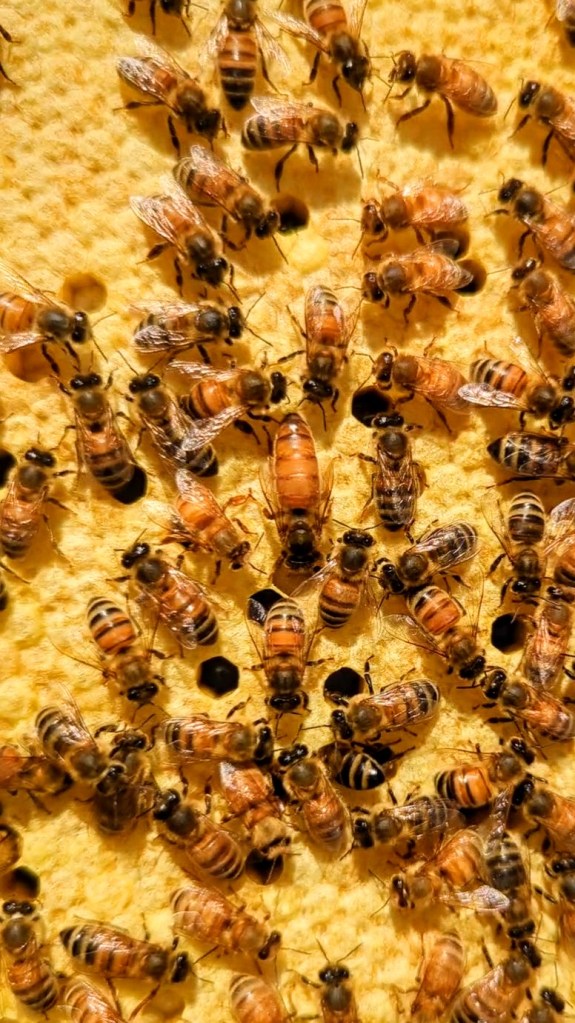
I had to try something new because my hand was forced: split the hive. I had to walk away because I wasn’t getting any new information. Nature sorted itself out, and now I have a small but going-strong colony to see if I can’t build up for the next two months going into winter.
The obstacle is the way.
Learn by doing.
Stay curious.
Graham
thanks for reading complimentary blueberry juice -
Compost Squash Insights into Soil Function
The reason I love watching things grow in compost piles is that it’s a very visual and clear example of how plants respond to high microbial activity and organic matter.
There’s an overflow compost here, a sort of secondary pile where anything extra I can’t process through a worm bin first ends up. It’s a two-year old pile by now and starting to look really nice. I only turn it a couple times a year to incorporate the new material into it.
After the last flip which was probably in early July, we got a few volunteer seeds germinate. One of which was a squash, and out of interest I declined to turn the pile and instead be more amused by the pace at which the squash was growing. I don’t know what kind of squash it is as it is likely from last year’s discard pile, but a winter squash of some sort.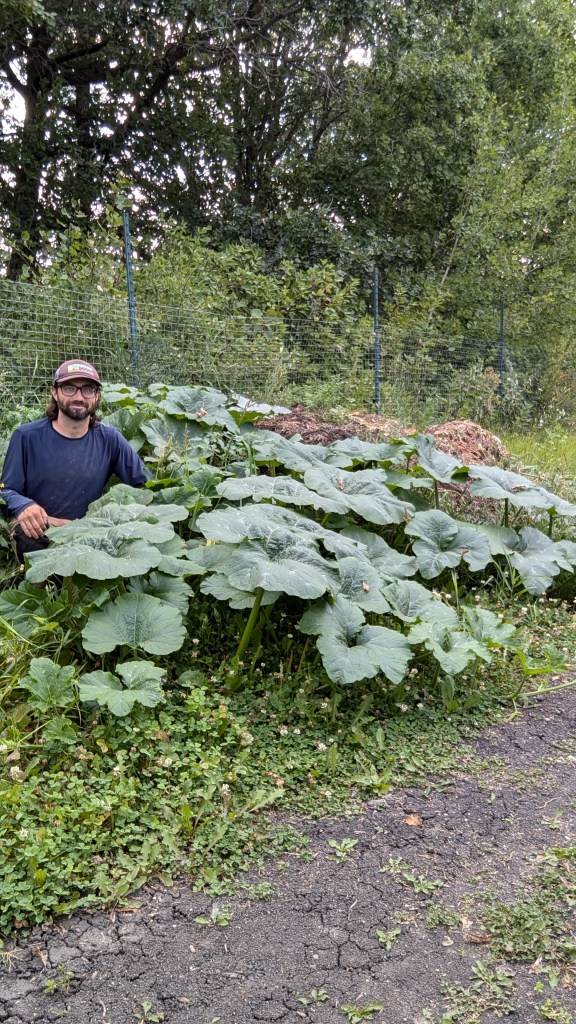
There is no fertilizer applied, and this squash germinated at least a month after the rest of our squash was planted….nor was it ever watered. This is 100% biologically-fueled growth.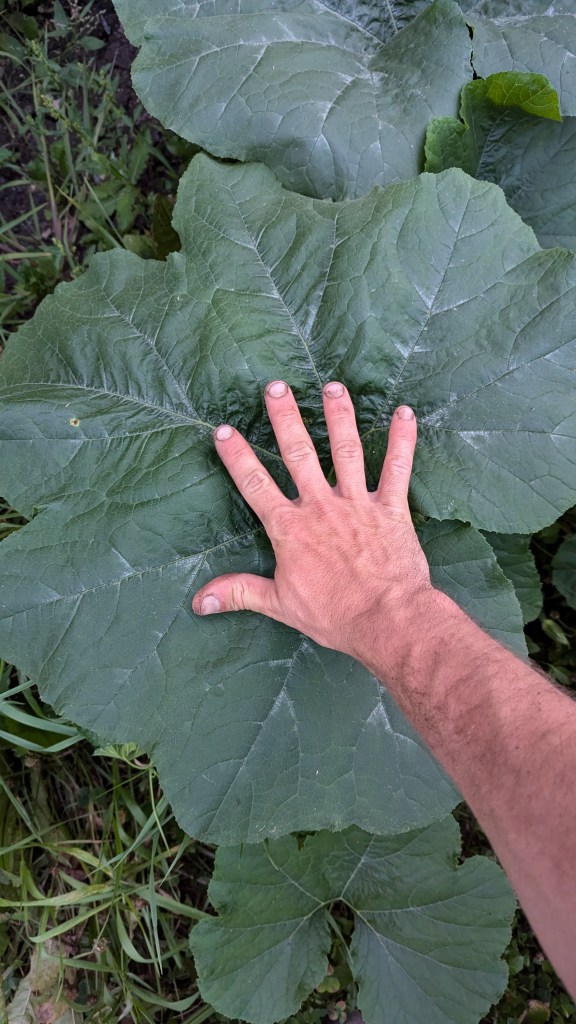
Plants function by feeding the microbial communities underground sugars from photosynthesis, and developing symbiotic relationships with many tiny organisms. Others, they consume via the roots. There is a great deal of communication going on between the plant and these organisms, and in a compost pile, they have many to work with.
What if we strive to make our agricultural systems as microbially rich and diverse as a compost pile?
What incredible things we would see.
What incredible things we could grow.
Graham
thanks for reading complimentary blueberry juice -
A Sweet August: Extracting Our First Honey
Just three months ago we had yet to get our first beehive. Now, we’ve got a massive colony, a bunch of very heavy honey boxes and it’s time to extract.
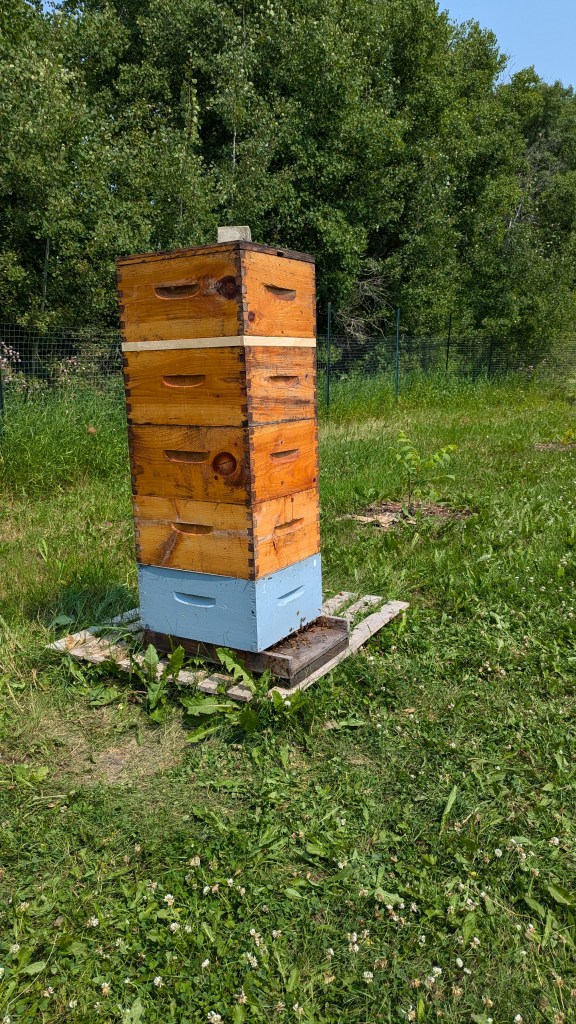
It’s been a bit overwhelming to have just the one hive and see how all the changes occur. A few weeks ago we nearly lost it…I missed a check and that’s all it took for the hive to explode in population, be crowded with resources and nearly swarmed. After a split and giving them some more boxes and regular weekly checks we got them back on track. I was even lucky enough to watch our queen lay some eggs!
Already I’ve learned another lesson, to not have it stacked 5 boxes high. I’m not that tall, and that top box ended up weighing nearly 36 kilos, or 79 pounds. I might be a farmer and used to physical things and lifting heavy boxes of potatoes, but even that was a bit much for me. In the future we can extract more regularly and not have the boxes get so filled and difficult to move.
Turns out all those frames are heavy when they’re drawn out and filled with thick honey.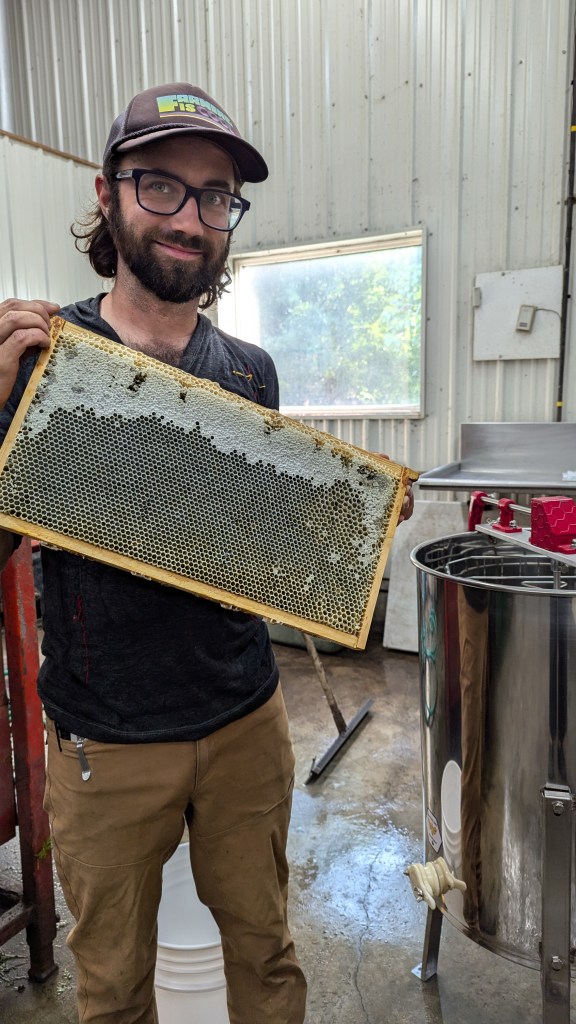
We ended up getting a simple manual 4-frame extractor from Dancing Bee, which seemed like the perfect unit for us and it was. I was actually most amazed at how little effort was required to get the honey out of the frames. With a small extractor, in the future we can extract specific boxes at specific times for something like spring honey or sunflower honey. It also helps with box management, as we can put the empty comb right back on the hive the next day.

There’s at least 2 more boxes, if not more, depending on how long the late season flowers last.
Wow!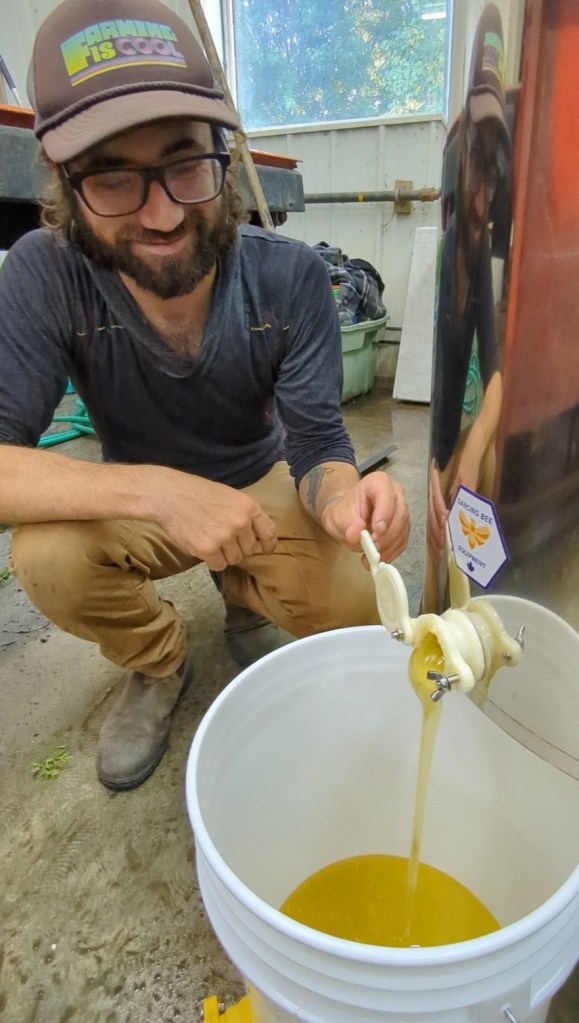
This has really been an amazing and eye-opening experience to see up close. All the bees, all the things they do, and seeing it all for the first time. It’s even more amazing to taste it and wonder how all those tiny insects could collect so much nectar, and work their magic to preserve it.
The next step is to jar it all, and then back for more!
Graham
thanks for reading Complimentary Blueberry Juice -
Our First Cover Crop: Update
It’s been about 5 weeks since we seeded our first cover crop. The initial post is here, if you want to review our installation. We got the rain overnight following the seeding, and the cover crop germinated.
Here’s a before/after: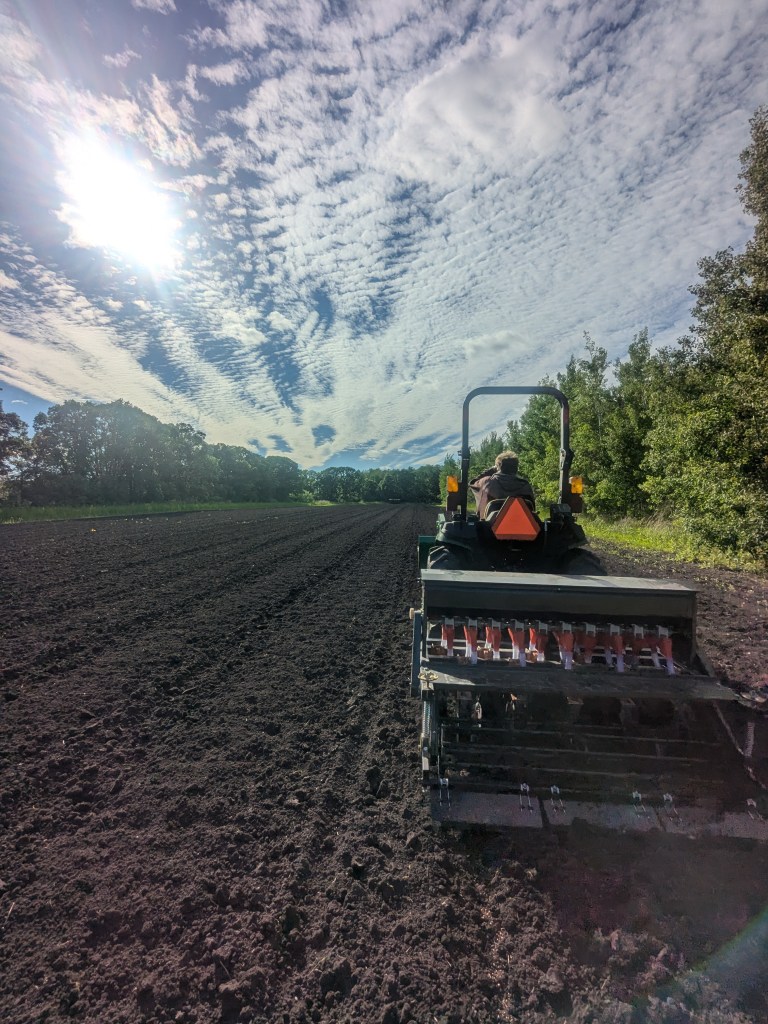
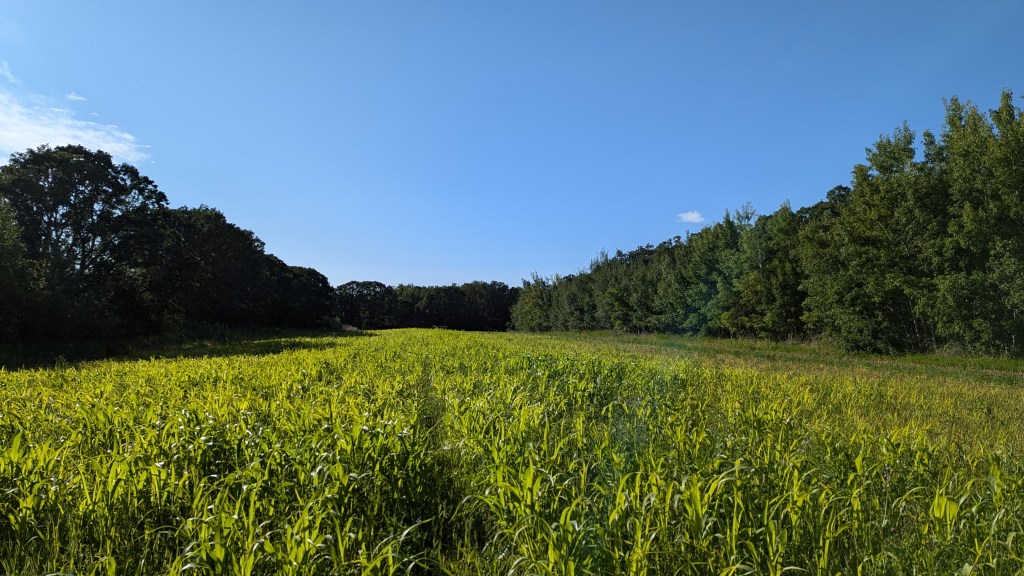
It’s pretty exciting to go through this process for the first time and have such a good result. On the next update I’ll stand in the field for scale, but the Sorghum is about 3 feet tall at this point. The rain allowed quite a lot of our cover crop seeds to get going quickly. While there are some weeds present, for the most part, they are now firmly in the understory of the cover. Further rains in July helped keep this crop going.
So far it is working as intended: the ten-way seed mix is absorbing solar energy, converting it via photosynthesis to sugars, and the soil is 100% covered. Even after weeks of no rain and high temps, the clay soil is not baked hard and cracked underneath.
The cover crop has also illuminated a major issue we have had with this field for quite awhile, and that is the aspen on the north side of the field are sending runners out. This greatly affects what we can grow and how close to the treeline we can get. Here is a photo from the north side: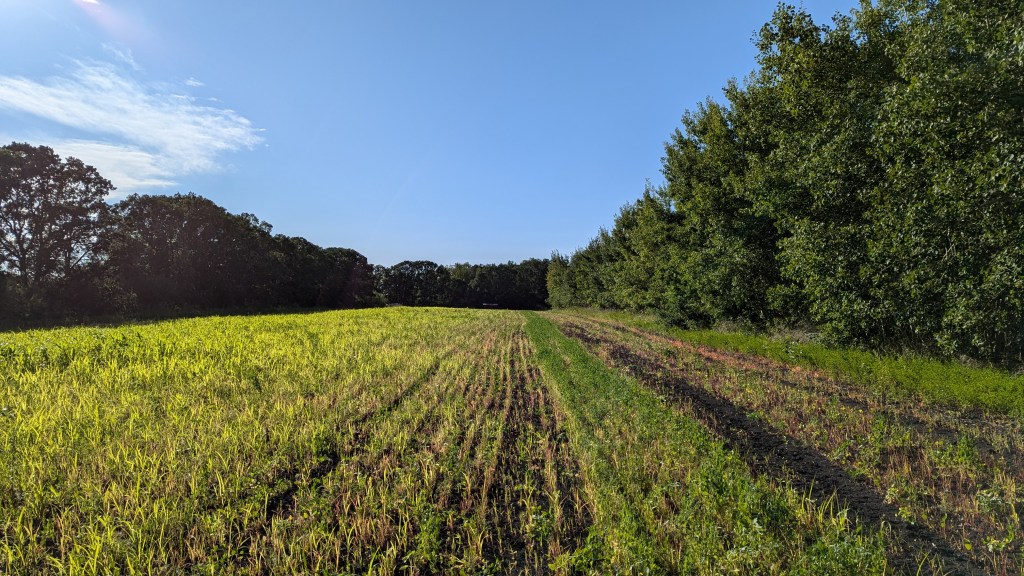
Quite the difference!
Up to 30% of the field is affected by the aspen runners. It is not possible to grow vibrant, beautiful vegetable crops in this current condition. About 4 or 5 years ago we learned this the hard way with Garlic.
I’m not sure what the next step with this field will be. We will of course allow the cover crop to continue growing until frost. At that time we will have to decide what our actions will be. For now, I’m considering using the half of the field that is in very good condition, as the south field side is mainly Oak trees which are not pioneering tree species and do not send runners. We can consider more drastic actions for the other part of the field, or else we risk losing this field for vegetable production indefinitely.
This field is super important to the near-term infrastructure developments at the farm. It is close by, it is able to be irrigated, and we can potentially move many many crops to this sheltered location.
We will keep the updates coming!
Graham
thanks for reading complimentary blueberry juice -
Lettuce Protector
One of the things I love most about our no-till permanent beds is the abundance of life that is embedded in the field. While harvesting lettuce this week, baby Gray Treefrogs were jumping from Romaine to Romaine. I was lucky enough to get a really amazing photo at about 7:30AM.
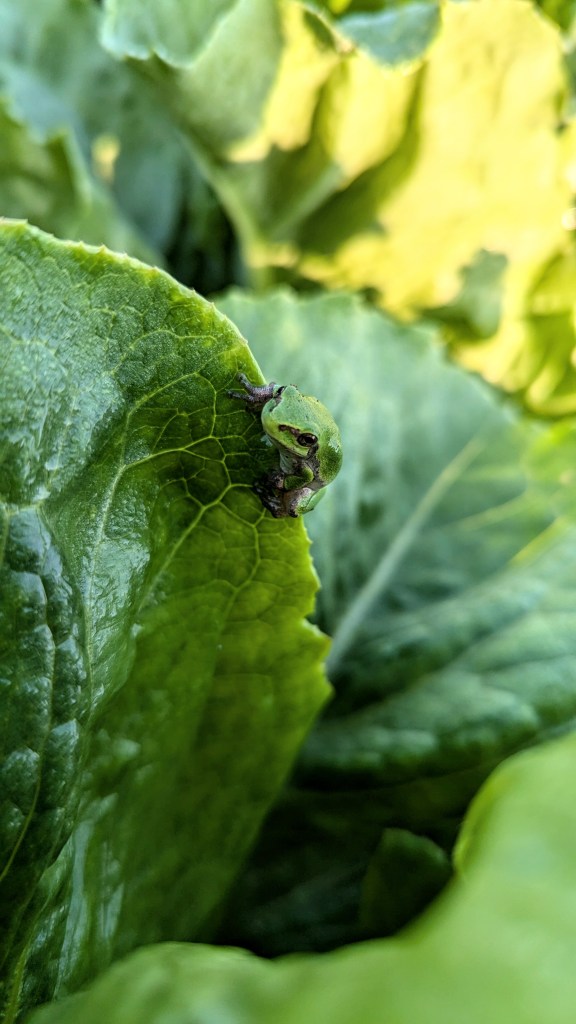
These little Lettuce Protectors and many other frogs are all over the place now, having emerged as tadpoles. I have no idea what these frogs are eating, but they have a lot of choices (if they are choosy).
There are so many things living in this field and a wide majority of these things are not harmful. The encouragement of more life should be the goal of all agricultural systems.
And we can get some great photos while we’re at it!
Graham
thanks for reading complimentary blueberry juice
-
Everything Covered
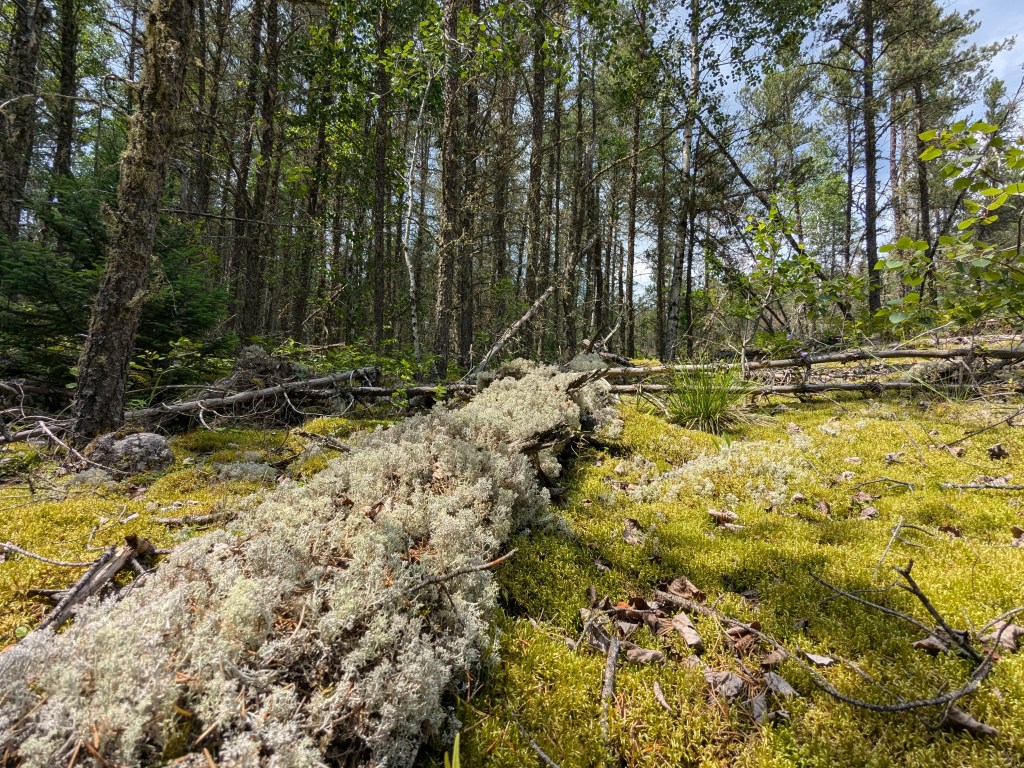
On a hike in Nopiming Provincial Park, the forest floor was covered in mosses and lichens. Likely because of this wet season we have been having, the forest floor ecosystem was lush and vibrant.
Something that is really noticeable in a forest like this is how many layers there are and how nearly total the sunlight capture is: the forest canopy, the understory, and moss-covered everything on the forest floor. The only places where light does not hit something photosynthesizing are the exposed ancient shield rocks…and even those are covered in lichens.
I love places like this because it really drives home that our soil comes from what came before it.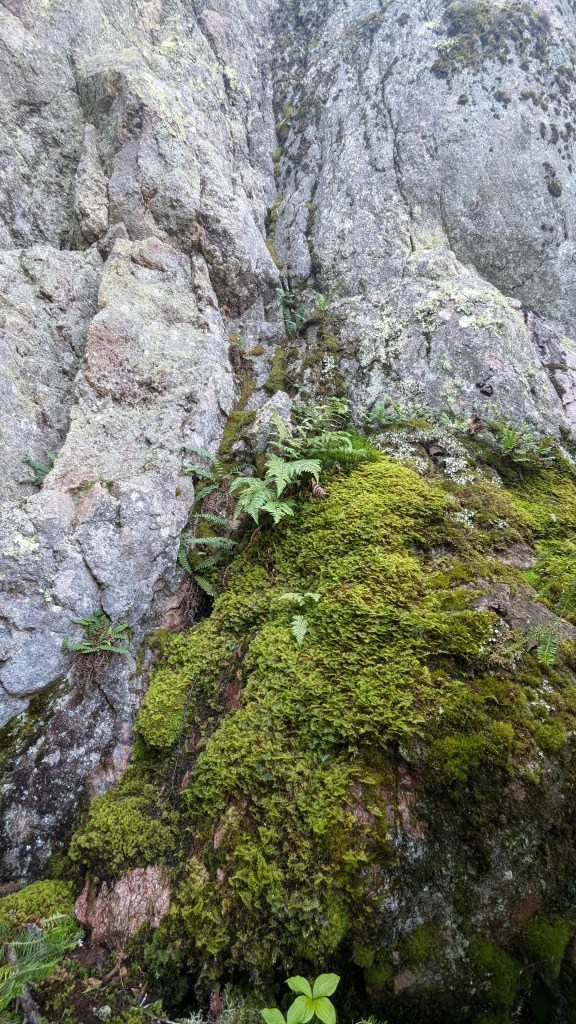
Soils are created by photosynthesizing life, and the symbiotic nature of what processes they enable.
Graham
thanks for reading complimentary blueberry juice
Home
About Graham
Graham is an ecologist-farmer from Canada working on educating about the wonders and beauty of the natural world, and how we can design biodiverse food production systems.

 Complimentary Blueberry Juice