-
Swallows & Honey
For the past few weeks, we’ve been treated to quite the display as we are working in the field. The sight of two Tree Swallow parents flying about all day and the sounds of hungry hungry Tree Swallow babies was really captivating and a joy to see.
When I left for a couple days for some camping, I thought I could return and get some nice footage of the baby Tree Swallows feeding at the nest box entrance or even trying to fly. But…I was too late. All it took was two days, and everyone was gone from the nest. I guess if you’re a baby Tree Swallow, once you leave that nest hole there is no going back!
It was a bit of a shame as I’d hoped to get some final footage before they were gone, but Nature goes by her own timeline. We as humans cannot be present for all the moments in other creature’s agendas. Camping for all of two nights was all it took for some baby birds to get big enough to learn to fly, catch their own food and be wholly independent. Even though I missed the big moment, I still feel lucky I got to see them daily for about two months. Now it feels a bit empty and weird that my resident Tree Swallows have gone away.
As a good Canadian, first I knocked to be polite, and once I was sure nobody was home I checked the side door.
It’s amazing that so much went on inside these several square inches of floor space, for months. Even to think that an unknown number of baby Tree Swallows thought that this tiny box was the entire world for the first weeks of their lives.
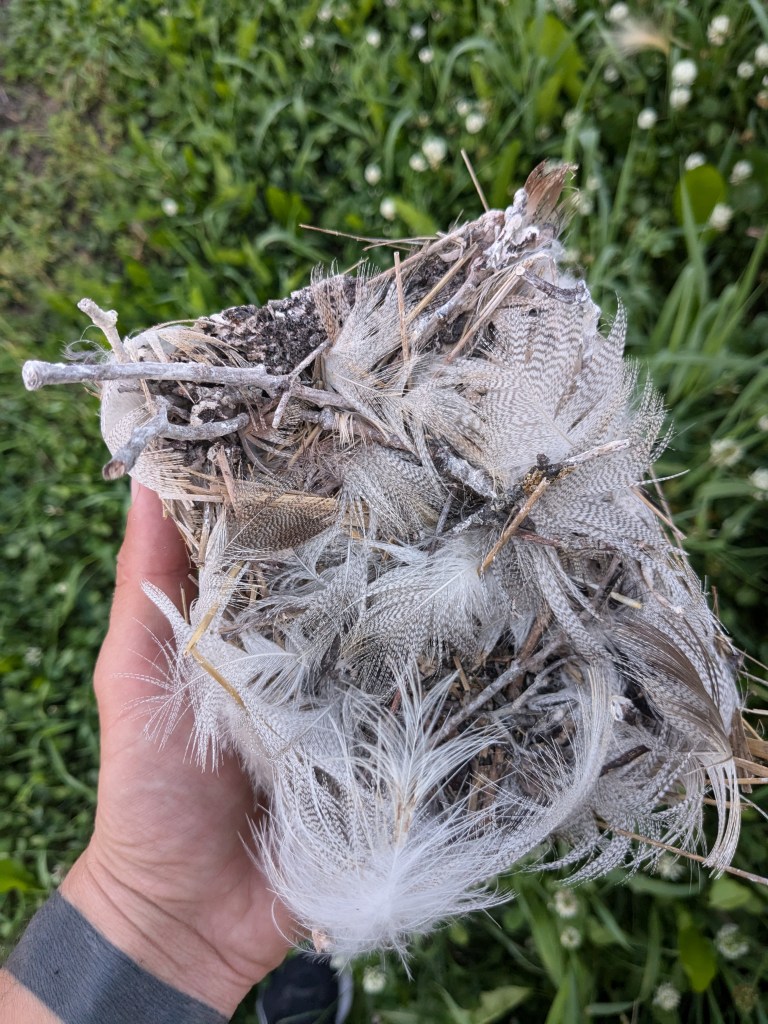
A square-shaped bird nest is not what most of us have in mind! But this is what it looks like when I pulled it out to leave it empty for a future resident.
As a side note, I checked the other two boxes I had put up and both also had constructed bird nests in them, but no residents. Interesting! I had noticed some sparrows checking one of them, and a pair of Eastern Bluebirds checking in on the other, but neither seemed to pay more than the occasional visit. The entrance hole size for the Eastern Bluebird was too small, so I had ruled them out as a possibility (but also may make the hole bigger for them for next year). It was surprising to find that someone had been busy making nests! I did not know that birds may sometime construct nests and then not use them. Perhaps they are backup nests? Perhaps birds make multiple nests? If anyone knows, let me know in the comments.
And so I know a lot of you are interested in hearing about the bees…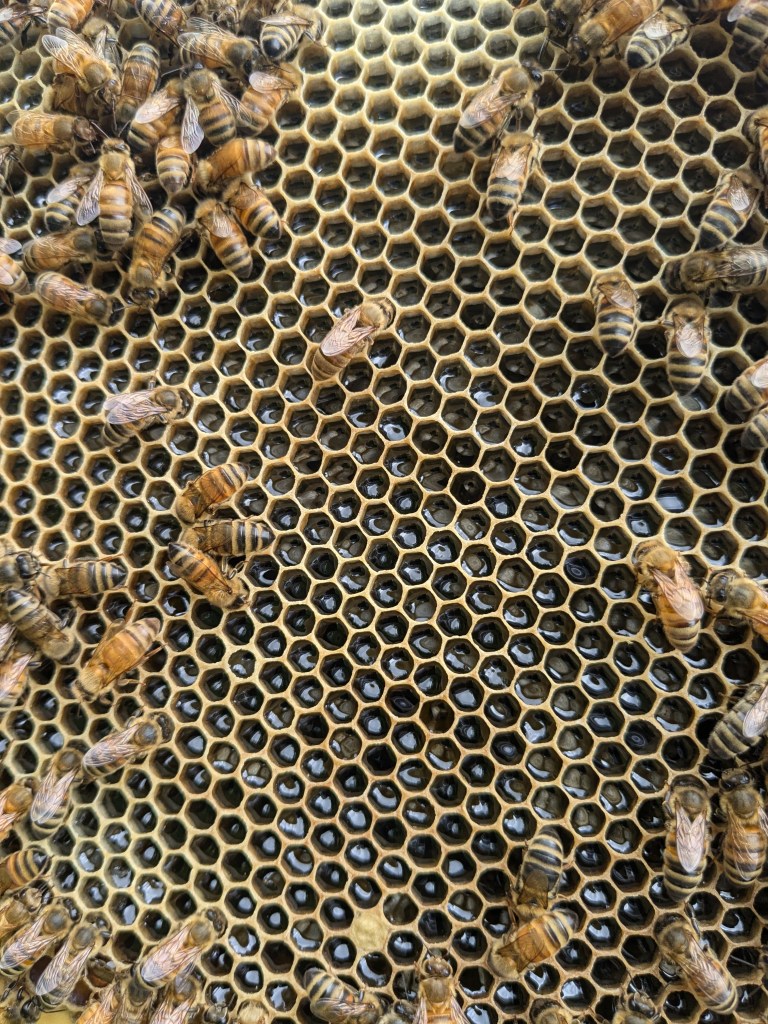
Yes the bees have been extremely busy and I have been extremely lucky as a first time beekeeper, with a strong nucleus colony and a fantastic queen. A few weeks ago, I checked the honey supers, and there was very little in the way of honey. They had started building and repairing combs, and a little honey was visible. A week later, the honey super was heavy and the bees had packed at least 30 pounds of nectar into the combs in just one week. A week after that, the box weighed somewhere close to 60 pounds and it was getting hard to lift.
I could go on and on about all the things I find amazing about this process (such as the speed at which the bees can fill a box), but for this season and this post, I’ll just focus on one aspect of it: where is the nectar is coming from?
There are no large-scale agricultural crops in the area. This means only one thing: the bees are sourcing all the nectar and honey 100% from wildflower sources.
This was really surprising to me, as I’ve always wondered why some beekeepers were able to separate their honey. I always wondered “how do they know it’s wildflower or X or Y or Z?” And I now understand: This is the only source available right now. There is no canola, no flax, no sunflower.
But what has been having a fantastic year? Conventional grain farmers might be having a hard time, but the wildflowers have been booming! The amount of vetch, daisy, wild rose, and others I have yet to identify, all came into focus. All of a sudden I started paying attention to what was in the tree lines, the forests, and the meadows. There are flowers everywhere!
This is reflected in the darker, amber-coloured appearance of the honey in the above photo. That is not an optical illusion or reflection from a camera. That dark brown is what the honey actually looks like.
Well of course I had to take a sample. What I experienced was one of the most wonderful things, a full-bodied, complex, layered, and floral taste. Wow! This is really the premium! I tasted it against some general honey I had in my cupboard, and there was no comparison. The raw honey I had in the cupboard was of course excellent, but it became evident that the additional subtle flavours of the wildflowers my bees have been bringing in is something really special.
We’ll have to see how the rest of our honey flow comes in over the next 2-3 weeks and if the consistency matches.
It’s been an exciting summer for a first time beekeeper and a first time bird box builder. Lots to learn, and lots to consider that is outside the bubble of the daily focus of the workday.
Nature always provides so much more to see, hear, touch and taste, and always just barely beyond the scope of our comprehension and understanding .
Stay curious.
Graham
thanks for reading complimentary blueberry juice -
Under The Canopy
This week I was able to get away from farming for two days and went camping in Nopiming Provincial Park. The heat had finally arrived and after going non-stop since the end of April, with the cool season we’ve had the heat hit hard and fast. There’s no point to getting heat exhaustion this early in the season before slowly getting used to working in it.
Nopiming was beautiful as always, and the sun was there with it’s high UV. But in the cool shade of the trees, the campground was relatively cool and relaxing. Some light hiking and forest bathing was really nice. There’s nothing like an undisturbed forest, the pinnacle of ecosystems.
Tulabi Falls, Nopiming Park.
I returned to the farm to a heat warning. So of course I went outside and took some soil temperatures. I had spent two days marvelling at the lush understory life of the forests in the coolness, protected from the sun. I thought there was no better way to show a proof of concept than to go and take some readings.
Excessive heat is deadly. Not just to us, but to other life as well. Nature has mechanisms to lower the temperature. One of the best ways is to simply cover the soil. If sunlight can’t reach it, it doesn’t absorb UV energy, doesn’t heat up as much and retains moisture.
The surface soil temperature that I recorded today, in uncovered, barren, tilled soil, approaches 37C.
This soil is highly vulnerable. Despite getting some 120mm of rain in the last month, it will not take very long under these conditions to dry up, parch, crack, turn to concrete, and radiate heat. This would be bad for agricultural purposes, wouldn’t it?
The topsoil temperature at a depth of 3cm in this uncovered soil is 32C. The entire top layer will dry up and parch in a matter of days. Little life will survive here under these conditions. Soil life is sub-aquatic and requires moisture and living plants to thrive.
Under the carrot canopy….
The topsoil temperature at a depth of 3cm here is a mild 26C.
Despite the heat warning, little light gets here – just like the forest in Nopiming – and the surface soil still has moisture. It is cool to the touch. It will retain it’s coolness and moisture for many many more days (and even weeks) than exposed soil.We need to keep our soil covered and protected in agriculture. There is no benefit to exposing it like this to the elements. Our biggest resources dry up and are gone before we know it, creating more difficult if not impossible management conditions where there are no good options. It creates knock-on effects that we will see in the coming days and weeks.
Nature has provided and shows us what the solutions are all the time.
All we have to do is listen.
Graham
thanks for reading complimentary blueberry juice -
Why Are New Generations Leaving Farming?
This morning I was asked to be on local CBC Radio One to speak about the higher than average rainfall and how it affects vegetable growers. At the end of the brief interview, I was asked by the broadcaster why I wanted to farm, despite the broad trend of young people leaving the farm behind. I wasn’t satisfied with my answer, and realized I could have said some far more important things than just “life brought me back here and I’m good at it.” Since I’ve had all day harvesting to think about it, I will answer the question further here.
The question of “why are younger generations leaving the farm behind” is something that is happening across the country and, as far as I know, broadly in the west. Many do not see a future for themselves in agriculture. After all, if they did, they would stay and continue. Long hours, hard work, expensive equipment and chemicals, and as I was brought on this morning to talk about, inclement weather can change your outcome (if you haven’t designed your farm to be prepared for it).
Why would a young person take all that risk, when the property, because of the commodification of land and housing, is worth far more than they would ever make farming?
Take the easy way out.
Most do.
But the views on agriculture that lead to feeling like there is no future in the industry are broken and false. There is so, so much to be excited about in the agricultural space. One does not have to do things as it was done before. The leaps and bounds of science – particularly in the biology, soil biology and plant physiology spaces – in the last ten years alone are immense. They have profound implications for agriculture, and it means there’s a new game out there.
The frontiers of agriculture are always changing. This is a historical fact, agricultural innovation has been ongoing for millennia. I feel like the general contemporary view of agriculture is stagnant, like it hasn’t changed, like few alive today can remember a time when it wasn’t tractors and giant monocultures sprayed with chemicals and using fertilizers. The changes that are happening and about to happen have not penetrated the public writ large, and, I suspect, many young folks who feel they have no future at the farm do as well.
So why did I choose to farm?
Life did bring me back here. But first I spent my child hood catching frogs, then I spent 6 years in university studying plants. I would drop out before getting a degree, feeling my efforts useless there, and I found myself with no future. All the things I loved and wanted to study and work with, the plants and animals, wetland systems and forests, only seemed to be government jobs or whatever “environmental consulting” means. It didn’t seem to be something society valued. There was no “job” waiting for me. In many career consultations in university, nobody suggested to me in university that farming might be an option. After all I was in biology school. Farming? That’s over there, in the agriculture school.
But farming is biology. And here, right in front of me, was a framework wherein I could apply not only the things I learned, but that was also vehicle to explore the natural world, to conduct my own trials and experiments, to observe nature and solve very interesting problems.
I wish I thought my future was here a long time ago (I’d be so much further ahead now!)I’m glad I’m here now doing this important work and expanding the realm of whats possible. The work is not weeding and harvesting. The work is the innovation, the trying new things, the imagination, the steady progression to better. It happens to involve pulling weeds and harvesting. That’s incredibly exciting work! I wish more understood that this is what it could be like.
This morning, I watched a pair of Tree Swallows feed their young hatchlings, I saw my cover crop begin to germinate, I took a walk and saw the wild flowers blooming in the lush forests and diverse vegetation, I watched my honeybees begin their foraging flights for the day, and I harvested veggies that I have spent years dialing the methodology to grow and I will spend years more doing it even better.
Why would you walk away from that?
Graham
thanks for reading complimentary blueberry juice -
Our First Cover Crop
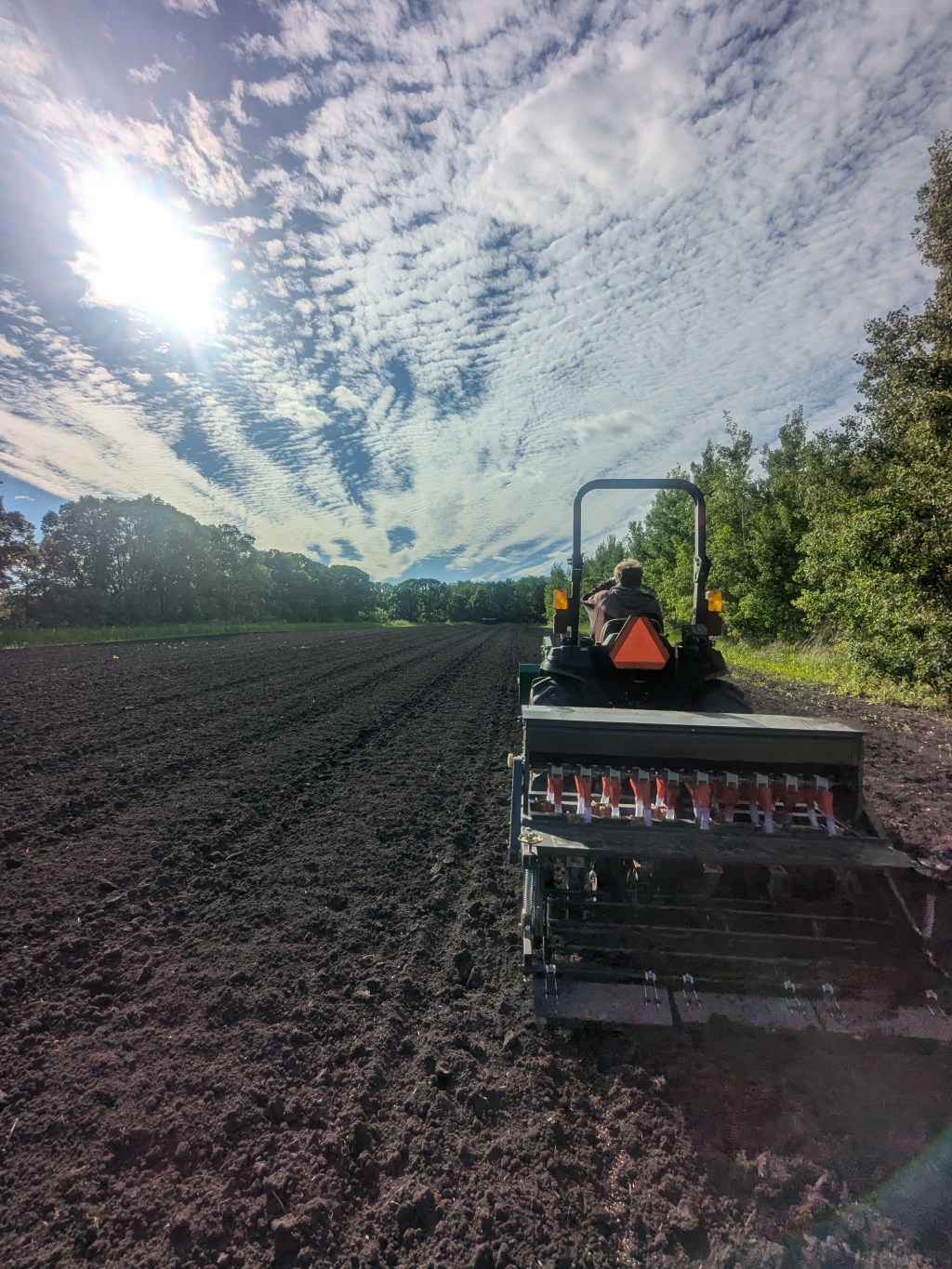
Today was the day we installed our first-ever cover crop.
We’ve been talking about it for years but today was the day. It is likely to rain soon, and as such we were able to prepare an unused field for seeding. After numerous seasons of drought (and as farmers who largely farm without irrigation ), we decided it was no longer plausible to hope for the best. Having things growing on unproductive land would, among other things, offer us a layer of resilience that we currently do not have. And so, last year we purchased a specialized 10-row seeder from Northern Tools that covers 5 feet to start us on a new journey.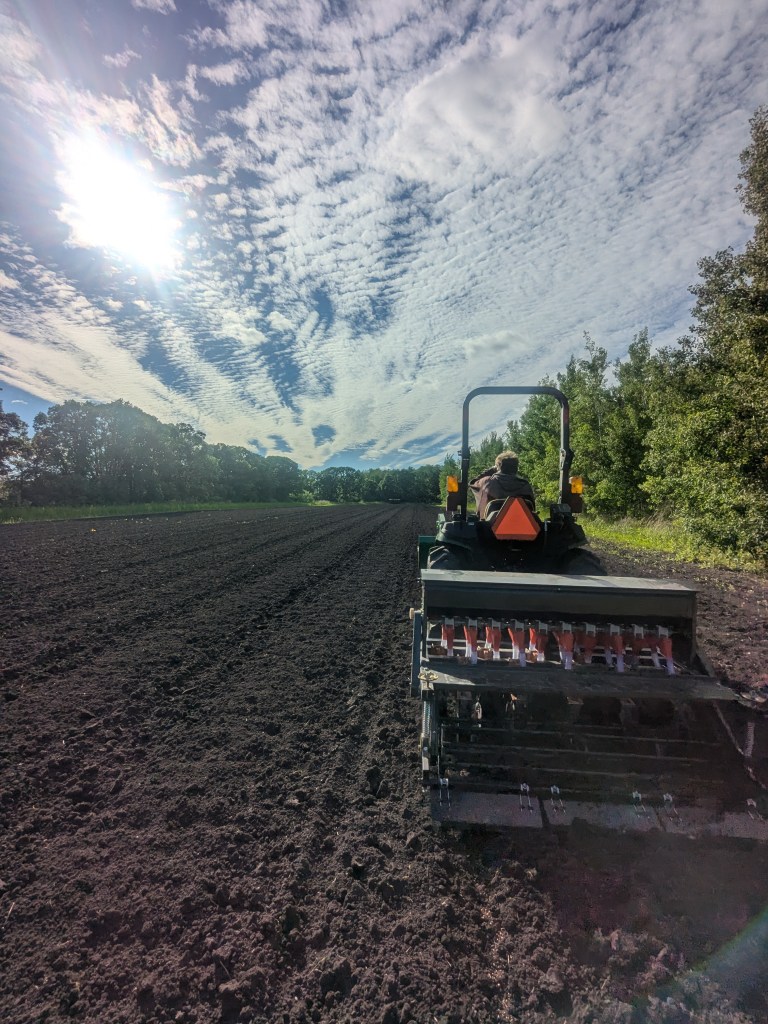
In one acre we hope to covert to a no-till as early as next season, we planted a 10-way cover crop mix:
Black Oil Sunflower
Sorghum Sudan
German Millet
Italian Rye Grass
Hairy Vetch
Forage Peas
Daikon Radish
Purple Top Turnip
Flax
Berseem Clover
Along with this seed mix, we had some leftover organic alfalfa fertilizer from a currently ongoing potato trial. We added it to our new hopper.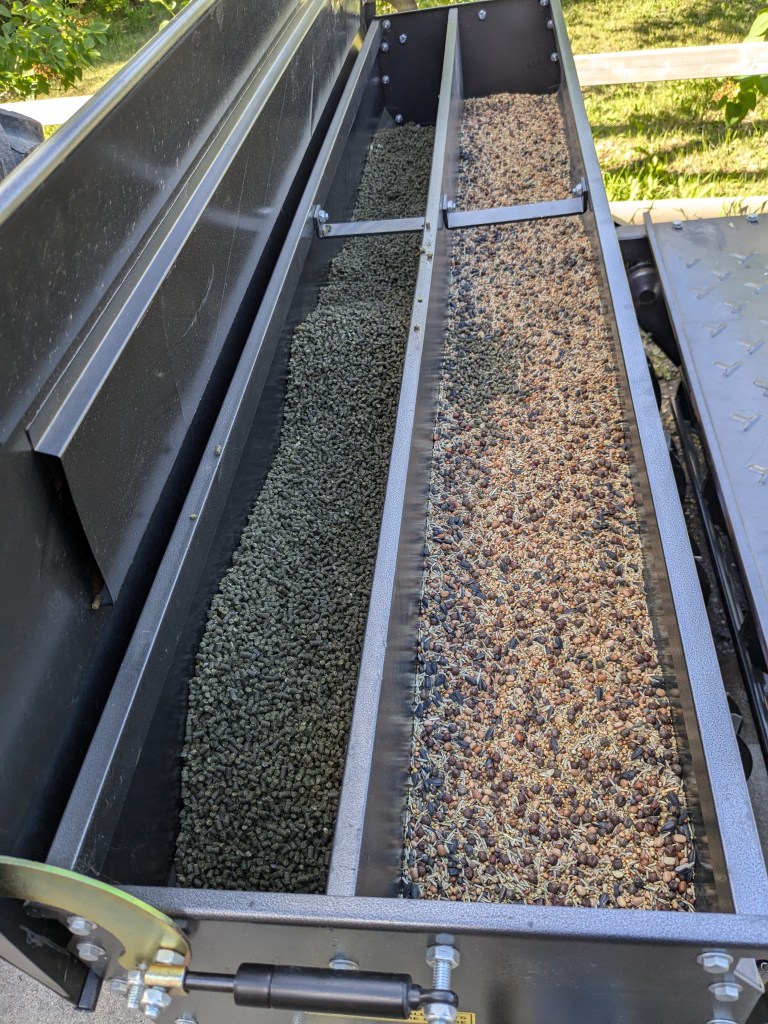
It’s really exciting to go through this process. Not only as farmers who have forever only planted one crop at a time, with tools designed to plant one thing at a time, using an implement like this was quite thrilling! All those seeds going down at once! To convert empty and barren soil lying fallow into something photosynthetically productive with diversity built in, with no intention of harvesting any of it. All the theory of what core crops are supposed to provide and benefit aside, we have no idea what is going to happen, as we’ve never experienced this before, never planted these plants before, and never used a tool like this before. And all of those unknowns is the most exciting part.
All we can do now is wait, and watch this grow.
We will repeat this process in multiple places, on multiple properties and at varying times of the season.
I’ve been hoping it would stop raining all year, but right now, I really hope it rains on Friday night as forecast. I would love to see this crop grow, to gather as much data as I can, and learn as much as possible.
In the coming months this summer I hope to provide updates on this field and delineate further of the benefits of covering barren soil with a wide array of photosynthetic organisms.
Stay curious!
Graham
thanks for reading complimentary blueberry juice -
Re-Designing Our Zero Till Bed System
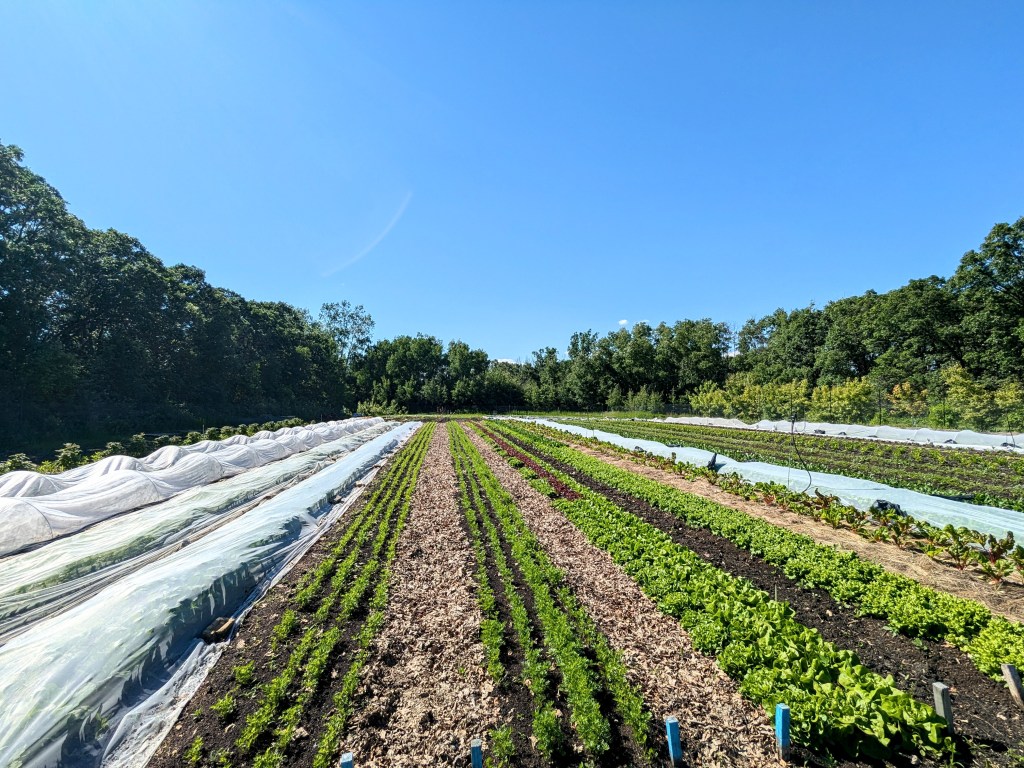
One of the infrastructure projects for this season is an on-the-fly re-design of our no-till experimental area. It’s a ton of work and it’s adding a lot of hours tot he weekly schedule, but on the whole so far it has been very rewarding and we’ve been able to keep up.
For several years we had configured everything to fit 30-inch-wide beds by 150 feet long. These worked great and we learned a lot from them. But it had many downsides: we were never able to keep up with the weeds it created, the 150 feet lengths meant 150-foot row covers which are difficult to manage, we’d be waiting to finish that last 20 or 30 or 50 feet before we could re-use the bed, which in a short season matters a lot. But mostly, we decided we just were not going to win the war on the weeds we had let out of our control over those years and all the various growing methods and mulches we had tried. I wrote about this last fall while collecting thoughts about where to go next.
This spring we realized a bunch of things things:
1) We could change the configuration to 100-foot bed lengths and eliminate many wide walking paths that were wasted spaces we used to separate our irrigation sections.
2) By doing so we could fit as many as twenty beds of 100′ length per section, with 3 full sections, giving us a total of 60 beds of 100′ length.
3) By using a combination of tillage and silage tarps, we could start the journey right now, and by the start of the 2025 season, have all 60 beds built, all problem areas eliminated/mitigated/dealt with.
4) There is additional spaces at the margins for all sorts of permaculture items, which not only act as space management tools, but double as productive crops.
5) This leaves a remaining ~5000 square foot section of empty space after this conversion, which we can install a variety orchard with clover cover crop for easy maintenance and a honeybee food source.
If it sounds exciting, it is!As of writing this post, we are at 26 beds, with 5 more to be built in the coming days. Half of the orchard has also been planted and we are now working on the clover cover crop area.
We are now using all the tools we have in the box to stay on top of the weeds as we construct our new zero-till system. This includes tilling areas out of use before building new beds, mowing, and constantly moving tarps to areas we won’t get to for some time.
So far, so good.
It was a challenge to ignore the sunk cost of several years of doggedly maintaining a no-till zone. But at the same time, it is natural to go through a disturbance period. One time in several years doesn’t seem bad, and we don’t seem to have lost much of what we have built before. It is picking up where we left off, and resulting in a far more organized and manageable system.
It is absolutely remarkable what you can fill in a 30-inch by 100-foot space. That’s 450 heads of lettuce. Also 450 leeks. It’s thousands of carrots. 133 kale plants. 200 swiss chard. 255 celery. 500 row-feet of radishes. Hundreds of bunches of Green Onions.
At this point, it is very exciting to look into the future of what this field can provide, and last year was a record season for us. Incorporating fruit crops into this mix is the biggest reward. Watching trees, bushes and rhizomes grow out and get closer each year to fruiting seems like a very big, very long-game win.
There’s also another entirely empty acre waiting to be designed that we haven’t even started on yet.
Lots to look forward to.
Lots of work to do.
Graham
thanks for reading complimentary blueberry juice -
Learn By Doing
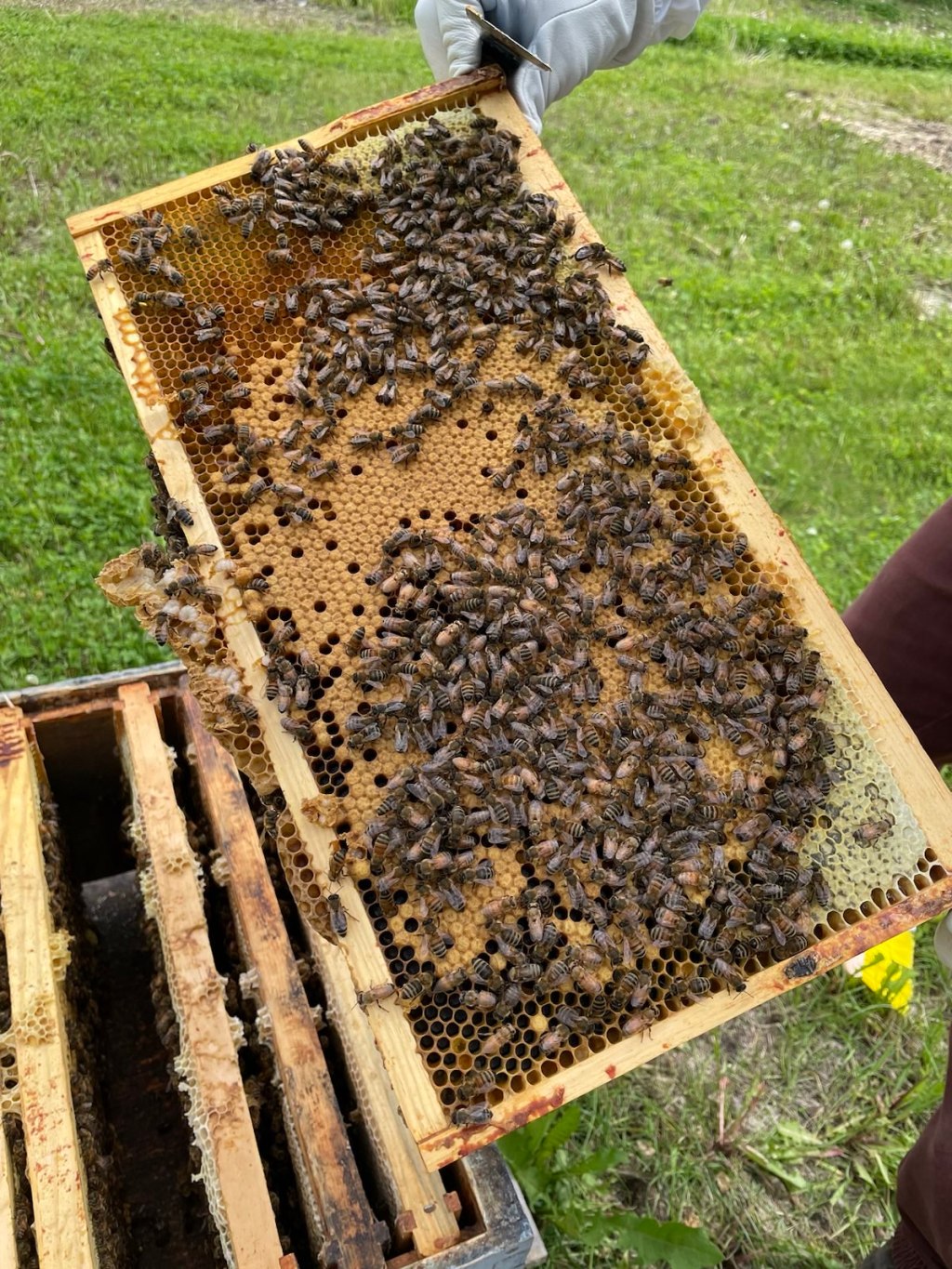
It’s been two weeks, and our beekeeping mentor couldn’t make it.
So, into the hive solo we go!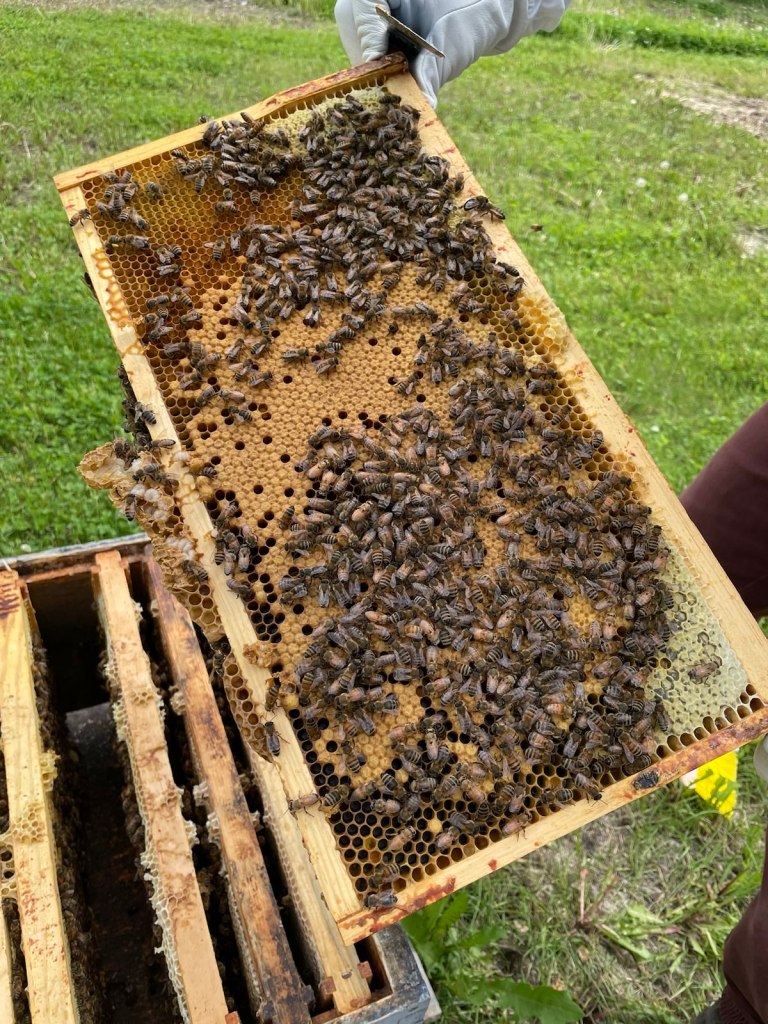
My favourite (and preferred) way of learning is to just do it yourself. Go for it. Get in there. How else are you going to know?
Books are great, YouTube is great. But there comes a point where there is no more training wheels. You can’t know all the in’s and out’s and all the variables until you face them, for real, in the real world, in real time.
This goes for beekeeping, for planting a garden, it goes for driving, for teaching, for wine tasting, for scuba diving, for public speaking, and for running a business. It doesn’t really matter what the application is, there is no substitute for real world experience.
And so today, at the two-week mark of our fledgling honeybee nuc, it was time for an inspection.
It was the first time I:
1) opened a hive by myself,
2) lit a bee smoker,
3) pried the bee-glued frames apart with a hive tool,
4) lifted each frame for inspection,
5) looked at honeycomb and differentiated what from what,
6) found my queen,
7) made my first real bee decision to add a honey super.
8) installed a queen excluder,
9) added a honey super
And it all felt really good!
I thought it a little crazy that in just two weeks, I had a 5-frame beehive, and now, it’s a 9-frame beehive and everything is full and there’s no room! The outside frames were completely empty two weeks ago. Now they’re full of stuff. There’s tons of bees, they’re bringing in food, nectar and pollen, the queen is laying eggs, larvae are hatching and it all seemed bursting. The only option that seemed relevant to me was to give the bees more space to grow, as they are clearly growing.
They’ve been busy and have been able to forage and find food. Which is great piece of ecological information: there’s a healthy queen, and there’s a healthy environment for honeybees at the moment.
Much of what we’ve done here at the farm over the past 10 years has been experimental. Almost all of it has been “idunno, maybe this would work.” And then doing it. And then re-assessing, and re-assessing again. Trial and refinement. Mulch, irrigation, tools, seeds, varieties, methodology, all of it. You name it, we’ve probably done it (and we keep trying new things for better or worse)
A lot of it is failure to be honest. A lot of it is problematic. A lot of it needed a hard rethink. But if we had waited until we knew what was perfect for us, we would have never gone down these bumpy roads, and we would have never have realized that what seems like the obvious path to go down were even possible.
There’s a lot of great things that can happen if you take a certain kind of leap and just decide to get on the slow-moving-boat that is enrolling on the journey.
There’s only one way to know.
Do the thing you’ve been wanting to do.
Stay curious.
(and take a lot of notes and photos)
Graham
thanks for reading Complimentary Blueberry Juice -
Rain, Heat, Choices, Repeat
We’ve spent many of the recent years in memory extremely stressed, – especially in springtime – with lack of moisture. Seeing nothing but suns and scorching heat in May and June coupled with wildfires and smoke from out-of-province gave a really grim feeling to most work days, running around trying to keep up with irrigating and stressed transplants or seedlings with no end to extreme heat or dryness in sight.
This year is the opposite. We count ourselves lucky, as many other people in our local boat have things much worse. Given our heat and drought streak in the past number of years, I’m not about to start crying about it being too wet! Our transplants are happy, and while some crops might be slow out of the gate, they are at least out of the gate.
It all goes to show that no two years are predictable. Success of a farm always comes down to a set of management choices.
One choice is to simply hope for good weather, and that there’s nothing you can do when it doesn’t go a certain way. The flip side to this choice is to roll with the punches, make the best decisions you can based on your knowledge and accrued experience.
The other choice is more invisible: the way one farms is a choice.
If you’re stuck waiting for the mud to dry before getting the big machines on the field…this is a consequence of choices. Just as it is a choice to cultivate and till, to spray chemicals, to grow wheat, or celery, or apples.
The management choices and decisions the farmer makes play a far greater role in how a farm responds to climatic shifts or unfortunately unlucky weather. As usual, even with all the rain, nature is booming. The frogs are calling, birds are singing, trees and shrubs are flowering, and mushrooms are fruiting.
We can choose to model our farms in such a way that offers resilience.
The options and paths towards resilience are as diverse as nature itself. The consequence of building resilience into the farm management model is generally the same: a buffer zone that greatly reduces any potential impacts. A much wider range of choices and options become available if you can only imagine the possibilities.
Some time ago we were stuck in the mud. One day, we decided we didn’t want to be stuck in the mud anymore. Getting stuck in mud sucks! That was really our first step onto dryer land.
Mindset is the most powerful tool in the tool box.
Graham
thanks for reading Complimentary Blueberry Juice -
My First Beehive
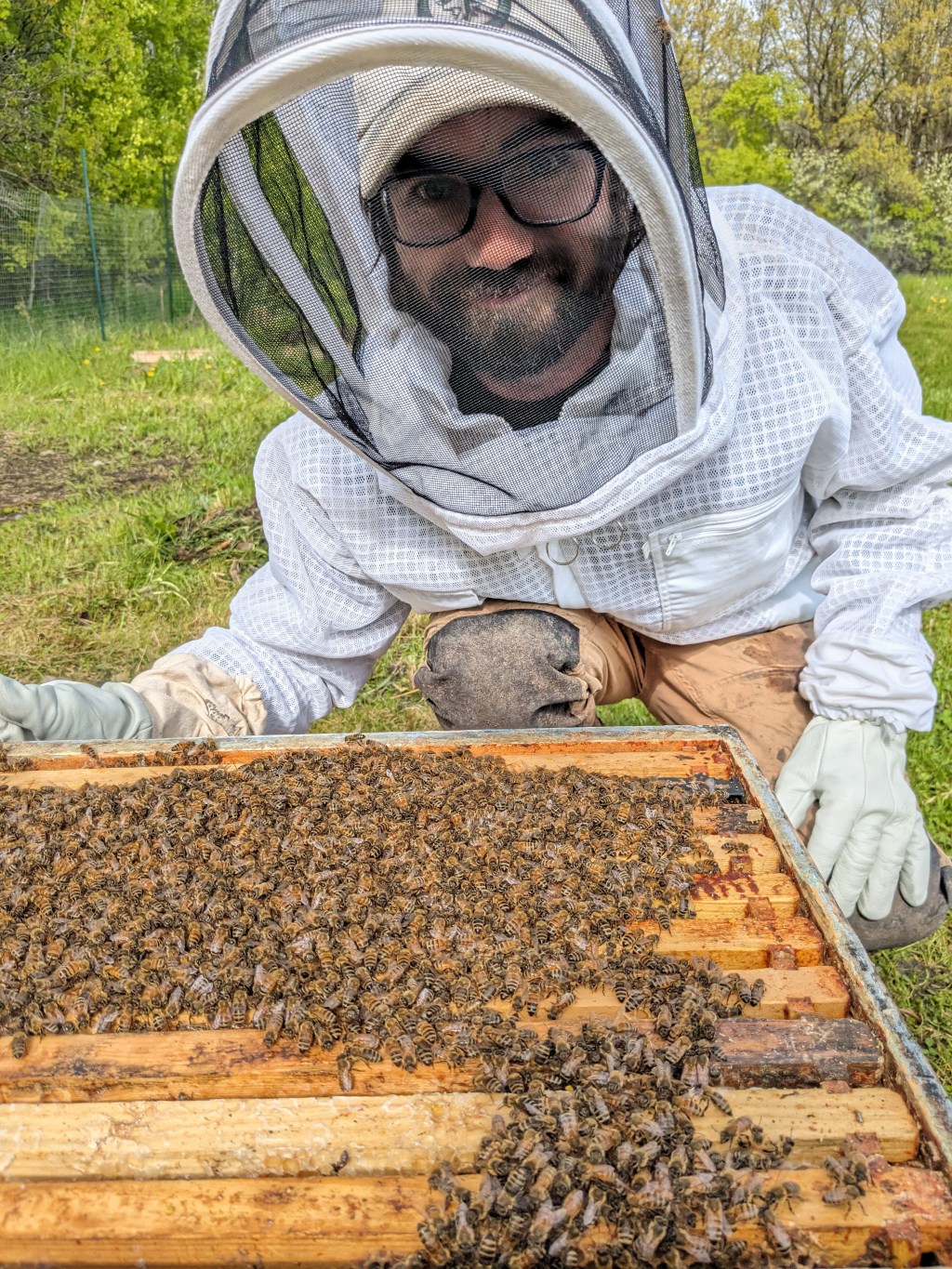
On Monday, something super exciting happened…I got my first honeybee hive! I’m super excited to go on a new journey with an entirely new learning curve.
The biggest reason I’ve wanted to keep bees is that I think it will connect me to nature and the surroundings in a much deeper way. Watching and listening to beekeepers in the area made me realize that they were always aware of many things I wasn’t paying attention to…all because the bees were a source of information. What things are flowering or sources of pollen, and how the weather affects these things, all become revealed in observing the behaviour of the bees.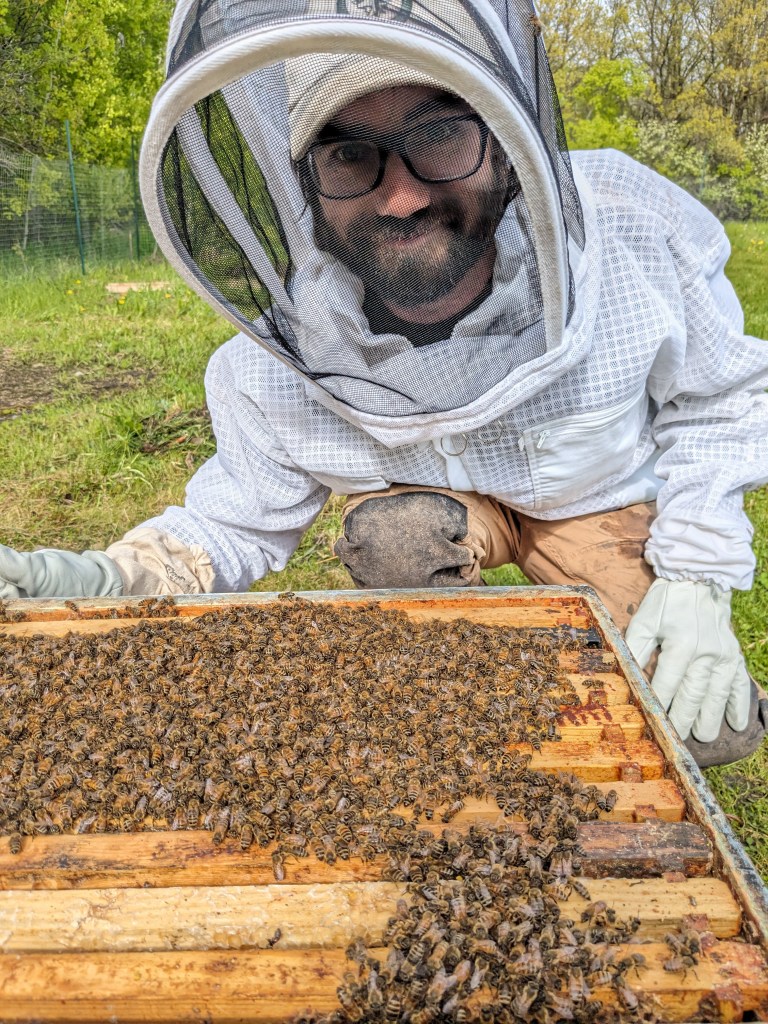
But to start, let’s rewind a bit. I’ve been thinking about getting a beehive for a few years, though at first it wasn’t entirely clear how this would all work out. What I didn’t want was to get a bunch of livestock and then be unprepared to properly care for them.
That’s when bees began to be included in the plans for our one-acre zero till plot. Last season, we planted a row of widely spaced Black Walnuts and Korean Pine (two species that are very uncommon in this area of central Canada) with the idea that as they grow, we can have an apiary nestled in the gaps. The area is close to a tree line and by a vernal wetland, so this was an area unsuitable for growing vegetables.
The last couple years we have tried to get bees, but things just didn’t align. Either we were unprepared, our our bee source wasn’t ready. Finally, this May, the bees were healthy and the beekeeper was making splits. And on Monday, we installed our first 5-frame nuc (honey bee nucleus colony).
Knowing bees were on the way this year, I was able to pay attention a lot more to my immediate surroundings and took note of all the things my bees will be able to take advantage of at our farm: the wild plums and Saskatoons that set pollen and bloom early, no-mow zones featuring dandelion, clovers and milkweed, and our burgeoning apple orchard, all just a short fly from the front door of the hive.
Getting into beekeeping is a bit overwhelming, there’s a ton of information and lingo to get used to. But overall, I’m really excited to nature and care for this hive for the first couple seasons of the learning curve.
Somehow I’m always looking for more ways to connect with and understand the landscape that surrounds us, and we’re going to have quite the ride with bees added to the mix. I just love that this social collective of insects can gather, carry and transmit so much information, not only to their sisters, but to us.
Stay curious!
Graham
thanks for reading complimentary blueberry juice -
The Beauty of Flight
Something that consistently blows my mind about the natural world is flight.
There are no pilots,
no training programs,
no fossil fuels,
yet capable of feats and actions that no amount of engineering can solve.One of the things I love most about nature is that the human equivalent for what nature already designed always proves to be deeply flawed and limited.
There is no drone or robot that could possibly replicate what variables a Tree Swallow processes along a 100-metre landing approach to a vertical landing spot less than 4cm wide for $0. Here’s a second video at 1/18th speed of just that.
These Tree Swallows are a real treat to watch every day!
Humans perceive the world in a really limited way. We think we’re good at things, but there’s a big part of nature that is often completely invisible to us. It may be incredibly small or so fast we barely register it.
All these beautiful things around us, everywhere, all the time.
What can we learn from all of it?
Graham
thanks for reading complimentary blueberry juice -
Build It And They Will Come
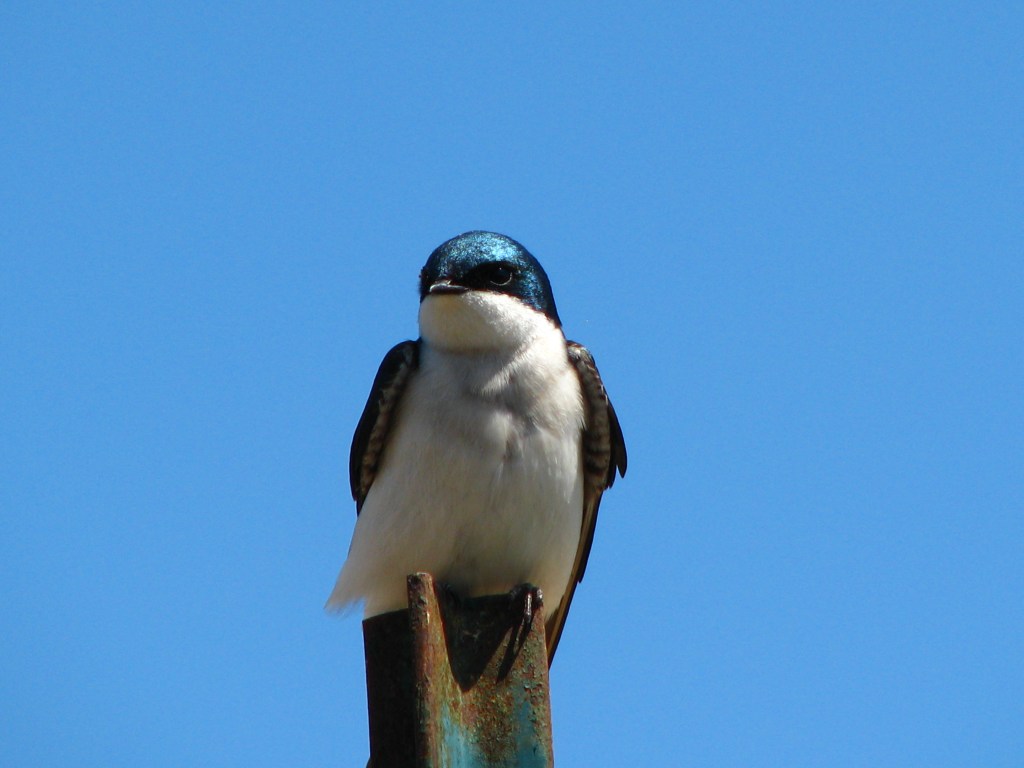
I’m so excited! It took less than 24 hours since the Tree Swallows first returned and I put up the nest boxes. There have been several pairs flying around the field and checking out each box.
It’s really a very satisfying feeling to plan to provide a home for a specific thing, build what will attract it, and watch it all play out.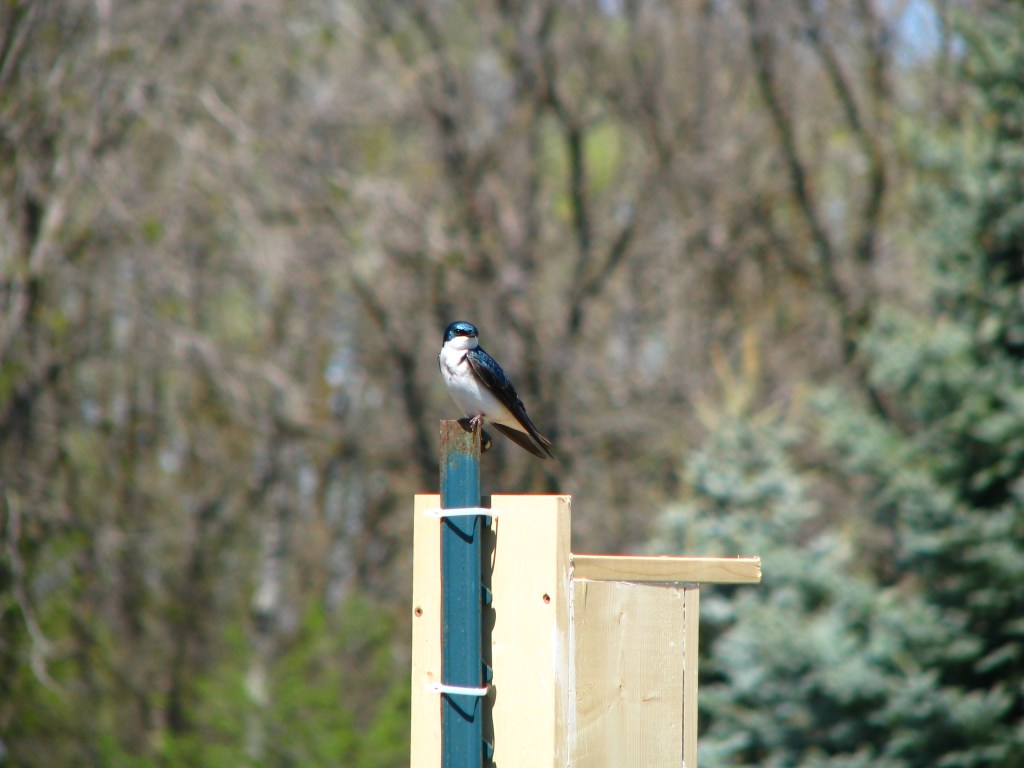
What has been most surprising is how close they let me get, and perching on a fencepost was good for my amateur bird photography skills. They don’t seem too afraid of us (perhaps they are used to seeing us all the time from the treeline anyhow and are used to our farmer behaviour).
They already feel almost like pets. You can feel a closer bond to nature when you engage with the outdoor world in such a way that you are collaborating with and supporting what goes on around you. Humans have the ability to choose to act in this capacity on a global scale and across all of our food production systems.Just look at this shiny guy! I’m still excited I was able to get these photos. The web of nature and how all the intricate pieces fit together is not only fascinating, but it never gets old because you can never possibly know it all. There is always another bird and ecological behaviour to observe, another insect life cycle to learn, or another mushroom to identify. The design of nature is as grand as it is beautiful. In the case of the Tree Swallow, it also happens to be iridescent.
Lots more biodiversity projects on the way at the farm based on expanding our permaculture design that I’ll be writing about in the months to come. Some of these 2024 projects include…
– More nest boxes targeting different species (Owls, Eastern Bluebird, Tree Swallows, Barn Swallows)
– Tree Planting (diversifying tree species and creating a sheltered space)
– Beekeeping
– Planting native wildflowers as a no-mow property maintenance strategy for marginal cropping areas while providing for pollinators
– Cover cropping mechanically fallowed fields
Thanks for reading,
Graham
if you like complimentary blueberry juice, consider sharing with a friend
Home
About Graham
Graham is an ecologist-farmer from Canada working on educating about the wonders and beauty of the natural world, and how we can design biodiverse food production systems.

 Complimentary Blueberry Juice